
Practical Sales Training™ > How To Lose The Sale > The High Demand Fallacy

The High Demand Fallacy
What Is It?
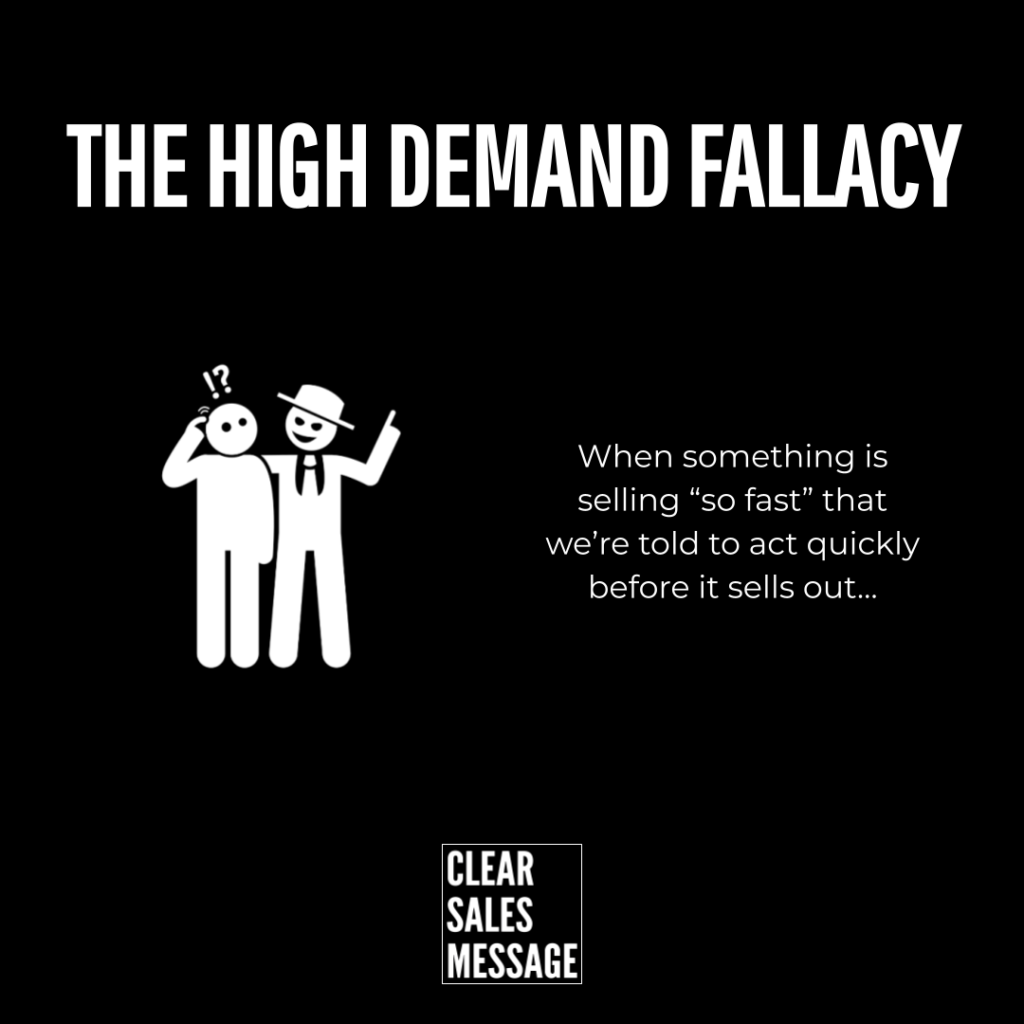
You’ve seen the post before: “Only 3 spots left, selling fast.” So stop and ask something first. If it’s selling that fast, why does it need promoting?
The High Demand Fallacy is using the illusion of popularity to create demand. But it’s just that, an illusion. Real demand doesn’t need a caption to prove itself.
Why Does It Work?
Here’s the problem. It doesn’t really work. It just annoys buyers, because it’s a lie, and most people can spot one.
The only person fooled is usually the seller. They think the trick is landing. Instead, buyers quietly scroll past, unconvinced.
An offer that isn’t performing well is hard to hide for long. Eventually the gap between claim and reality becomes obvious. So once buyers notice, they remember.
How Can You Use It?
Understand Why Buyers See Through It
Buyers have seen fake urgency before, so they already look for the signs. Even a countdown that resets is one giveaway. So is a “few spots left” that never runs out. These small cracks are what break trust fastest.
Check Your Own Messaging
Look at your own claims honestly. Are you saying something is selling fast because it actually is? Or because you hope saying it will make it true? That gap is where credibility quietly leaks away.
Replace Hype With Proof
If your urgency is real, show it instead of saying it. A specific number or a real result still does more work than any exclamation mark.
When It Works Best
Here’s the honest answer. It doesn’t work best. In fact, it works worst, especially with buyers who’ve been sold to before.
Even so, plenty of sellers keep using it. Usually because it feels like it’s working in the short term. A few extra clicks here, a bit of urgency there. But short term clicks are not the same as long term trust.
When It Becomes Dangerous
The real damage shows up over time. Buyers start questioning every claim you make. That includes messages that aren’t even urgent. So once trust drops for one, it drops for all of them.
Repeat offenders lose the most. If your audience sees the same “selling fast” post every week, the words stop meaning anything. In fact, they start working against you.
At that point, your urgency claims do the opposite job. Instead of pushing people to act, they push people away.
Common Mistakes
Repeating The Same Urgency Too Often
“Only 3 spots left” loses all meaning by the tenth time you post it, so buyers notice the pattern fast.
Faking Numbers You Can’t Back Up
You can’t answer how many spots are actually left. So you shouldn’t be making the claim at all.
Confusing Hype With Proof
Saying something is popular isn’t the same as showing it. Buyers trust evidence instead of adjectives.
The High Demand Fallacy – An Example
The Coach Who Cried Wolf
An online coach posts “Only 3 spots left! Selling FAST!” It’s a strong line. But a quick scroll through her timeline shows the same post every week for two months. Still, the comments underneath stay empty.
It comes across as desperate rather than in demand. Buyers start questioning the offer itself. That doubt goes beyond just one post. So if demand were genuinely high, she wouldn’t need to keep repeating it.
Compare that to a different approach. “Last month’s cohort filled in 4 days. This one is now open to 12 new people.” That’s specific. It’s checkable too. So it’s believable.
The proof behind it makes all the difference. Urgency alone convinces no one.
See also