Practical Sales Training™ > How to connect with your buyer > The Sinatra Effect

The Sinatra Effect
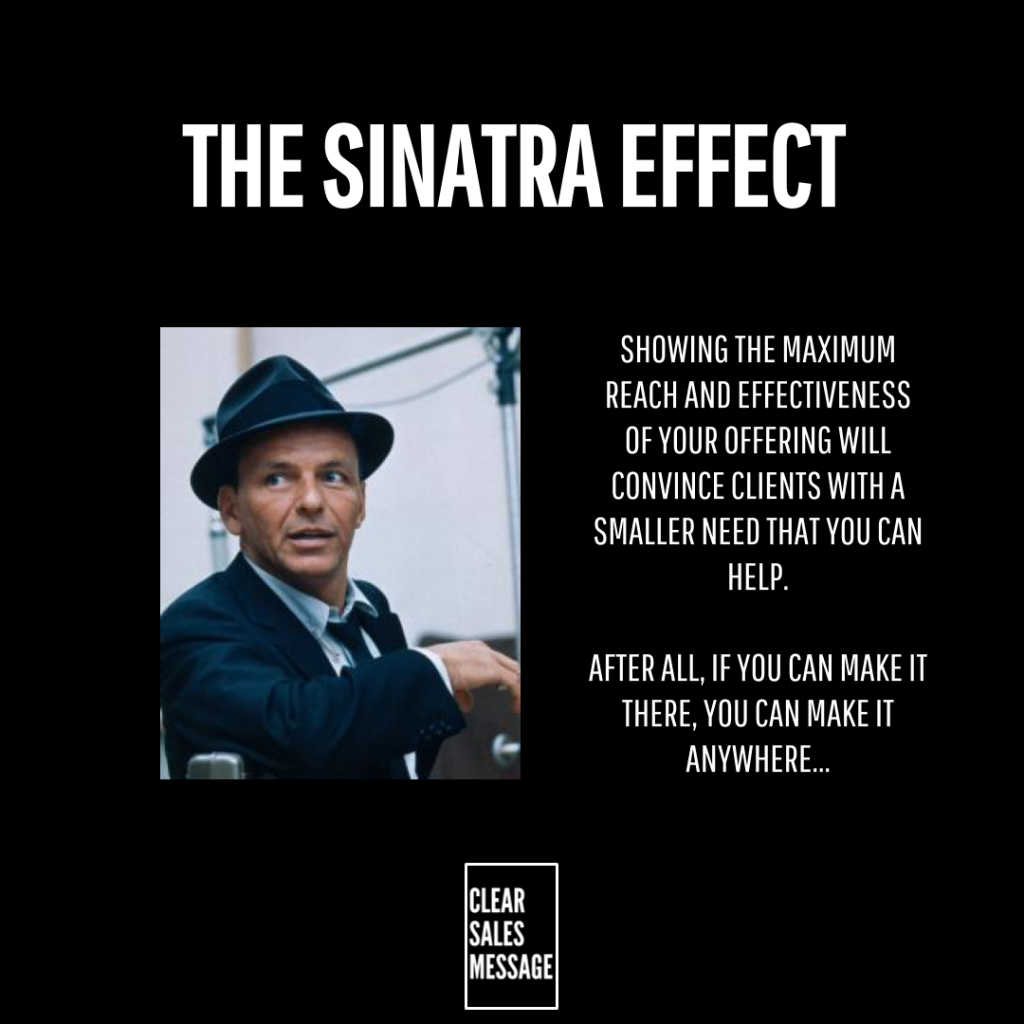
Frank Sinatra sang about New York as the ultimate test. Make it there and you have proved yourself against the toughest standard. Everything else is easier by comparison.
The same logic works in sales. If your cleaning spray handles a caked industrial grill, it will manage a domestic oven without effort. If your software runs payroll for 5,000 staff, it can handle yours with 50. If your insurance covers air traffic control, your business is well within its capability.
The buyer does not need to take your word for it. The harder use case has already done the proving.
What Is The Sinatra Effect?
The Sinatra Effect is when you demonstrate that your offering handles a significantly bigger or more demanding challenge than the one your buyer is facing. By showing it can do the harder thing, you make their specific need feel well within reach.
It is a confidence signal. When a buyer sees evidence that your product or service operates at a higher level than they need, their uncertainty drops. The question shifts from “will this work for me?” to “of course it will work for me.” That shift makes the sale easier.
The technique works across categories. Products, services, software, insurance, training, equipment. Anywhere you can point to a more demanding application than the one your buyer faces, you can use the Sinatra Effect.
Why Does The Sinatra Effect Work?
It works because it demonstrates capability rather than just claiming it. Anyone can say their product is reliable or their service is effective. Pointing to a harder use case where it already performs is a different thing entirely. That evidence reassures buyers in a way that a list of features never quite does.
There is also a contrast effect at play. When you place a demanding use case alongside the buyer’s own situation, theirs feels smaller and more manageable by comparison. The gap between what your offering can do and what they need it to do becomes visible. Because that gap is clearly in their favour, confidence in the purchase goes up.
The Sinatra Effect also signals versatility. If your cleaning spray can tackle an industrial grill, the buyer knows it will handle a greasy cooker, some tools, and anything else they throw at it. You do not need to list every possible use case. The extreme example does that work for you.
Finally, it removes a common unspoken fear. Many buyers worry that their need is too niche, too complex, or too specific for an off-the-shelf solution. Showing your offering already operates at a higher level of complexity makes that fear disappear before they ever voice it.
How Can You Use The Sinatra Effect In Sales?
Start by thinking about the most demanding use case your offering already handles. Not a hypothetical. A real one. Then contrast that with what your buyer actually needs, and make the gap visible.
Find Your Most Demanding Use Case
Think about your biggest clients, your hardest jobs, or the most complex version of the problem you solve. That is your New York. The use case that, if you can handle it, proves you can handle anything. Because the contrast only works when the difference is meaningful, choose a use case that will genuinely make the buyer’s situation feel simple by comparison.
Make the Contrast Explicit
The Sinatra Effect does not work if the buyer has to join the dots themselves. State it clearly. “We manage payroll for businesses with 5,000 staff. Yours has 40. We can handle that.” The contrast needs to be said out loud, in your copy, your pitch, or your advertising. Leaving it implied is leaving the reassurance on the table.
Use It in Your Marketing Materials
Client logos, case studies, and sector references all carry Sinatra Effect potential. A well-known brand name in your client list, a high-stakes sector you operate in, or a record-breaking result you have delivered all signal that you operate at a high level. Because buyers scan for these signals before they read the detail, placing them prominently does more work than you might expect.
Use It to Handle Objections
When a buyer raises a concern about whether your offering is up to their specific need, the Sinatra Effect is one of the cleanest responses available. Point to the harder thing you already do. “We handle X, which is more complex than your situation. So yes, we can do this.” That response closes the objection with evidence, not reassurance.
When The Sinatra Effect Works Best
It works best when the buyer has unspoken doubts about whether your offering is capable enough for their needs. That doubt is common in competitive markets, with new or unfamiliar suppliers, or in high-stakes purchases where getting it wrong matters. In all of those situations, pointing to a harder use case builds confidence faster than any amount of specification detail.
It also works well for businesses that serve a wide range of client sizes or sectors. When a smaller buyer sees that you also serve much larger or more complex clients, they gain reassurance that your offering is not going to be stretched by their requirements. Because you already operate above their level, their need is comfortably within your range.
Similarly, it works well in advertising where you have limited space to make a case. A single well-chosen contrast, like an insurance brand referencing a high-stakes industry to reassure a general business audience, communicates more in one image than a paragraph of copy ever could.
When The Sinatra Effect Becomes Dangerous
The risk is choosing a use case the buyer cannot relate to. If the contrast is so extreme that it feels irrelevant to their world, the effect is lost. A buyer running a small consultancy may not feel reassured by knowing your software powers a global bank. The gap needs to be meaningful without feeling like a different universe entirely.
There is also a credibility risk. The harder use case has to be real. If a buyer investigates and finds the claim is exaggerated or unverifiable, the trust you were building collapses. So only use genuine examples. A real, verifiable demanding use case is far more powerful than an impressive-sounding one that cannot be substantiated.
Common Sinatra Effect Mistakes
Not Making the Contrast Explicit
Mentioning a big client or a demanding sector without drawing the connection to the buyer’s situation leaves the work half done. The reassurance only lands when the buyer can see the gap clearly. So say it directly. “We do X which is harder than what you need. That means your situation is well within our capability.”
Choosing an Irrelevant Use Case
The harder use case needs to be in the same broad category as the buyer’s need. If the contrast is between completely different industries or applications, the buyer cannot make the connection. Choose a use case that feels like a bigger version of their problem, not an unrelated one that happens to sound impressive.
Using It Too Early in the Conversation
The Sinatra Effect is most powerful when the buyer already has a sense of what they need. If you lead with it before they have told you their situation, the contrast has no anchor. Listen first. Understand their use case. Then show them the harder thing you already handle and let them draw the conclusion themselves.
Forgetting to Keep the Focus on the Buyer
The Sinatra Effect is a tool to reassure the buyer, not to show off. If the harder use case feels like bragging rather than proof of capability, it will land badly. Keep the language focused on what it means for the buyer. “We handle X, which means your situation is well within our range” keeps the buyer at the centre. “We work with the biggest names in the industry” puts you at the centre instead.
The Sinatra Effect – An Example
Howden, the insurance broker, ran an ad that used the Sinatra Effect to make a point about cyber insurance. The ad referenced their work with a high-stakes, safety-critical industry to reassure a general business audience that their own needs were comfortably covered.

The contrast does the work. If they protect organisations where the stakes are as high as they get, your business, with its comparatively manageable risks, clearly falls well within their capability. You do not need to read any more to feel reassured. The harder use case has already made the case.
That is the Sinatra Effect. Find the most demanding thing you already do. Make it visible. Let your buyer’s need feel easy by comparison.
See Also