Practical Sales Training™ > Wordplay > Antimetabole
Antimetabole
Some phrases stay with you long after you’ve heard them. “Ask not what your country can do for you. Ask what you can do for your country.” You’ve probably heard that line. You can probably repeat it. That’s antimetabole at work.
The reversal is what does it. The brain enjoys the symmetry. It spots the pattern, processes the contrast, and files the phrase away. As a result, the message sticks in a way that a plain statement never would.
In sales, that kind of recall is valuable. So if you want your key message to travel further and land harder, antimetabole is worth knowing.
What Is Antimetabole?
Antimetabole is a rhetorical device where words are repeated in reverse order to create impact, rhythm, and memorability. It’s used in speeches, slogans, and sales messaging because the mirrored structure makes the phrase stick in people’s minds.
Famous examples include “Ask not what your country can do for you. Ask what you can do for your country” from John F. Kennedy, “Eat to live, not live to eat” from Socrates, and “If you fail to plan, you plan to fail.” Each one is easy to remember and hard to argue with. The structure itself does half the persuasive work.
In sales, antimetabole turns a standard claim into a line that travels. Because the phrase is so easy to repeat, buyers and audiences pass it on without even thinking about it. So the message spreads further than a conventional sentence ever could.
Why Does Antimetabole Work?
It works because the reversal creates a pattern the brain finds satisfying. People enjoy symmetry and contrast. When a phrase delivers both at once, it feels clever. As a result, the listener pays closer attention and remembers it more easily.
There are four reasons antimetabole is so effective. First, it creates emphasis. Repeating and flipping key words makes them land twice instead of once. Second, it feels smart. The listener is rewarded for spotting the reversal, which creates a small but genuine moment of engagement. Third, it’s memorable. Because the structure is distinctive, the phrase is easier to recall later. Fourth, it makes complex ideas simple. A difficult concept wrapped in a mirrored phrase suddenly feels clear and punchy.
Together, these effects make antimetabole one of the most efficient tools in persuasive communication. So when you need a phrase that converts attention into recall, this is the technique to reach for.
How Can You Use Antimetabole In Sales?
You can use antimetabole in marketing, sales, and branding to make your message stand out. Here’s how it works in practice.
Slogans and Taglines
Create memorable taglines that flip the structure. For example, “Buy what you love, love what you buy” or “We don’t just sell to clients, we let clients sell for us.” Because the phrase is easy to repeat, it becomes part of how buyers describe your brand to others. That’s word-of-mouth built directly into the language.
Sales Conversations
Use it to simplify key points in a pitch. “If you don’t follow up, you follow out” is a good example. So is “Don’t sell what you make. Make what you sell.” These phrases land quickly, make the point feel obvious, and give the buyer something to take away and repeat to their team. That repetition is a form of built-in follow-up.
Social Media Posts
Write sharp one-liners that are shareable and quotable. A well-crafted antimetabole phrase performs well on LinkedIn and other text-heavy platforms because it stops the scroll and rewards a second read. Similarly, it tends to get saved and reshared more than plain statements do, since it feels like something worth keeping.
Presentations
End with a mirrored phrase the audience can easily recall. A presentation close built on antimetabole gives the listener a single, repeatable line to take away. That line often becomes the version of your talk they share with others. So instead of forgetting the detail, they carry the essence.
Tips for Success
Keep it short. The power of antimetabole is in its simplicity. Use strong, action-oriented words that stand out when reversed. Also, test it with your audience. A clever phrase only works if people understand it instantly. Because if they have to work out what it means, the phrase has already failed.
When Antimetabole Works Best
It works best when the two halves of the phrase make genuine sense on their own. The reversal only lands if both directions are meaningful. When the flipped version is as true as the original, the phrase becomes more than clever. It becomes convincing.
It also works well for high-stakes messages where recall matters. A sales close, a campaign headline, or a keynote ending all benefit from a phrase the audience can repeat later. Because antimetabole is so easy to remember, it travels with the listener long after the conversation is over.
Similarly, it works in competitive contexts where you want to challenge the status quo. A phrase that flips conventional wisdom makes people stop and reconsider what they assumed was true. That reconsideration is exactly what opens the door to a new idea or a buying decision.
When Antimetabole Becomes Dangerous
It becomes a problem when the reversal is forced. If the flipped version doesn’t make real sense, the phrase sounds clever but feels hollow. Buyers notice that disconnect. As a result, a failed antimetabole can undermine your credibility rather than build it. So only use it when the reversal is genuinely meaningful.
It can also misfire when it’s overused. One antimetabole phrase in a presentation is memorable. Three in a row start to feel like a gimmick. So use it sparingly. The more rare it is in your communication, the more impact it carries when it appears.
And it can become a crutch that replaces substance with style. A phrase that sounds good but says nothing still says nothing. So always make sure the underlying point is strong before you wrap it in a mirrored structure. Because the technique amplifies a good message. It can’t rescue a weak one.
Common Antimetabole Mistakes
Forcing the Reversal
The best antimetabole phrases feel inevitable. The worst feel engineered. If you find yourself bending the meaning of a word to make the flip work, the phrase isn’t ready yet. Instead, look for reversals that emerge naturally from what you’re already saying. Because when the structure fits the idea, the phrase lands without effort.
Making It Too Long
Antimetabole works because it’s tight. When the phrase runs too long, the reversal gets lost and the impact disappears. So aim for brevity. The shorter the phrase, the more clearly the flip registers. If you can’t say it in under fifteen words, simplify it further before you use it.
Using It Without a Clear Point
A mirrored phrase that sounds clever but doesn’t say anything specific is a wasted opportunity. Every antimetabole should make a clear, useful point. For example, “If you fail to plan, you plan to fail” isn’t just clever. It’s also true and actionable. So when you write yours, check that the phrase earns its place by saying something worth saying.
Overusing It in the Same Piece
One strong antimetabole is memorable. Several in a row become predictable. When the audience starts expecting the flip, the novelty disappears and the technique loses its power. So treat each antimetabole as a moment, not a style. Use it once or twice in a single piece and let the surrounding content stay plain. The contrast is what makes it land.
Antimetabole – An Example
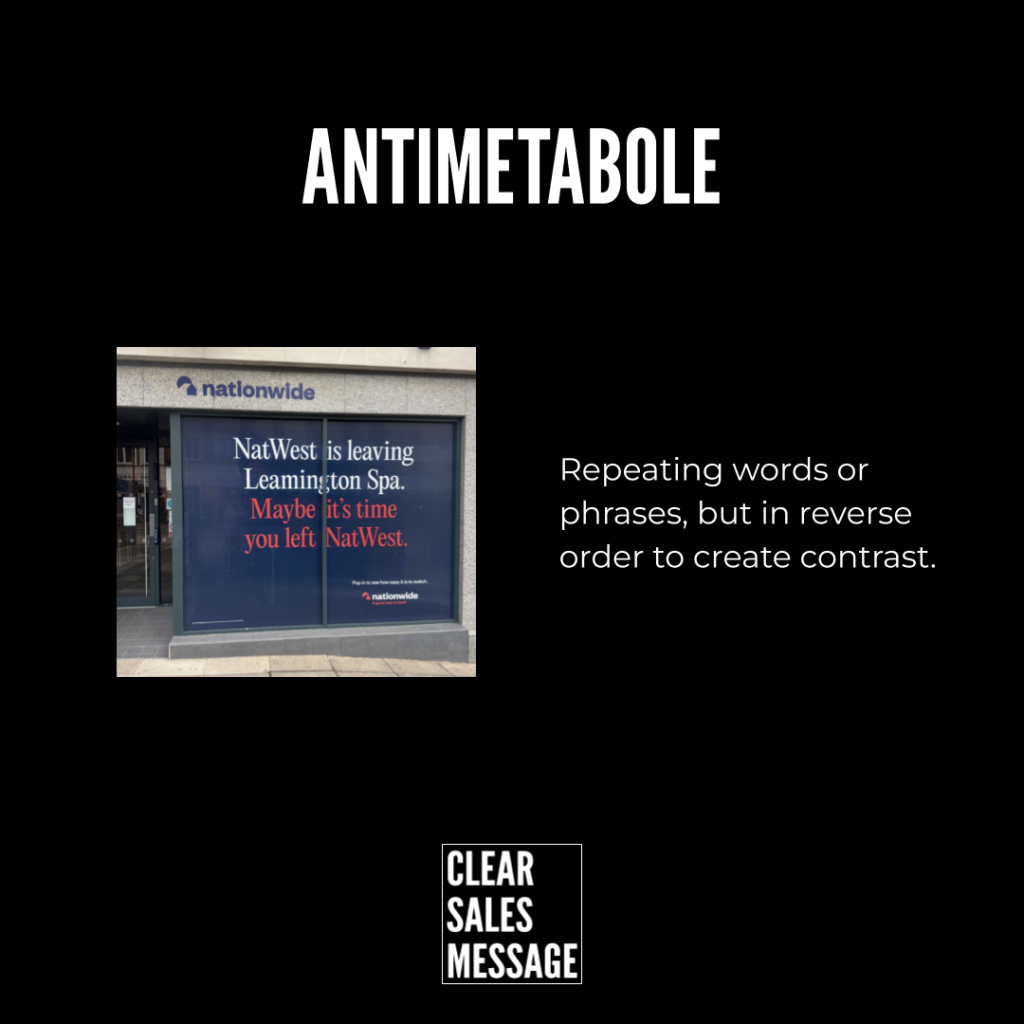
This Nationwide advert uses antimetabole to take a sharp, confident swipe at a competitor. NatWest had announced it was closing its Leamington Spa branch. So Nationwide placed an advert in the window of their own branch on the same street. The message read: “NatWest is leaving Leamington Spa. Maybe it’s time you left NatWest.”
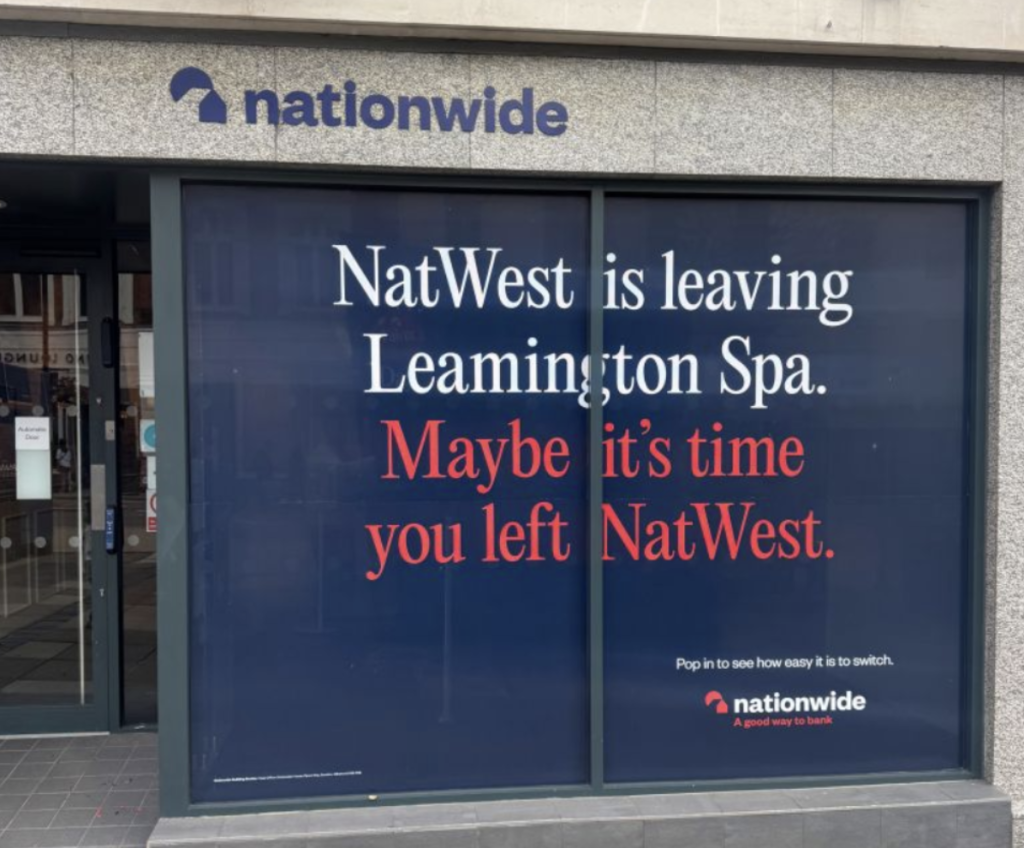
The phrase works because it flips the word “left” to mean two different things. NatWest is leaving a town. But the second “left” means leaving the bank entirely. The reversal is clever. But more importantly, the underlying point is strong. As a result, the advert got shared widely and generated significant press coverage. That’s antimetabole doing exactly what it should: turning a single smart phrase into a message that travels far beyond its original location.
See also