Practical Sales Training™ > How To Lose The Sale > Interchangeable Names
Interchangeable Names
Your name is the first thing a buyer sees. So if it sounds exactly like three other companies in your space, you have a problem before you have even spoken.
Interchangeable Names happen when a business picks a name that describes what it does, but does it so literally that the name tells you nothing specific. It fits anyone. As a result, the buyer cannot tell you apart from the rest.
This is one of the quietest ways to lose a sale. The buyer does not object. They do not push back. They just forget you, or worse, mix you up with someone else.
What Are Interchangeable Names?
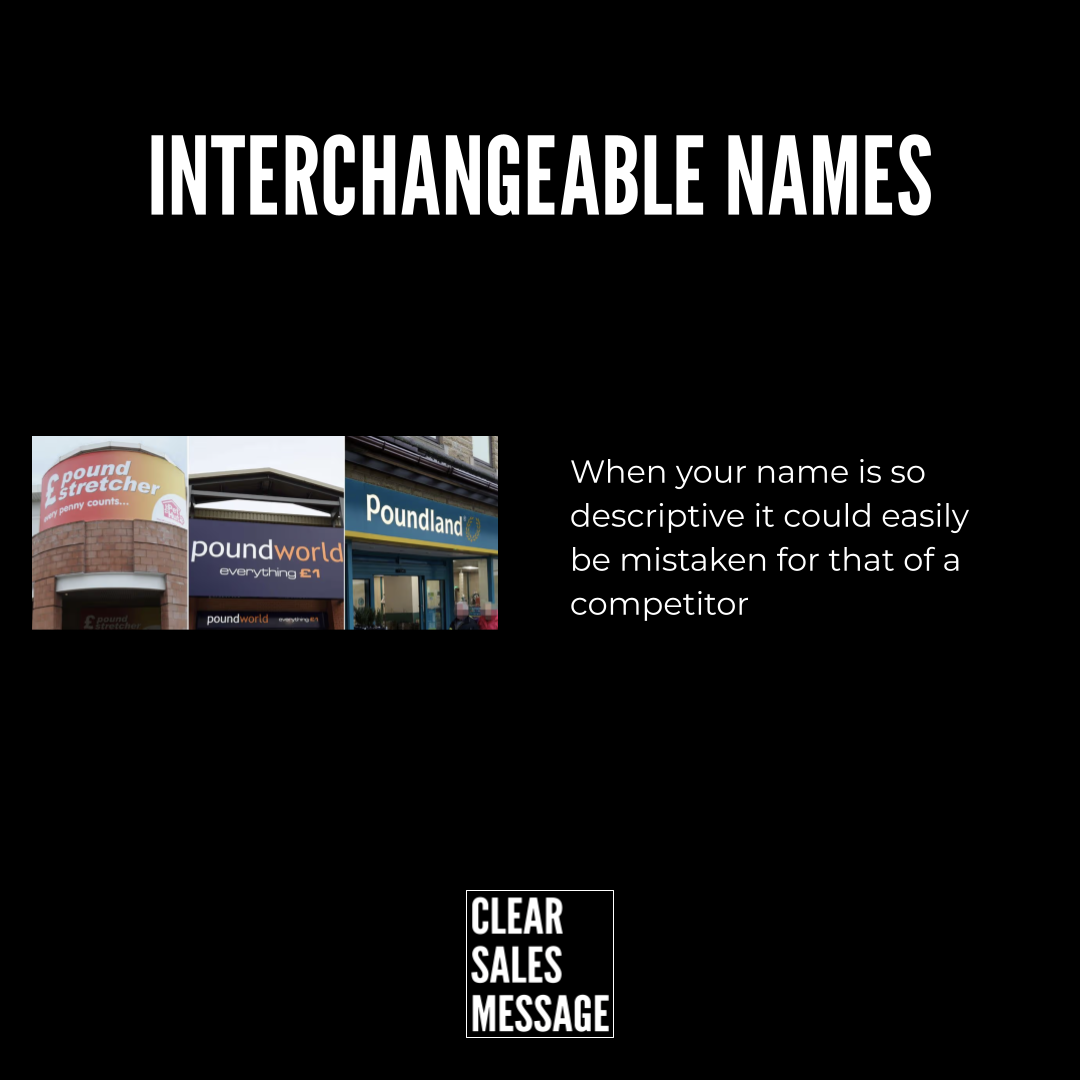
An Interchangeable Name is a business name so broad or descriptive that it could easily belong to a rival. Think of names like “Poundworld”, “Poundland”, and “Poundsaver”. They all describe the same thing in almost the same way. So in the buyer’s mind, they blur together.
The same thing happens in services. “Pro Cleaning Services”, “City Clean Pro”, “CleanRight Solutions” – these names all say the same thing. Because none of them say anything different, buyers treat them as the same. That means the only way to stand out is on price, and that is not a race you want to win.
However, this is not just a branding problem. It is a sales problem. When your name does not help buyers remember you or place you, your whole message has to work harder to make up for it.
Why Do Interchangeable Names Happen?
Most businesses name themselves based on what they do, not how they want to be known. It feels like the safe choice. If you describe your service in your name, surely buyers will understand you straight away.
But that logic has a flaw. The more descriptive your name, the more it overlaps with your competitors. And the more it overlaps, the harder you are to remember – or recommend.
In fact, some of the most memorable business names say almost nothing about what the company does. Apple does not describe computers. Amazon does not describe retail. Therefore, the name alone is not doing the selling. The story behind it is.
Why Does This Hurt Your Sales?
Buyers make fast decisions. So when they cannot tell you apart from the competition, they default to whoever is cheapest, most familiar, or easiest to find. You lose not because your offer was worse, but because you blended in.
There are a few ways Interchangeable Names damage your pipeline:
Buyers mix you up with rivals
If your name sounds like a competitor, buyers may think they have already spoken to you when they have not. Or they may recommend you but send the enquiry elsewhere by mistake. Both hurt.
You become a category, not a brand
When your name describes a category rather than a company, buyers lump you in with everyone else. As a result, you are a “type of business” rather than a specific choice. That makes it easy to delay, compare, or shop around.
Word of mouth breaks down
A buyer who wants to refer you has to remember you. But if your name is similar to two others, they may get confused and refer the wrong one, or give up trying to remember at all.
Price becomes the only point of difference
When names are interchangeable, everything else has to do the heavy lifting. And if your pitch, website, and offer are also similar, the buyer has no reason to choose you over anyone else except cost.
How Can You Use This In Sales?
Even if you cannot change your name right now, you can change how you talk about yourself. The goal is to close the gap between your name and your difference.
Lead with a clear distinction
If your name does not separate you, your first sentence has to. Do not wait until the third paragraph of your website or the end of a sales call to say what makes you different. Say it first, because buyers are already comparing you before you open your mouth.
Make your difference easy to repeat
Word of mouth is how many small businesses grow. So your difference needs to be short enough for a buyer to pass on. If it takes a paragraph to explain, they will not bother. Instead, give them one clean line they can use.
Own a specific outcome or buyer type
Generic names often come with generic positioning. But you can fix that by being specific about who you help and what they get. For example, “we work exclusively with law firms” does more work than “we offer HR support to businesses of all sizes”.
Test if you have this problem
Ask someone who does not know your business to look at your name and the names of three competitors. If they cannot tell who is who, you have an Interchangeable Name problem. That test takes five minutes and can change how you sell.
When Interchangeable Names Work Best
There are times when a descriptive name is not a major problem. If you operate in a niche with very few competitors, the name does not need to do as much work. Similarly, if your business is built almost entirely on personal relationships and referrals, the name matters less because buyers are buying you, not the brand.
Also, if you are a local business in a tight area, a clear descriptive name can work fine. “Sheffield Window Cleaning” may blend in nationally, but locally it gets found and remembered well enough.
However, these are exceptions. For most businesses trying to grow, win new clients, or compete online, an Interchangeable Name is a quiet drag on everything from search to referrals to conversion.
When Interchangeable Names Become Dangerous
The risk goes up fast in crowded markets. If your sector has many players with similar names, yours gets lost even faster. Buyers doing research online will skim past you. They will not investigate further, because nothing in your name tells them to.
It also becomes a real problem when you try to scale. Referrals get muddled. Your brand is hard to search for. Ads are less effective because the name does not stick. Therefore, what was a minor issue when you started becomes a block on growth.
And if a competitor with a similar name does something bad, you can get caught in the fallout. Buyers may not remember which company did what. That kind of confusion is hard to fix.
Common Interchangeable Names Mistakes
Thinking the name does not matter because the service is good
A great service does not fix a forgettable name. Buyers have to get to the point of experiencing your service first. If the name does not help them choose you or remember you, many of them never will.
Assuming buyers will look more closely
Most buyers do not dig deeper when they are confused. Instead, they move on. So if your name does not give them a reason to stop and look, they will not.
Fixing the name without fixing the message
A new name alone will not solve the problem. You also need a clear message behind it. Because a unique name with a vague pitch still blends in – it just blends in under a different word.
Not testing it with real people
Founders often cannot see this problem because they know their brand too well. However, someone who has never heard of you will see it immediately. Ask them. Their confusion is your data.
Interchangeable Names – An Example
Three local IT support firms all trade in the same city. Their names are “ProTech IT Solutions”, “TechPro Support”, and “IT Pro Services”. Each one uses the same words in a slightly different order. Their websites look the same, and every one of them says they offer “friendly, local IT support for small businesses”.
A buyer searches for IT support and finds all three. They cannot tell them apart, so they email all three asking for a quote. The one who replies fastest gets the job. Not the best. Not the most experienced. The fastest – because nothing else gave the buyer a reason to choose.
Now imagine one of those firms had instead called itself “The IT Company for Law Firms” and led with a message about the specific risks that law firms face when their systems go down. That firm stands out before anyone replies. As a result, they compete on fit rather than speed, and they win a better type of client.
See also:
- 60+ ways to LOSE the sale
- 100+ ways to differentiate
- Wordplay: how your choice of words affects how buyers see you