

Practical Sales Training™ > How To Keep Your Clients Happy > Client Segmentation
Client Segmentation
Treating every client exactly the same sounds fair. But in practice, it means your best clients get the same attention as your least profitable ones. That’s not fair on them, and it’s not good for your business.
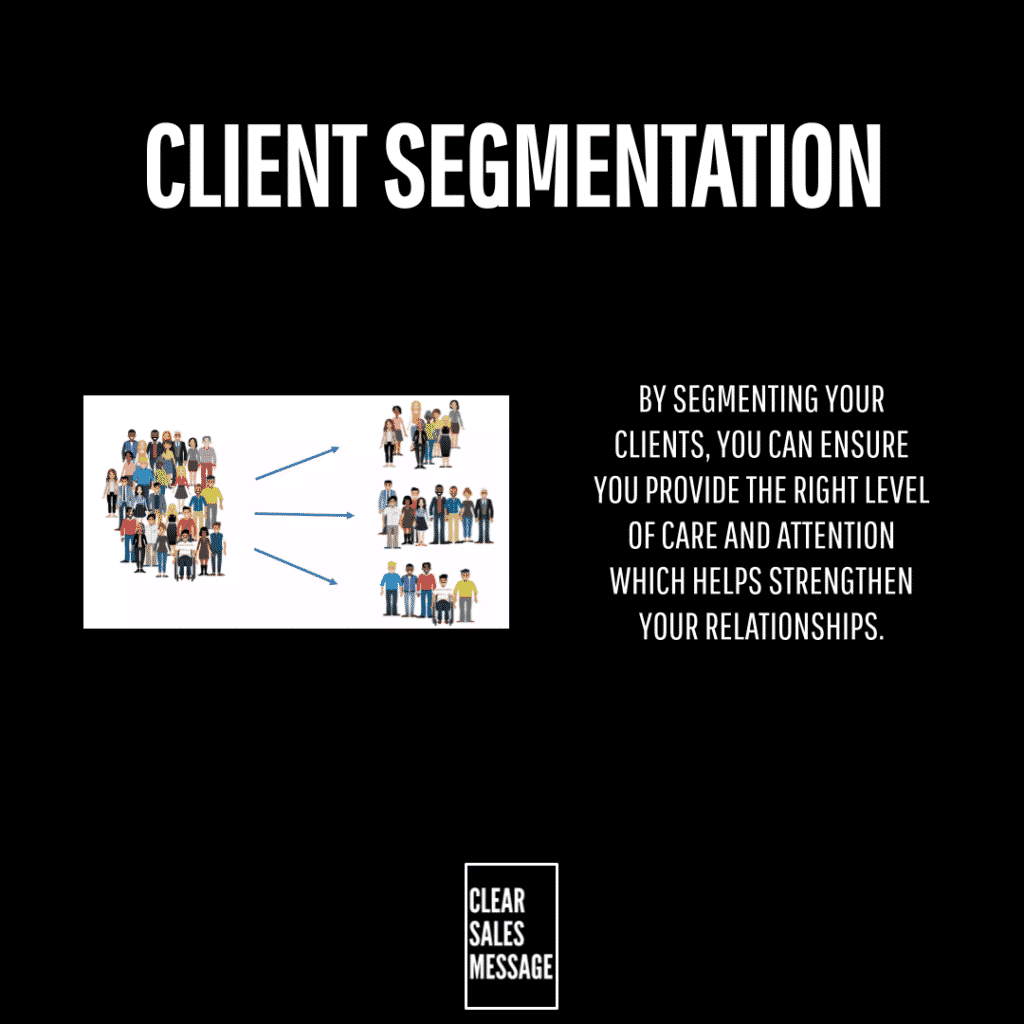
Client segmentation means dividing your clients into groups based on what they spend, how much time they need, and how valuable they are to your business. So you can give your top clients the care they deserve, without burning out your team trying to give everyone the same.
Most businesses have a heavily uneven spread of revenue. A small number of clients drive the majority of income. Segmentation helps you see that clearly and act on it, because you can’t manage what you haven’t mapped.
What Is Client Segmentation?
Client segmentation is the process of grouping your clients by value, need, or behaviour so you can serve each group in the right way. Instead of one-size-fits-all service, you create different levels of care and attention for different types of client.
The most common approach is a tiered system. A-tier clients are your highest spenders or most strategic relationships. B-tier clients are solid, mid-level accounts. C-tier clients are smaller or lower-value, and they need a different kind of service model to be sustainable for you.
Segmentation isn’t about valuing some clients as people more than others. It’s about making smart decisions with limited time and resource, because trying to go the extra mile for everyone means nobody gets your best.
Why Does Client Segmentation Work?
It works because it brings clarity to a problem most businesses feel but never properly address. The 80/20 principle tells us that roughly 80% of revenue tends to come from 20% of clients. Segmentation shows you exactly which clients sit in that 20%, so you can protect and grow those relationships deliberately.
It also removes the frustration of over-investing in clients who simply aren’t engaged. Without segmentation, it’s easy to spend as much time on a low-value, high-maintenance account as on a top spender. That’s a poor use of your energy, and over time it leads to burnout and resentment.
When you know which clients are which, you can anticipate situations rather than react to them. As a result, your best clients feel looked after and your team’s time goes where it actually makes a difference.
How Can You Use Client Segmentation In Sales?
Start by pulling together your full client list, including current, past, and ongoing clients. Then score each one based on factors like revenue, time demands, growth potential, and how enjoyable the relationship is to manage. From there, you can assign each to a tier and build a service model around it.
Define your tiers clearly
Your tiers only work if the criteria are clear. Decide upfront what makes a client an A, B, or C. Is it annual spend? Frequency of contact? Strategic importance? Write it down so the whole team applies it consistently, not just by gut feel.
Build a service model for each tier
Each tier needs its own approach. A-tier clients might get quarterly review meetings, priority response times, and proactive ideas. B-tier clients get a solid standard service. C-tier clients may be better served through a self-service portal or lighter-touch model that frees your team up for higher-value work.
Review the segments regularly
Clients move between tiers over time. A small account that grows quickly might become an A-tier client within a year. Similarly, a once-large account that has reduced its spend may need to move down. So review your segments at least once or twice a year to keep them accurate.
Use segmentation to shape your sales focus too
Your A-tier clients tell you who to look for when prospecting. Because you know what your best clients look like, you can target more people who match that profile. Segmentation isn’t just a retention tool. It’s also a targeting tool.
When Client Segmentation Works Best
Segmentation works best when you have a reasonably sized client base and limited capacity to give everyone the same level of personal attention. The bigger your client list, the more valuable a clear segmentation system becomes.
It’s also most effective when your team is stretched. If your people are spending equal time on every account regardless of value, segmentation gives them permission to prioritise. That clarity reduces stress and improves the quality of service across all tiers.
For businesses with recurring revenue models, segmentation is especially powerful. Because you can see clearly which clients are most likely to renew, grow, or refer others, and focus your retention effort accordingly.
When Client Segmentation Becomes Dangerous
Segmentation causes problems when C-tier clients feel like second-class customers. If they receive a noticeably worse experience, they’ll talk about it. So the goal isn’t to neglect lower-tier clients. It’s to serve them in a way that’s appropriate and sustainable.
It can also backfire when the criteria are too rigid. A client who is small today may be your biggest account in two years. Therefore, build enough flexibility into your system to recognise and respond to clients who are growing fast.
And segmentation only works if the whole team knows about it and applies it. A system that lives in one person’s spreadsheet but never influences how the team behaves is just an exercise. However, when everyone uses it to guide their decisions, it changes how the business operates.
Common Client Segmentation Mistakes
Only looking at current spend
Revenue today is one factor, but it’s not the only one. A client who refers others, opens doors, or has strong growth potential may deserve a higher tier than their current spend suggests. So factor in the full picture, not just the invoice total.
Never reviewing the segments
A segmentation system you built two years ago and never updated is unreliable. Clients change. Build a regular review into your process so the tiers stay accurate and useful.
Making lower tiers feel it
The service model for C-tier clients should be lean, not dismissive. Design it so they still feel looked after, just in a more streamlined way. A self-service portal done well can feel like a benefit, not a demotion.
Keeping it to yourself
If the segmentation exists only in your head or your own files, it won’t change how your team works. Share it, brief everyone on the criteria, and make sure the service model for each tier is clearly defined and followed.
Client Segmentation – An Example
A consultancy firm has 50 active clients. But when they look at their revenue, they find that 10 clients generate 70% of their income, while the other 40 are smaller accounts that take just as much time and attention.
So they segment their clients into A, B, and C tiers:
- A-tier clients get priority support and quarterly strategy calls.
- B-tier clients receive standard service with bi-annual reviews.
- C-tier clients move to a self-service portal, freeing up time for higher-value work.
As a result, the firm increases retention with its best clients while still providing value to smaller ones. However, they’re no longer over-investing time where it doesn’t pay off. A clear segmentation system makes the whole business more focused, more profitable, and easier to run.
See Also