Practical Sales Training™ > How to connect with your buyer > Loss Aversion
Loss Aversion
Ask someone if they want to win £100 and most will say yes. Tell that same person they might lose £100 they already have and the reaction is much stronger. That difference is Loss Aversion in action.
We are wired to protect what we have. A threat of losing something triggers more urgency than the promise of gaining something equivalent. So in sales, the way you frame your message matters as much as what you are selling.
Shift the focus from gains to protection, and you tap into one of the most reliable drivers of buying decisions there is.
What Is Loss Aversion?
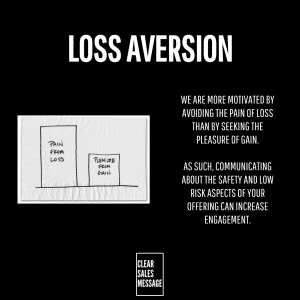
Loss Aversion is the tendency to feel the pain of a loss more strongly than the pleasure of an equal gain. Research suggests losses feel roughly twice as powerful as gains of the same size. So avoiding a £100 loss feels more urgent than winning £100.
In a buying context, this means buyers are often more motivated by what they stand to lose if they do nothing than by what they might gain if they act. Threats like a data breach, a missed deadline, a lost client, or a wasted investment all carry more emotional weight than the promise of a productivity boost or a marginal revenue increase.
Loss Aversion connects closely to Zero Risk Bias. Both stem from the same instinct: we want to feel safe. When your message speaks to that instinct, it lands harder than one built purely around opportunity.
Why Does Loss Aversion Work?
It works because the brain processes potential losses and potential gains differently. A gain feels good. But a loss feels urgent. Urgency drives action far more reliably than desire does. So a message that shows the buyer what they risk by doing nothing creates more momentum than one that shows what they could have if they act.
It also works because most buyers already have something they want to protect. A client base. A reputation. A budget. A process that currently runs smoothly. When you frame your offer as a way to protect those things rather than grow them, you speak directly to what the buyer values most.
Also, Loss Aversion works because it connects to real fear rather than abstract hope. Buyers can picture a data breach, a missed renewal, or a costly mistake far more vividly than a vague future benefit. That vivid, concrete fear is what moves people to act now rather than later.
How Can You Use Loss Aversion In Sales?
The key is to reframe your message around what the buyer stands to lose by not buying rather than what they stand to gain by buying. That shift does not require a different product. It just requires a different angle on the same value.
Lead With the Cost of Inaction
Before you describe what your product does, describe what happens when a buyer does not have it. What goes wrong? How much does the problem cost them over a year? When the buyer feels the weight of inaction before they hear your solution, they are far more ready to listen. Because the pain of doing nothing is already vivid in their mind.
Reframe Gains as Protection
Many features and benefits can be expressed in two ways. “Gain more storage space” and “never lose your data again” describe the same thing, but the second version uses Loss Aversion. So go through your current messaging and look for gains you can reframe as protections. “Save time” becomes “stop wasting hours you cannot get back.” “Improve accuracy” becomes “stop the errors that cost you clients.” The product stays the same. The message hits harder.
Use Real Examples of What Others Have Lost
Case studies that show the cost of not acting land harder than ones that show the benefit of acting. A story about a business that lost a key client due to the problem your product solves is more compelling than a story about a business that grew by 20% after using it. Because Loss Aversion means your prospect connects more strongly with the loss story. So look for examples of what goes wrong and use them where appropriate.
Highlight What Buyers Already Have at Stake
The most powerful version of Loss Aversion is personal. When you can show a buyer that something they specifically value is at risk, the urgency becomes very real. Reference their current client base, their existing systems, their reputation in their market, or their team’s time. Show them exactly what they stand to lose if the problem goes unaddressed. Then show them how your offer protects it. That sequence is one of the most effective in sales.
When Loss Aversion Works Best
It works best when the buyer already has something worth protecting. The more they value what they currently have, the stronger the effect. So Loss Aversion is particularly powerful with established businesses, senior decision-makers, and anyone with a reputation, a client base, or a revenue stream they cannot afford to put at risk.
It also works best when the threat is credible and specific. A vague warning about potential problems lands weakly. But a precise, realistic scenario about what could go wrong and what it would cost lands with real force. So the more specific your Loss Aversion message, the more it moves people.
Also, it works well at the decision stage when a buyer is close but stalling. Highlighting what they risk by delaying, rather than pushing harder on the benefits, often breaks the logjam. Because the buyer who is almost ready to act just needs the cost of waiting to feel more real than the comfort of doing nothing.
When Loss Aversion Becomes Dangerous
The main risk is using fear in a way that feels manipulative. When loss-based messaging exaggerates the threat, invents risks, or creates panic that is not proportionate to the real situation, buyers feel pushed rather than informed. That damages trust and often pushes them away. So always base the loss framing on something real and relevant to that buyer’s situation.
There is also a risk of overuse. If every message focuses on threat and loss, the tone of your communication becomes relentlessly negative. Buyers can find this draining. So balance Loss Aversion with positive framing where appropriate. Use the loss angle to create urgency, but also show buyers what a better situation looks like on the other side of the decision.
However, the biggest danger is applying it without understanding what the buyer actually values. Loss Aversion only works when the threat connects to something the buyer cares about losing. If you frame the wrong risk, the message falls flat. So listen carefully before you pitch. Find out what matters most, then show how that specific thing is at risk.
Common Loss Aversion Mistakes
Using Vague Threats
One common mistake is using general warnings like “you could lose clients” or “your competitors will get ahead” without making the threat specific or real. Vague threats create no urgency because the buyer cannot picture them clearly. So name the risk precisely. Tie it to something real in their business. Give it a cost, a timeline, or a consequence they can feel. Because a specific threat lands hard and a vague one lands nowhere.
Forgetting to Offer the Solution
Another mistake is leaning so heavily on the loss angle that the message becomes all threat and no resolution. Loss Aversion creates urgency. But urgency without a clear path forward creates anxiety, not action. So always follow the loss framing with a direct, simple offer of how your product prevents it. The buyer needs to feel the risk and see the exit in the same conversation.
Exaggerating the Risk
A third mistake is overstating the threat to make the message land harder. Buyers with experience in their field will spot an inflated risk claim immediately. When they do, your credibility takes a serious hit. So keep the loss framing honest and proportionate. A real risk, clearly and calmly described, is far more persuasive than a dramatised one. Because trust is the foundation that makes Loss Aversion work. Without it, the technique fails entirely.
Loss Aversion – An Example
A cybersecurity company has two ways to frame the same offer:
Gain framing: “Gain more storage space with our secure backup system.”
Loss framing: “Don’t risk losing your client data. Protect it with our secure backup system.”
Loss framing wins. Risking client data triggers far more urgency than gaining storage space. So the same product, framed around protection rather than growth, converts better.
An investment adviser faces the same choice:
“Protect your retirement savings from market volatility” outperforms “grow your retirement fund faster” for the same reason. Buyers feel the threat of losing what they have built far more sharply than the appeal of gaining more.
That is Loss Aversion at work. Frame the risk, make it real, then offer the protection. That sequence drives more decisions than almost any gain-based message ever will.
See Also