
Practical Sales Training™ > How To Convert > Zero Risk Bias

Zero Risk Bias
What Is It
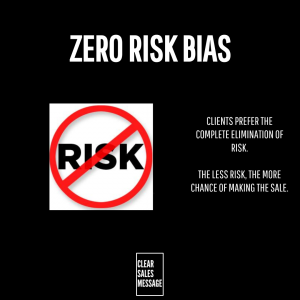
The Zero Risk Bias looks at our natural preference for things that carry minimal to zero risk.
So when a choice feels risk free, it feels easy. Nobody has to weigh a downside that isn’t there.
That ease is exactly what drives the decision to buy.
Why Does It Work
By mitigating risk factors, we can engage clients and encourage them to buy. Connecting to the potential fears of clients ensures those fears don’t become obstacles to the sale.
A buyer’s biggest hesitation is often unspoken. It’s the fear of a bad outcome, not the price itself. Remove that fear, and the price stops being the real obstacle.
How Can You Use It
Offering money back guarantees, providing free delivery and returns, and sharing real world case studies are three simple ways to reassure your clients.
Each one tells the buyer the same thing. If this goes wrong, you’re covered.
When It Works Best
This works best on purchases where the buyer can’t try before they buy. Online products, subscriptions, anything they can’t physically test first.
It also works best when the guarantee is genuinely honoured without friction. A refund that’s easy to claim reassures far more than one buried in complicated terms.
When It Becomes Dangerous
It backfires if the guarantee has hidden conditions that make it hard to claim. A buyer who discovers the fine print feels tricked, not reassured.
It also becomes risky if the offer costs you more than it earns. A guarantee has to make financial sense, not just sound generous.
Overusing risk reversal on things buyers were never worried about wastes the technique on the wrong moment.
Common Mistakes
Adding hidden conditions to a guarantee
Adding hidden conditions to a guarantee undermines the entire point of offering one in the first place.
Making the refund process difficult
Making the refund process difficult defeats the reassurance the guarantee was meant to provide.
Using it where nobody was worried
Offering it on products buyers were never actually worried about wastes the technique where it isn’t needed.
Zero Risk Bias – An Example
A Mattress Company’s 100-Night Trial
Hypothetical Example: An online mattress company knows buyers hesitate to purchase a mattress without trying it first. To address this, they introduce a 100-night risk-free trial with free returns and a full refund if customers aren’t satisfied.
This offer removes the perceived risk of “what if I don’t like it.” It makes the decision feel safe.
As a result, conversions skyrocket, because customers feel they can’t lose. They either love it, or they get their money back.
See also