

Practical Sales Training™ > How To Get Attention > Relatable Moment Effect
Relatable Moment Effect
The fastest way to get someone’s attention is to show them something that feels like their life. Not a vague promise about results. Not a list of features. A moment they know. A feeling they have had. A situation they have been in.
When that happens, the buyer stops scrolling. Because the message feels personal, even though it was not written for them specifically, it lands with the weight of something that was. That connection is what the Relatable Moment Effect creates.
It is one of the most powerful tools in sales communication. And it is surprisingly underused. Most businesses describe what they do. The best ones show buyers a moment from their own life and let the message do the rest.
What Is The Relatable Moment Effect?
The Relatable Moment Effect is when you use a real-world, contextual situation in your messaging that your buyer will immediately recognise and connect with. It might be a feeling, a frustration, a milestone, or a scenario that is common to your target audience. The moment does not have to be dramatic. It just has to be true to their experience.
The effect works because of familiarity. We respond differently to things that feel like part of our world. When something in an ad, a social post, or a sales message reflects a situation we have actually been in, our guard drops. We stop processing it as marketing and start processing it as something that applies to us.
That shift is everything. A buyer who feels recognised is far more open to what comes next than one who feels targeted. The Relatable Moment Effect creates that recognition deliberately, by grounding the message in something the buyer already knows.
Why Does The Relatable Moment Effect Work?
It works because relatability signals understanding. When a business references a moment or a feeling that the buyer knows well, it tells them something important: this brand gets me. And a brand that gets you feels like a safer, smarter choice than one that speaks in generic terms about generic benefits.
There is also a memory effect. We remember things that connect with our own experience far better than things that do not. A message built around a relatable moment is more likely to stick. Because the buyer files it alongside their own memory of that moment, the brand becomes associated with something real and personal rather than something abstract and forgettable.
The Relatable Moment Effect also creates empathy. When buyers recognise a feeling in your messaging, especially a frustration, a fear, or a desire they have felt, they feel that you have experienced it too or at least understand it deeply. That empathy builds trust faster than almost any other approach. Because the buyer feels heard before the conversation has even started, the relationship begins from a much warmer place.
Finally, relatable moments trigger self-insertion. When a buyer sees a scenario that mirrors their own experience, they naturally place themselves in it. They do not just observe the message. They inhabit it. And once a buyer has imagined themselves in your story, the step towards buying feels much smaller.
How Can You Use The Relatable Moment Effect In Sales?
Start by thinking about your buyer’s world, not your product. What situations do they find themselves in? What moments lead them to need what you offer? What feelings do they have just before they start looking for a solution? Those are the raw materials for a Relatable Moment.
Identify the Trigger Moments
Every buying decision starts with a moment. Something happens and the buyer realises they need help. That moment is your entry point. When you describe that moment accurately in your messaging, buyers who are in it or have recently been through it will feel an immediate connection. Because the moment is specific and real, it lands harder than a general description of the problem ever could.
Use Real Language, Not Marketing Language
Relatable moments only land when the language feels authentic. If the copy sounds like an ad, the relatability evaporates. So write the way your buyers talk. Use the words they use when they describe the situation to a friend. Because slang and everyday language signal that you are in their world, the right words can make a message feel personal even when it is reaching thousands of people at once.
Reference Life Milestones
Some of the most powerful relatable moments are tied to life events. Starting a business, having a child, moving house, changing careers. These milestones carry strong emotions and strong needs. When your messaging references one that is relevant to your offer, buyers who are at that stage of life feel an immediate and personal connection. Because the milestone is significant to them, the message that acknowledges it feels significant too.
Use Imagery That Places the Buyer in the Scene
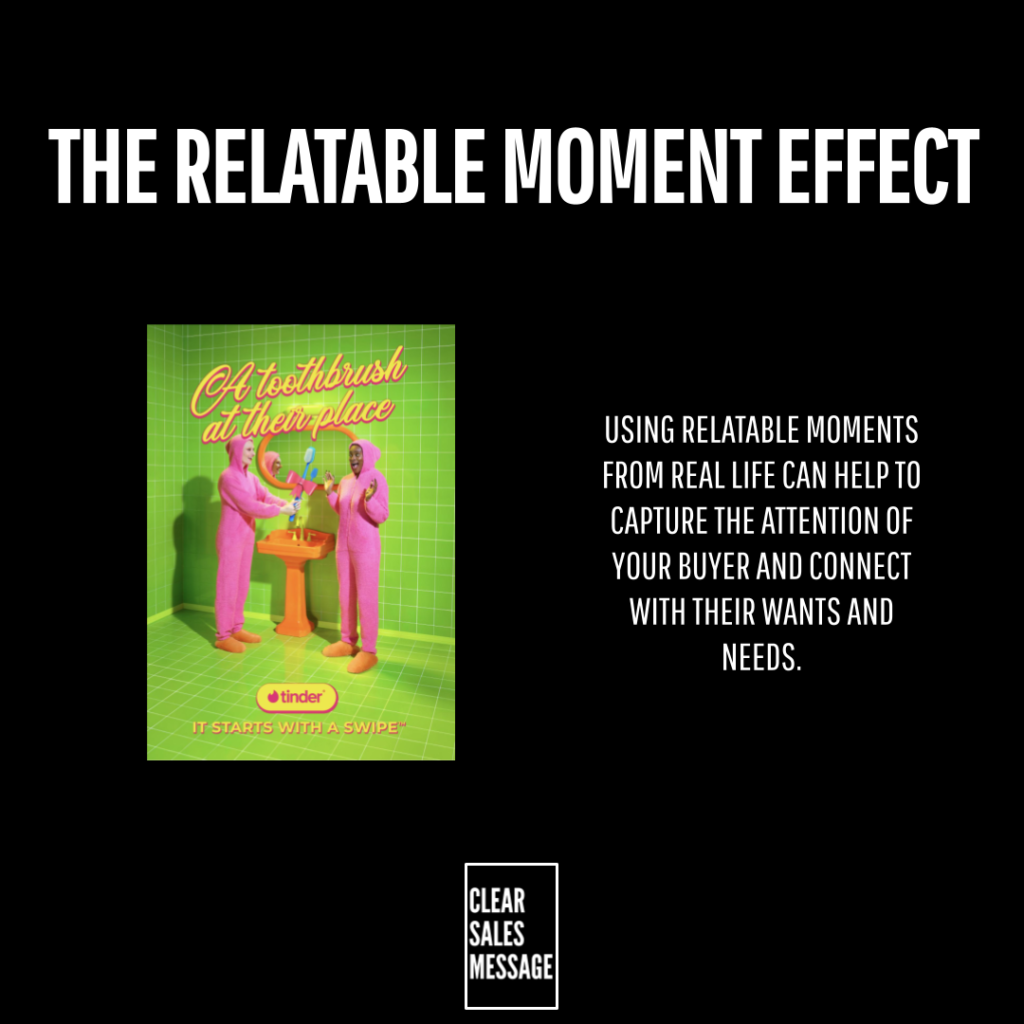
A well-chosen image can do the work of a hundred words when it comes to relatability. Show a scene, a situation, or a feeling rather than a product shot or a stock photo of a smiling team. Because the buyer projects themselves into imagery that mirrors their experience, a relatable scene in an ad creates connection instantly and without requiring the buyer to read a single word.
Use It in Opening Lines
The first sentence of any piece of sales communication is the hardest working sentence on the page. Starting with a relatable moment, rather than a company description or a product claim, immediately pulls the buyer in. Because the opener feels like the start of a conversation rather than the start of a pitch, buyers are more likely to keep reading and less likely to switch off.
When The Relatable Moment Effect Works Best
The Relatable Moment Effect works best when your buyer has a clearly defined experience that leads them to your product. The more specific and universal that experience is within your target audience, the harder the moment hits. Because everyone in that audience has felt the same thing, the message resonates across the whole group without feeling generic.
It also works well in crowded markets where competitors are saying similar things. When every rival talks about features and results, a message that speaks to the human experience behind the buying decision stands out sharply. Because the emotional connection is harder to replicate than a product claim, it creates a point of difference that is genuinely difficult to copy.
Similarly, it works well at the top of the funnel, when you are trying to create awareness and interest rather than close a sale. A relatable moment pulls buyers in and starts a relationship. It is not a closing technique. But it is one of the best ways to get buyers into the conversation in the first place.
When The Relatable Moment Effect Becomes Dangerous
The risk is choosing a moment that misses the mark. A relatable moment that only resonates with part of your audience can alienate the rest. So be careful about how specific you go. The moment needs to be common enough to apply broadly but specific enough to feel real. Too broad and it becomes generic. Too narrow and it excludes buyers who could have been reached.
There is also a risk of being patronising. If the relatable moment feels forced, exaggerated, or condescending, buyers will notice and react badly. The moment has to feel true. Because buyers are good at spotting inauthenticity, a relatable moment that feels manufactured will damage trust rather than build it.
Common Relatable Moment Effect Mistakes
Describing the Product Instead of the Moment
The most common mistake is leading with what you sell rather than with the situation the buyer is in. A message that opens with a product description asks the buyer to do all the connecting work themselves. A message that opens with a relatable moment does that work for them. Because buyers are not thinking about your product before they see your ad, meet them where they actually are.
Choosing a Moment That Is Too Generic
Relatability requires specificity. “Running a business is hard” is not a relatable moment. It is a vague observation. “Spending Sunday evening catching up on admin instead of being with your family” is a relatable moment. Because specific scenarios produce specific emotional responses, the more precise the moment, the stronger the connection it creates.
Using Imagery That Does Not Match the Moment
A relatable message paired with a stock photo that looks nothing like the buyer’s world undermines the whole effect. Because the image is often the first thing a buyer processes, it needs to reinforce the relatable moment rather than contradict it. Choose imagery that feels like it came from the buyer’s life, not from a photo library.
Not Connecting the Moment to the Solution
A relatable moment that does not lead anywhere is just an observation. The moment needs to connect clearly to what you offer and how it resolves the situation the buyer is in. Because the goal is conversion as well as connection, the relatable moment should open the door and your offer should walk through it. Make that link explicit and the buyer will follow.
Relatable Moment Effect – An Example
This ad for Trusted Choice Independent Insurance Agents uses a scene that nobody has literally experienced. But the feeling it creates is one many business owners know well: the sense of being stuck, unsupported, and left to carry a weight that should not be yours alone to bear.

The image works because of self-insertion. Viewers place themselves in the scene almost immediately. Most will not picture themselves as the person doing the lifting. They will picture themselves as the one who is tied up and helpless, watching the consequences unfold. That is the Relatable Moment Effect in action. The scenario is absurd. But the feeling it represents is completely real.
When a message makes a buyer feel something true about their own situation, they pay attention. And when they pay attention, they are ready to hear what comes next. That is what a well-chosen relatable moment achieves every time.
See Also