
Practical Sales Training™ > How To Connect > The Bystander Effect

The Bystander Effect
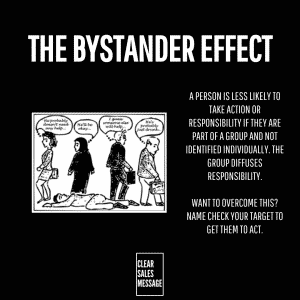
You’ve probably seen the footage. Someone gets hurt in a busy street, and a crowd just watches. Nobody steps in.
It’s not that people don’t care. It’s that in a crowd, nobody feels like it’s specifically their job to act.
This is the Bystander Effect, and it shows up in sales and marketing far more than most people realise.
What Is The Bystander Effect?
When unidentified and in crowds, people feel diminished responsibility and are less likely to act. So the bigger and more anonymous the group feels, the less any one person feels accountable for doing something.
It’s a strange quirk of human psychology. Being part of a crowd should make help more likely, but it often makes it less likely instead.
Why Does The Bystander Effect Work?
It works because in anonymity, there is no accountability. So we can be as lazy and irresponsible as we like, because there are no consequences attached to us personally.
This is how you can see people being attacked in the street and no one does anything. These people aren’t “responsible,” so they’re expecting others to act. And of course, then nothing happens.
How Can You Use The Bystander Effect In Sales?
Identify your audience directly
To overcome the Bystander Effect, you need to identify your audience. So use their name, call them out in emails, and personalise every communication you can.
Remove the anonymity
Personalise everything you can, so the person feels identified rather than anonymous. Once they feel seen, they’re far more likely to act.
Borrow from what already works
This is why marketing emails, letters, coke bottles, and cups of coffee often feature your name. These companies are engaging with you directly, instead of letting you stay anonymous in the crowd.
When The Bystander Effect Works Best
It works best when you’re asking someone to take a specific action, such as donating, replying, or signing up. The clearer the ask feels to one specific person, the more likely they are to follow through.
It also matters most in large audiences, since the bigger your list or crowd, the easier it becomes for any one person to assume someone else will respond instead.
When The Bystander Effect Becomes Dangerous
It becomes dangerous if you ignore it completely and keep sending generic, mass-addressed messages. Response rates quietly drop, and you may never know why, because the message looks fine on the surface.
It can also backfire if your personalisation feels fake or forced, since a clumsy “Hi [First Name]” with nothing genuinely personal behind it can do more harm than sending no name at all.
Common Bystander Effect Mistakes
Addressing everyone and no one
Messages aimed at “everyone” rarely move anyone to act. So always write as if you’re speaking to one specific person, even in a mass message.
Using a name with no real context
A first name alone isn’t enough if the rest of the message stays generic. Pair it with a detail that shows you actually know something about them.
Assuming the ask is obvious
If the action you want isn’t crystal clear, people default to doing nothing. So spell out exactly what you’d like them to do next.
The Bystander Effect – An Example
A charity’s generic email versus a personalised one
Imagine you run a charity and you send out a generic mass email: “We need donations to help families in need. Please donate today.”
This message might be ignored because it feels addressed to “everyone,” so no one feels directly responsible to act.
Now compare it with a personalised message: “Hi Sarah, we noticed you’ve previously supported local families. Right now, 3 children in your area need urgent help. Would you consider donating £10 today?”
By using the recipient’s name and adding specific, personal context, you remove the anonymity and make them feel individually accountable. So this personalised approach is far more likely to drive action.
See also
- The Name Check Effect
- 100+ ways to get your buyer to take action
- 150+ ways to connect with your buyer