Practical Sales Training™ > How To Get Attention > The Repetition Effect
Practical Sales Training™ > How To Get Attention > The Repetition Effect

The Repetition Effect
What Is It
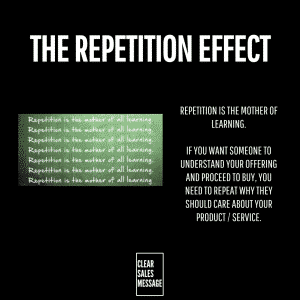
The Repetition Effect is quite simply repeating things so they’re noticed and understood. Say a point once, and it can vanish. Say it three times, and it starts to stick.
It sounds almost too obvious to be a technique. Most businesses still mention their best point exactly once, then wonder why nobody remembers it.
The fix isn’t a cleverer sentence. It’s the same good sentence, said more than once.
Why Does It Work
If you want someone to understand your offering and proceed to buy, you need to repeat why they should care about your product or service. As human beings, we’re simple souls.
Making a couple of good points and repeating them will help you break through our 8 second attention span. It also uses The Recency Effect, where we’re more likely to remember the last thing we hear or see.
So repetition does two jobs at once. It reinforces the point through sheer frequency, and it makes sure the point lands again right at the end, exactly where memory is strongest.
How Can You Use It
Recap your key points, don’t just state them once
Using a “recap” and bullet point lists to repeat the most important points about your products or services ensures the message actually gets through. A single mention buried in a paragraph rarely survives.
Build a tagline that repeats itself for free
Catchy taglines are a great way to use repetition. Each time your client recalls the tagline, they repeat, to themselves, why they should care about your offering.
Repeat the same points everywhere, not different ones each time
Repetition only works if it’s the same message across every touchpoint. Three different taglines in three different places just creates three weak points instead of one strong one.
When It Works Best
This works best when you genuinely have one or two strong points worth repeating. Repetition amplifies whatever you say, good or weak.
It also works best across multiple touchpoints, website, emails, calls, proposals, since each repetition reinforces the last rather than standing alone.
When It Becomes Dangerous
It backfires if you repeat something vague or weak. Repetition doesn’t fix a poor point, it just makes buyers notice it more.
It also becomes risky if the repetition feels robotic rather than natural. The same exact sentence in every single sales call starts to sound like a script, not a genuine belief.
Overdoing it causes its own damage too. Past a certain point, repetition stops reinforcing a message and starts to irritate the person hearing it.
Common Mistakes
Repeating too many different points at once
Ten repeated messages dilute each other. Pick your one or two strongest points, and repeat only those, everywhere.
Changing the wording every time
Rephrasing the same idea differently each time weakens the recall effect. Consistency in the exact words matters more than variety here.
Only repeating it in one place
A tagline that only appears on the homepage does far less than one echoed across the website, emails, and every proposal. Repetition needs reach, not just repetition.
The Repetition Effect – An Example
A CRM Software Company
In their sales pitch and marketing materials, they consistently repeat:
- “Saves you time”
- “Grows your revenue”
- “Simplifies your sales”
These three points are mentioned:
- On the website headline
- In the email signature
- During every demo walkthrough
- At the end of every proposal
- As part of the product tagline
“Saves you time. Grows your revenue. Simplifies your sales.”
Why it works: Repetition reinforces recall. The more a buyer hears the same value points, the more those benefits become associated with your product. It also projects clarity and confidence in your message.
See also