Practical Sales Training™ > How To Lose The Sale > The Cleverness Trap

The Cleverness Trap
Trying to sound clever is one of the fastest ways to lose a sale. When your buyer doesn’t understand your message, they don’t stop and ask what you mean. They move on, and you never know why.
This is The Cleverness Trap. It happens when the desire to sound smart, creative or different pushes out the one thing that actually sells: clarity.
The frustrating part is that most people who fall into it don’t realise they’ve done so. The message sounds great to them. But to the buyer, it says nothing at all.
What Is The Cleverness Trap?
The Cleverness Trap is what happens when you try to sound clever, use abstract slogans, reach for metaphors that don’t land or replace plain language with something more poetic. The result is a message that feels impressive to the person who wrote it but confuses the person who reads it.
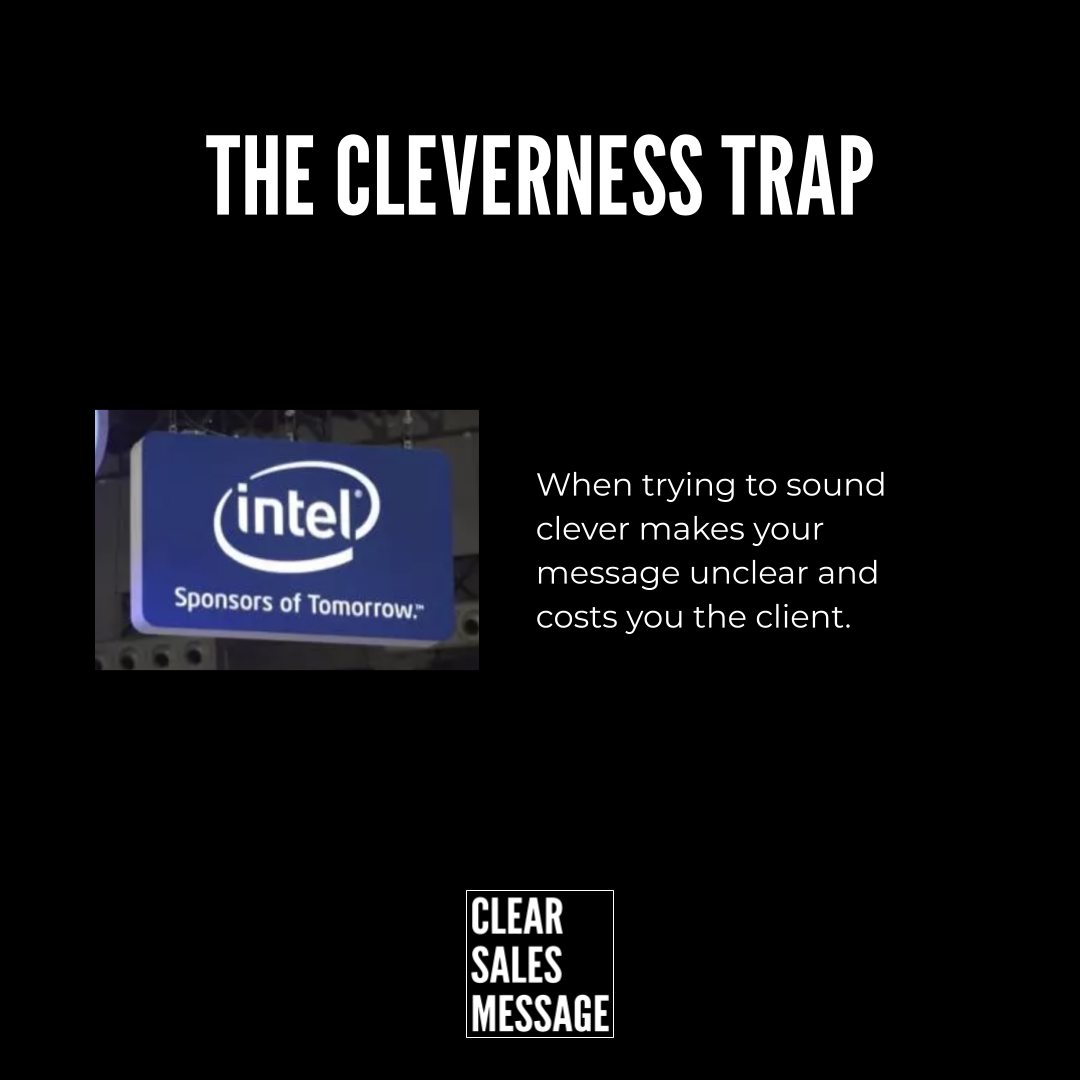
Examples of clever but unclear slogans include “Sponsors of Tomorrow,” “Empowering human potential,” “Unlocking tomorrow’s possibilities today” and “Innovating the future.” These all sound polished. But ask a buyer what any of them actually mean and you’ll get a blank stare. They sound good and say nothing.
The trap works both ways. It makes your message harder to understand and it makes you look less credible, because buyers assume that if you can’t explain what you do simply, what you do must be complicated.
Why Does The Cleverness Trap Lose Sales?
1. Clever language slows the brain down
Clear language is fast to process. Clever language requires decoding. When buyers have to work out what you mean, they lose interest before they reach your point. People don’t buy what they don’t understand instantly, so every extra second of confusion costs you trust.
2. Buyers blame you for the confusion
When your message is unclear, buyers don’t think “I must be missing something.” They think “this feels complicated,” “this won’t be easy to work with” and “if they can’t explain it simply, it must be messy inside.” Clarity signals competence. Confusion signals chaos. And once a buyer senses chaos, they start looking elsewhere.
3. Cleverness hides what makes you valuable
When you chase clever language, you push out the things that actually matter: the problem you solve, the person you help, the result you deliver and the reason you’re different. Buyers don’t care how smart your slogan sounds. They care whether you can help them. So if your message doesn’t answer that question clearly, it doesn’t matter how elegant it is.
4. Clever messaging feels ego-driven
Buyers can sense the difference between a message written for them and a message written to impress them. Clever language says “look at how smart we are.” Clear language says “here’s how we help you.” Only one of those converts. The other just admires itself.
How Can You Avoid The Cleverness Trap In Sales?
1. Replace clever with clear
Swap vague slogans for direct statements. “Helping you unlock tomorrow” becomes “We help your team sell more today.” “Powering possibilities” becomes “We reduce your cost of delivery by up to 40 percent.” “Reimagining the future of operations” becomes “We automate your manual processes so your team saves time.” In every case, the clear version is shorter, faster to read and far more likely to convert.
2. State exactly what you do in one sentence
A simple template cuts through almost any confusion: “We help [person] achieve [specific result] by [how you do it].” For example: “We help SaaS founders win investment by clarifying their sales message.” Or: “We help teams sell more by improving their communication.” This format leaves no room for interpretation, which is exactly what you want.
3. Put clarity above creativity
Creativity is welcome in your messaging, but only after clarity is in place. Before you publish anything, ask one question: will my buyer understand this instantly? If the answer is no, fix the clarity first and add the creative layer after. Creativity on top of confusion is still confusion.
4. Test it with someone who knows nothing
Show your message to someone outside your industry and give them two seconds to read it. If they can tell you what you do, it’s working. If they ask “what does that mean?” or give you a polite nod while looking confused, you’ve fallen into the Cleverness Trap and you need to rewrite before it costs you a sale.
5. Use cleverness as seasoning, not the main course
You don’t have to strip out all creativity. Clever headlines, humour, visual design and story hooks all have a place. But they work as extras on top of a clear core message, not as replacements for it. Get the plain, literal explanation right first. Then, if there’s room, add something memorable around it.
When The Cleverness Trap Strikes Hardest
The Cleverness Trap hits hardest at the moments that matter most: your website headline, your elevator pitch, your proposal summary and your email subject line. These are the places where a buyer decides in seconds whether to keep going. If your message is unclear at any of these points, the rest of your content never gets read.
It also strikes hardest with experienced sellers and marketers. The more time you spend inside your own industry, the more familiar your language feels to you. But buyers don’t live inside your world. So what sounds obvious to you can still read as jargon to them. The longer you’ve been in a sector, the more regularly you need to test your message on people who haven’t.
Common Cleverness Trap Mistakes
1. Mistaking complexity for credibility
Many people believe that sounding sophisticated makes them look more credible. However, the opposite is true in sales. Buyers associate simplicity with confidence and complexity with confusion. The cleaner your message, the more capable you appear.
2. Writing for peers instead of buyers
It’s easy to write messaging that impresses people in your own industry while saying nothing useful to the buyers you actually need to reach. Your peers already understand your language. Your buyers may not. So always write for the person making the buying decision, not for the people who already know what you mean.
3. Confusing brand voice with clarity
A distinctive brand voice is valuable. But brand voice and clarity are not in conflict. You can be witty, warm, bold or direct and still be completely clear about what you do. The trap is using voice as a reason to avoid saying something plain. Tone is how you say it. Clarity is what you say. Both matter and neither replaces the other.
The Cleverness Trap – An Example

Intel: “Sponsors of Tomorrow.”
At a major trade show, Intel displayed a large illuminated sign with just two words beneath their logo: “Sponsors of Tomorrow.” It looks premium. It sounds ambitious. But step back and ask what it actually tells a buyer about Intel, and the answer is: almost nothing.
What does Intel make? Processors. Who do they help? Device manufacturers, businesses, developers and consumers who need fast, reliable computing. What does “Sponsors of Tomorrow” communicate about any of that? It doesn’t. It sounds impressive in a boardroom presentation. However, to a buyer standing in front of that sign at a trade show, it raises more questions than it answers.
Intel can afford this kind of messaging because their brand recognition does the explaining for them. Most businesses can’t. If you’re not already a household name, a clever slogan without a clear message is just noise. The buyer walks past, none the wiser, and your chance to connect is gone.
See also