Practical Sales Training™ > How People Work > The Decoy Effect
The Decoy Effect
You put two options in front of a buyer. They pick the cheap one. Then you add a third option that hardly anyone wants. Suddenly the bigger option starts selling. Your main offer stayed exactly the same. Only the options around it moved.
What Is The Decoy Effect?
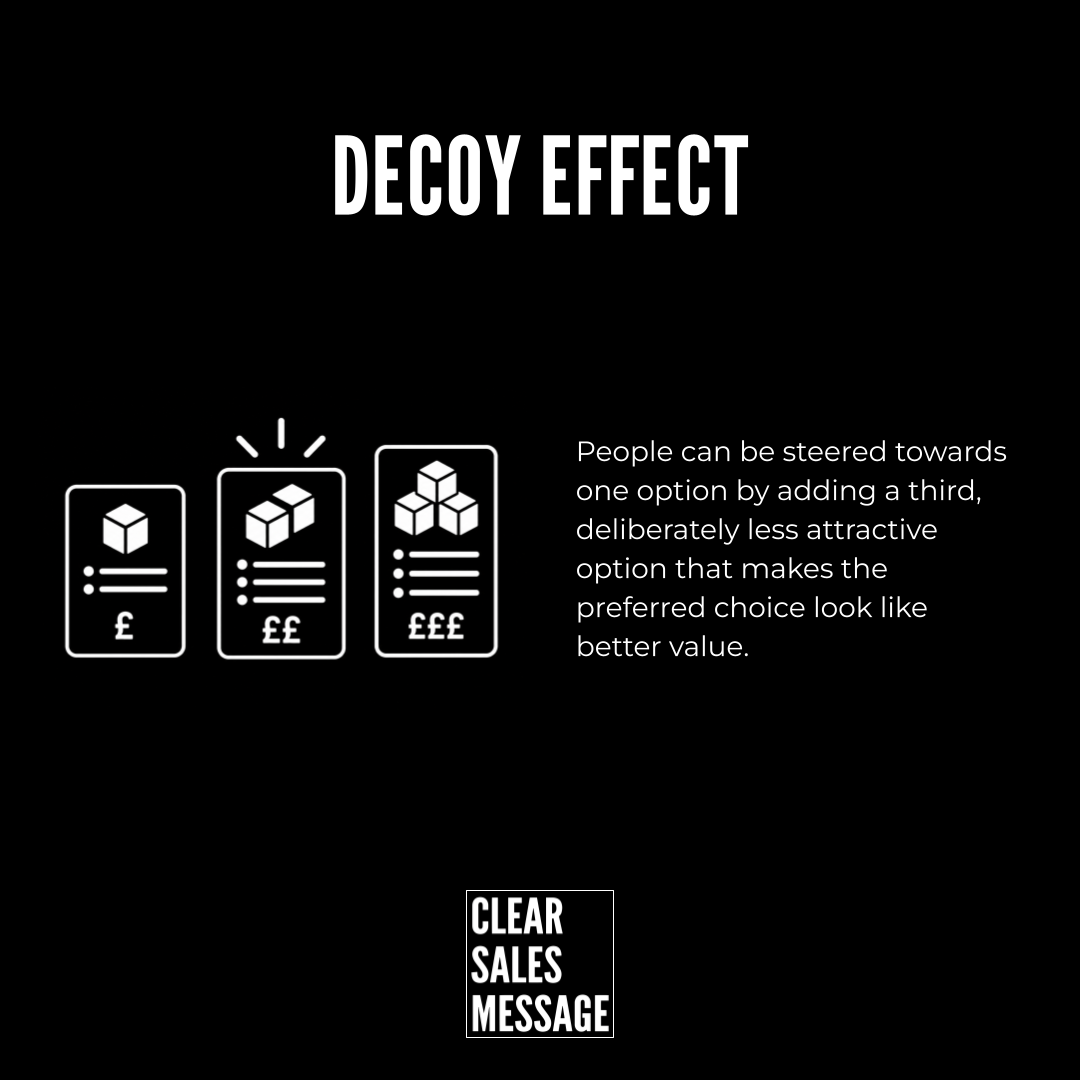
The decoy effect is when a third option shifts which of two choices people pick. That third option’s whole job is to lose. It sits close to the option you want to sell, but it’s clearly worse. So next to it, your target looks like a steal.
Buyers rarely judge a price on its own. Instead, they judge it against whatever sits next to it. And that’s good news for you. You get to choose what sits there.
Why Does The Decoy Effect Work?
Most people can’t judge value in a vacuum. Is £5,000 a lot for a project? It’s hard to say. But put it next to £4,800 for far less, and the answer feels obvious.
The decoy hands the brain an easy win. Comparing two options that look alike takes very little effort. So the buyer stops wrestling with the hard choice. Instead, they grab the one that clearly beats its neighbour.
It feels good too. Your buyer walks away sure they spotted a deal. As a result, they’re happier to commit, and they’re less likely to second guess it later.
How Can You Use The Decoy Effect?
Build Your Prices In Threes
Two options turn into a straight fight on price. Three options let you shape the choice. So place the option you most want to sell beside a weaker one at almost the same price. Then the cheap option struggles.
Make The Decoy Worse On One Clear Thing
Good decoys sit close in price but fall short on one key thing. Fewer users, no support, or a shorter term all work. Keep that gap sharp. If buyers have to study the gap, they start thinking hard. And hard thinking breaks the spell.
Use It In Proposals Too
Price pages get all the attention. However, proposals work the same way. Picture a short project with no follow up. Price it close to the full project with support. Suddenly the full one looks obvious. So you skip the haggling over scope.
Point At The Gap Out Loud
Some buyers will spot the deal alone. Many won’t, so say it for them. For example, “For £200 more, you get the support as well.” That one line does the maths for them. Then the choice feels easy.
When Does The Decoy Effect Work Best?
It works best when buyers can’t easily judge value alone. Services, new products and anything without a clear market price all fit. In those cases, people lean hard on whatever you put beside your offer.
It also works when buyers see every option at the same time. A price table or a proposal with three columns is ideal. And it works best of all when your target really is good value. Then the decoy simply makes the truth easier to see.
When Does The Decoy Effect Become Dangerous?
It turns sour when the decoy feels like a trick. Buyers who spot a fake option feel played. Then they start doubting every other number you’ve shown them.
It can also push people into spending more than they need. That might win the sale today. Yet if they never use the extra, you’ll face a tough renewal call. So only steer buyers towards an option that truly suits them.
Watch out for sharp buyers as well. Procurement teams compare prices for a living. If your middle option only looks good next to your own decoy, they’ll find that out fast.
Common Mistakes With The Decoy Effect
Making The Decoy Too Silly
A decoy has to look like a real choice. If it’s plainly absurd, buyers see straight through it. So make it believable, while still clearly worse than your target.
Pricing The Decoy Too Far Away
The decoy only works as a close neighbour. Price it miles away and buyers stop comparing the two. As a result, your target loses its easy win.
Adding Too Many Options
Three options steer people. Six options stall them. Each extra plan adds more thinking. So the buyer puts off the choice instead of making it.
Steering Buyers To The Wrong Option
A decoy pushes people towards whatever you design it to. So check what you’re pushing. If your target has thin margins or a poor fit, you’ve just built a machine for selling the wrong thing.
The Decoy Effect – An Example
The Economist Subscription
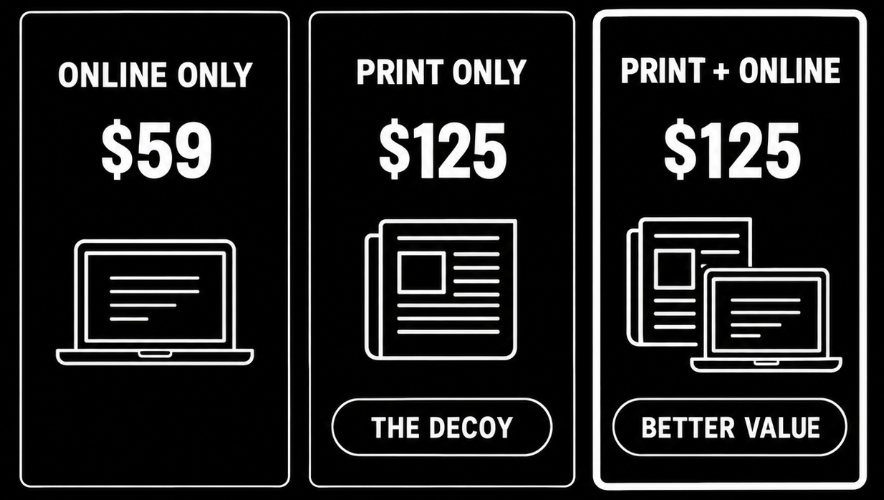
The Economist’s subscription offer, famously discussed by Dan Ariely:
| Option | Price |
|---|---|
| Online only | $59 |
| Print only | $125 |
| Print + online | $125 |
The print-only option is the decoy. It makes print + online look like an obvious bargain because you get more for exactly the same price.
Hardly anyone wants print alone. That’s the whole point. It’s there to make the bundle look like a gift. And when Ariely tested the offer without the decoy, far more people chose the cheap online option instead.
So one option that almost nobody picked changed what everybody else picked. Your price table can do the same. Just make sure the option it points to is one your buyer will thank you for.
See Also