
Practical Sales Training™ > Wordplay > Anaphora

Anaphora
Some messages land once and disappear. Others echo. The difference is often structure – and anaphora is one of the most powerful structures you can use.
By starting each sentence the same way, you build a rhythm the listener feels before they even process the words. That rhythm makes the message easier to follow, harder to ignore, and much easier to remember.
You hear it in great speeches. Strong ads use it too. And because it works so well out loud, it is one of the most useful tools a salesperson can have.
What Is Anaphora?
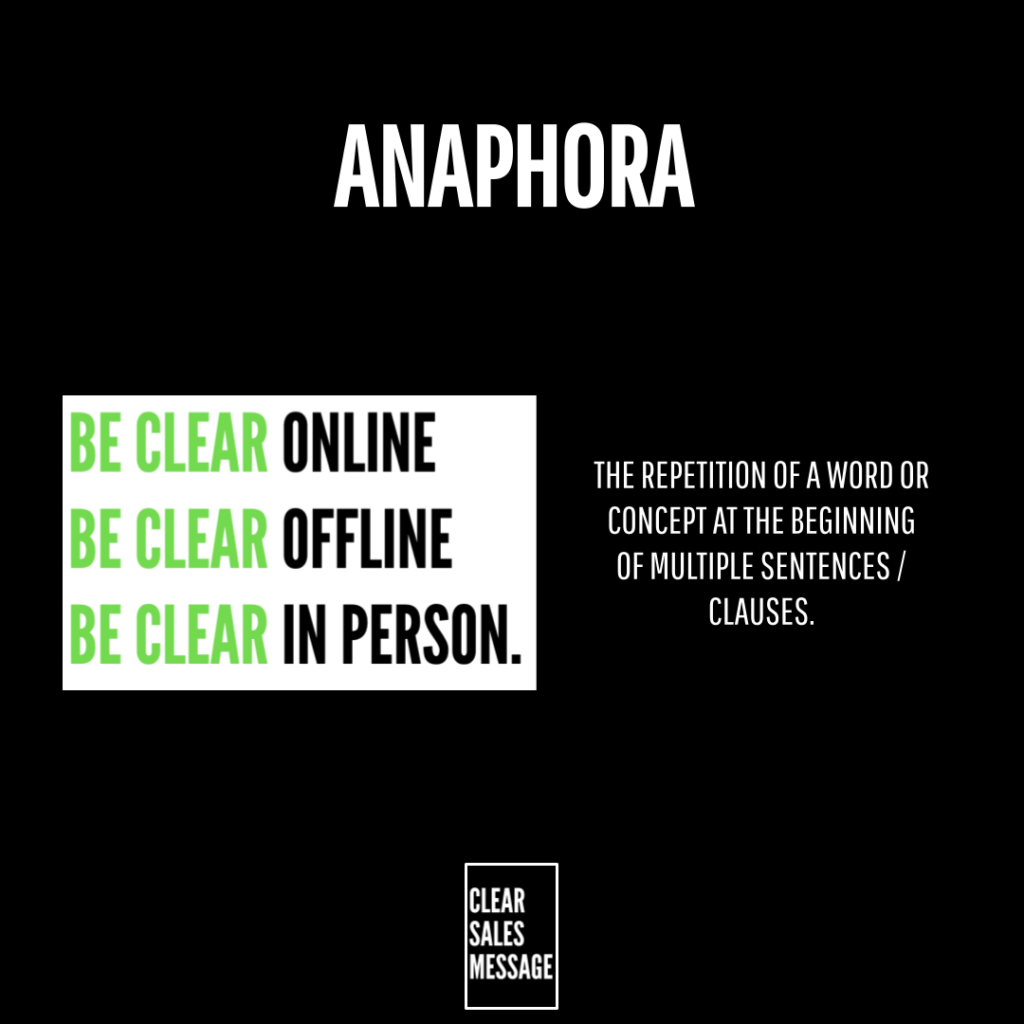
Anaphora is a writing and speaking technique where a series of sentences or phrases all start with the same word or words. The repetition creates rhythm, builds emphasis, and drives a single idea home through structure rather than explanation.
The word comes from ancient Greek rhetoric, but you do not need to know the history for it to work. What matters is the effect. Each repeated opening acts like a drumbeat – it sets the pace and keeps pulling the listener forward.
Famous examples include Martin Luther King’s “I have a dream” speech and Winston Churchill’s “We shall fight” address. Both work because the repeated opening does not just introduce a point – it hammers it in.
Why Does Anaphora Work?
Anaphora works because repetition is one of the most reliable tools in communication. When we hear the same phrase more than once, the brain starts to treat it as important. So the listener leans in rather than tuning out.
It also creates momentum. Each repeated opening carries the energy of the one before it. As a result, by the time you reach the final line, the audience feels the weight of everything that came before – and the ending lands harder because the build was deliberate.
Repeated structure also makes a message easier to recall. Our brains hold patterns better than random sequences. So a message with a clear repeating shape sticks in the memory in a way that a list of bullet points never does.
Finally, anaphora signals confidence. A speaker who repeats a phrase without apology sounds certain. That certainty transfers to the audience – and in sales, confidence in your message is one of the fastest ways to build confidence in your offer.
How Can You Use Anaphora In Sales?
Use it to open or close a pitch
The start and end of a pitch are the moments people remember most. So anaphora works particularly well in those positions. Opening with three anaphoric sentences sets a strong tone and grabs attention fast. Closing with the same structure leaves a clear, memorable final impression.
Apply it to your key benefit
If you have one core message you want buyers to walk away with, anaphora can drive it home. For example: “We save you time. We save you money. We save you the stress of doing it yourself.” Three sentences, one point, much harder to forget than a single statement.
Use it in social media and ad copy
Short-form content rewards rhythm. A post or ad that opens three lines the same way stops the scroll far more effectively than a block of plain prose. Because the eye picks up the pattern immediately, anaphora works especially well in formats where you have very little time to make an impression.
Build it around the buyer’s pain or goal
The repeated phrase lands hardest when it connects to something the buyer already feels. “You deserve better results. You deserve a supplier who shows up. You deserve a process that actually works.” Each line repeats the same opening but builds on a real frustration. As a result, the buyer feels heard rather than sold to.
When Anaphora Works Best
Anaphora works best when you need to make one point land with force. Spoken delivery suits it particularly well – presentations, pitches, video scripts, and keynote speeches all benefit from the rhythm it creates. When you say it out loud, the pattern becomes even more powerful than it looks on the page.
It also works well at emotional peaks in your communication. If you want a buyer to feel urgency, confidence, or trust, anaphora gives that moment structure and weight. The repetition amplifies the emotion rather than diluting it.
Content you want people to share or quote also benefits from this technique. A three-part anaphoric phrase is far more likely to appear in someone’s notes, social posts, or follow-up email than a paragraph of plain explanation.
When Anaphora Becomes Dangerous
Overuse kills the effect fast. If every paragraph starts the same way, the technique stops feeling deliberate and starts feeling lazy. So use it sparingly – two or three times in a piece of communication at most – and let it stand out by contrast with the plainer text around it.
It can also feel hollow if the repeated phrase does not connect to something real. Empty anaphora – repeating words that sound good but say nothing – reads as filler. The repeated phrase needs to carry genuine meaning, or the structure draws attention to the weakness rather than hiding it.
Finally, it does not suit every tone. In a calm, consultative conversation, a sudden burst of rhythmic repetition can feel out of place or overly theatrical. However, in a pitch, a presentation, or written content, it almost always helps.
Common Anaphora Mistakes
Using too many repetitions
Three is usually the sweet spot. Two repetitions feel like coincidence. Going beyond four starts to feel excessive. So aim for three lines, keep each one short, and stop before the pattern outstays its welcome.
Repeating a weak phrase
The power of anaphora depends entirely on what you repeat. A flat or vague opener produces a flat result no matter how many times you use it. So choose a phrase that already carries weight – one that connects directly to what the buyer wants or fears.
Not reading it aloud first
Anaphora is a spoken tool as much as a written one. A phrase that looks good on screen can trip over itself when said out loud. Always test it spoken before you use it in a pitch or record it for video – and if it does not flow naturally, rewrite it until it does.
Burying it in the middle
Anaphora needs space to breathe. When you bury it inside a long paragraph, the rhythm collapses and the effect disappears. Instead, give it its own block – three short lines, each starting the same way, with nothing around them to compete. That separation is what lets the pattern land.
Anaphora – An Example
A motivational speaker closes their talk with three lines:
“We will rise when we work together.
We will rise when we refuse to quit.”
And to close:
“We will rise when we believe in ourselves.”
The repeated “We will rise” builds rhythm across all three sentences. Each line adds a new condition, but the emotional weight carries forward from the first. By the third line, the audience feels the cumulative force of everything said before it.
In a sales context, the same structure works just as well. Consider: “We cut your admin time. We cut your costs.” And the closer that seals it: “We cut the chaos your team deals with every week.” One point, three angles, much harder to argue with than a single claim. And because the structure repeats, the buyer remembers it long after the meeting ends.
See Also