Practical Sales Training™ > How To Lose The Sale > Aspirational Names

Aspirational Names
People don’t just buy products. They buy identity. They want to feel like they’re part of something that reflects well on them. And names shape that feeling more than most businesses realise.
A name that signals progress, status, or purpose makes buyers lean in. A name that feels flat, generic, or slightly embarrassing makes them step back. The product can be identical. But the name changes what it feels like to say yes to it.
This is why aspirational names matter. Not as a cosmetic detail. But as a conversion tool.
What Are Aspirational Names?
Aspirational names are names that people feel proud to say, proud to join, and proud to be associated with. They signal progress, status, or purpose. So instead of describing what something is, they point toward what someone becomes by being part of it.
The opposite is a name that makes people feel average or less than. “Basic,” “Standard,” and “Entry Level” all do this. They describe a tier accurately but they also quietly signal that the buyer couldn’t or didn’t choose anything better. As a result, buyers resist them, even when the product is a perfect fit for their needs.
Aspirational names solve this. They give people a version of the same choice that feels worth saying out loud. And a name that feels worth saying gets adopted, repeated, and recommended far more readily than one that doesn’t.
Why Do Aspirational Names Work?
They work because identity drives behaviour. People make decisions that are consistent with how they see themselves and how they want others to see them. A name that aligns with a positive self-image gets chosen. A name that conflicts with it gets avoided, often without conscious reasoning.
There are four specific reasons aspirational names perform well. First, they point to an outcome people want. “Scale Plan” is more compelling than “Large Plan” because it names a destination, not a size. Second, they carry status without sounding smug. A well-chosen name signals quality without alienating buyers who feel it’s out of reach. Third, they’re simple and easy to remember. Aspirational names tend to be short, clear, and easy to repeat in conversation. Fourth, they make association feel good. When customers and teams feel proud of the name, they use it more. And the more it gets used, the more it spreads.
In sales, identity beats features. So when you name things well, adoption gets easier before the pitch has even started.
How Can You Use Aspirational Names In Sales?
You can apply this thinking across your offers, your tiers, your communities, and your internal projects. Here’s how.
Name Your Offers for the Destination
Instead of naming a plan after its size or price point, name it after what the buyer achieves. Launch Plan. Momentum Plan. Scale Plan. Each one points forward. As a result, choosing the plan feels like a step toward something rather than a description of where you currently are. That’s a small but powerful shift in how buyers feel about the decision.
Name Your Tiers for Progress
Replace “Basic,” “Standard,” and “Premium” with names that signal a journey. Explorer, Builder, Leader. Each one describes a stage of growth rather than a level of spend. So a buyer on the entry tier doesn’t feel like they’re on the budget option. They feel like they’re at the start of something. That’s a very different starting point for the relationship.
Name Your Communities
If you run a community, a membership, or a group of any kind, the name is the first thing people say when they talk about it. Make it something they want to say. “The Closer Collective” or “The Conversion Club” carry identity. “The Basic Member Group” doesn’t. Because community names travel by word of mouth, an aspirational name is free marketing every time someone mentions it.
Name Internal Projects With Pride
The names you use internally shape how your team feels about the work. If the project would look embarrassing on a hoodie, it probably needs a better name. A team that believes in the name of what they’re building brings more energy to it. Similarly, when internal names are aspirational, they’re easier to sell to stakeholders and easier to rally people around.
Test Names Aloud
Say “I am part of ___” and “We are moving to ___” out loud. If either sentence feels flat, deflating, or slightly embarrassing, the name needs work. However, if both sentences feel good to say, you’ve probably found something worth keeping. Because a name that sounds right when spoken is a name that people will actually use in conversation.
When Aspirational Names Work Best
They work best when identity and social signalling are part of the buying decision. In B2C, buyers often want names they can mention to friends without feeling embarrassed. In B2B, buyers want names that sound credible when they present the decision to their team or board. So the stronger the social dimension of the purchase, the more important the name becomes.
They also work well for membership, community, or subscription products. These are products people associate with themselves over time. A weak name erodes that association gradually. A strong name reinforces it. As a result, retention is higher when people feel proud to describe what they’re part of.
Similarly, they work well when you’re competing in a crowded market. When the product difference between competitors is small, the name can tip the decision. Because buyers choose what they want to be seen choosing, a name that sounds better than the alternative carries real commercial weight.
When Aspirational Names Become Dangerous
They become a problem when the name sets expectations the product can’t meet. If a plan called “Scale” doesn’t actually help buyers scale, the name creates a credibility gap. Buyers feel misled. And a name that overpromises and underdelivers damages trust faster than a plain, honest name would have done.
They can also backfire when they’re so abstract that nobody understands what they refer to. “Apex,” “Summit,” and “Horizon” sound aspirational in isolation. But if a buyer can’t tell from the name what they’re buying, the aspiration is undermined by confusion. So the name needs to be both inspiring and clear. Not one or the other.
And they cause problems when every tier sounds premium. If your entry plan is “Pioneer” and your top plan is “Visionary,” buyers can’t tell which is which. The aspiration becomes noise. So use it with calibration. The names should feel progressively more elevated, not uniformly grand.
Common Aspirational Name Mistakes
Using Names That Make the Bottom Tier Feel Bad
If the entry option is called “Basic” or “Starter,” buyers on that tier feel labelled. Many will upgrade not because they need more features but because they don’t want to be on the “basic” plan. That’s not a good reason to upgrade, and it often leads to buyers choosing a tier that doesn’t suit their needs. So name the entry tier in a way that feels good to be on, not something to escape from.
Choosing Aspiration Over Clarity
A name that inspires but doesn’t communicate loses its value fast. Buyers need to understand roughly what they’re buying from the name alone. So test the name with someone who doesn’t know your product. Ask them what they think it means. Because if they can’t make a reasonable guess, the name is probably too abstract to be useful.
Naming Things You Wouldn’t Say Out Loud
If you wouldn’t say the name confidently in a room full of customers or colleagues, that’s a sign. Names should feel natural to speak. So run every name through the spoken test before you commit. A name that reads well on a pricing page but sounds awkward in a sentence will cause friction every time someone has to use it.
Leaving Naming as an Afterthought
Most businesses name things quickly and move on. But a name travels with a product for years. It shapes perception, drives adoption, and affects how buyers talk about what they’ve bought. So invest a little time in it before launch. Because a good name costs nothing extra to create and pays back every time someone says it with pride.
Aspirational Names – An Example
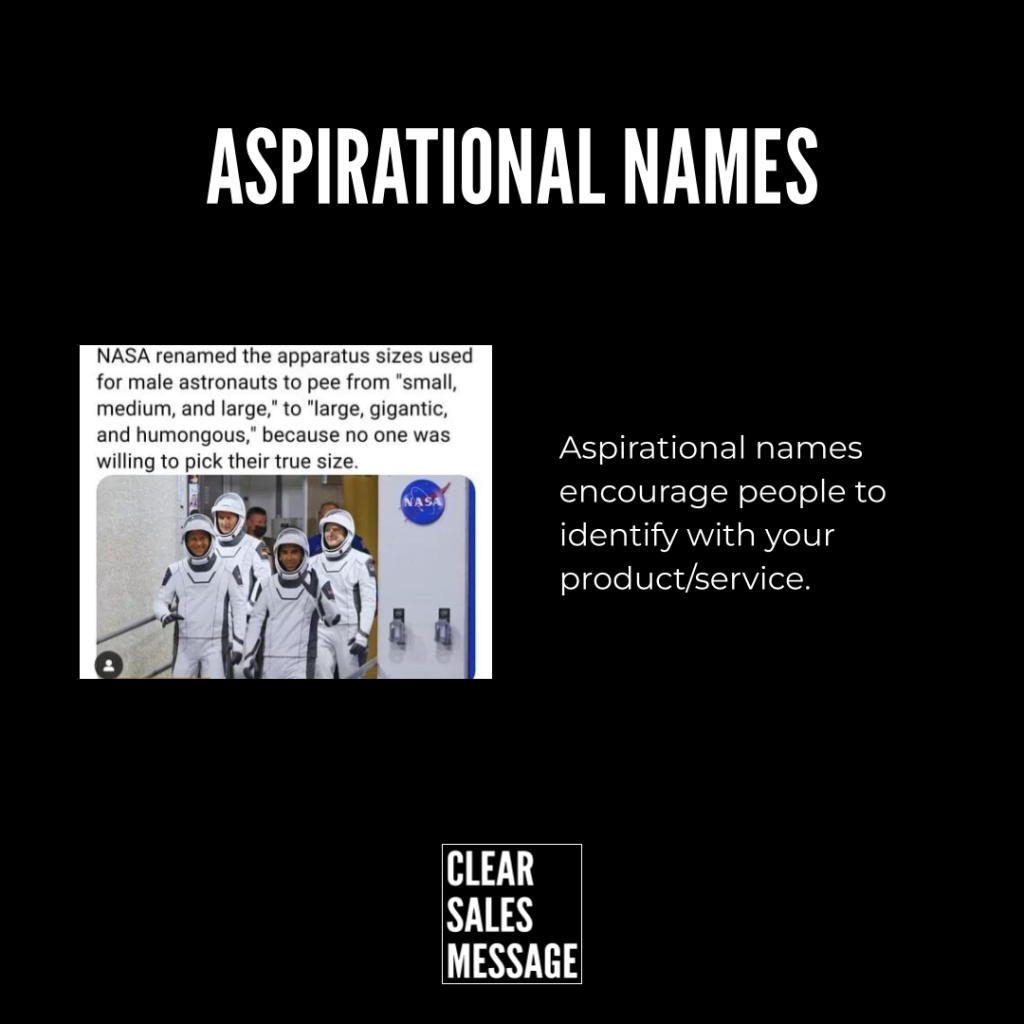
Apollo-era astronauts used a urine collection device that came in small, medium, and large. Nobody wanted to select “small.” So informally, the sizes became known by more heroic names: extra large, immense, and unbelievable. The story, attributed to astronaut Michael Collins, illustrates the point perfectly. People will go to lengths to avoid a name that deflates them. And they’ll gravitate toward names that don’t.

The meme version of this story claims NASA officially renamed the sizes to “large, gigantic, and humongous.” Fact-checkers classify that as exaggerated. But the underlying truth is real. Names shape behaviour. When a name feels diminishing, people avoid it. When it feels elevating, they choose it. That’s the commercial logic behind aspirational naming.
See also