
Practical Sales Training™ > Wordplay > Homophone

Homophone
What Is It
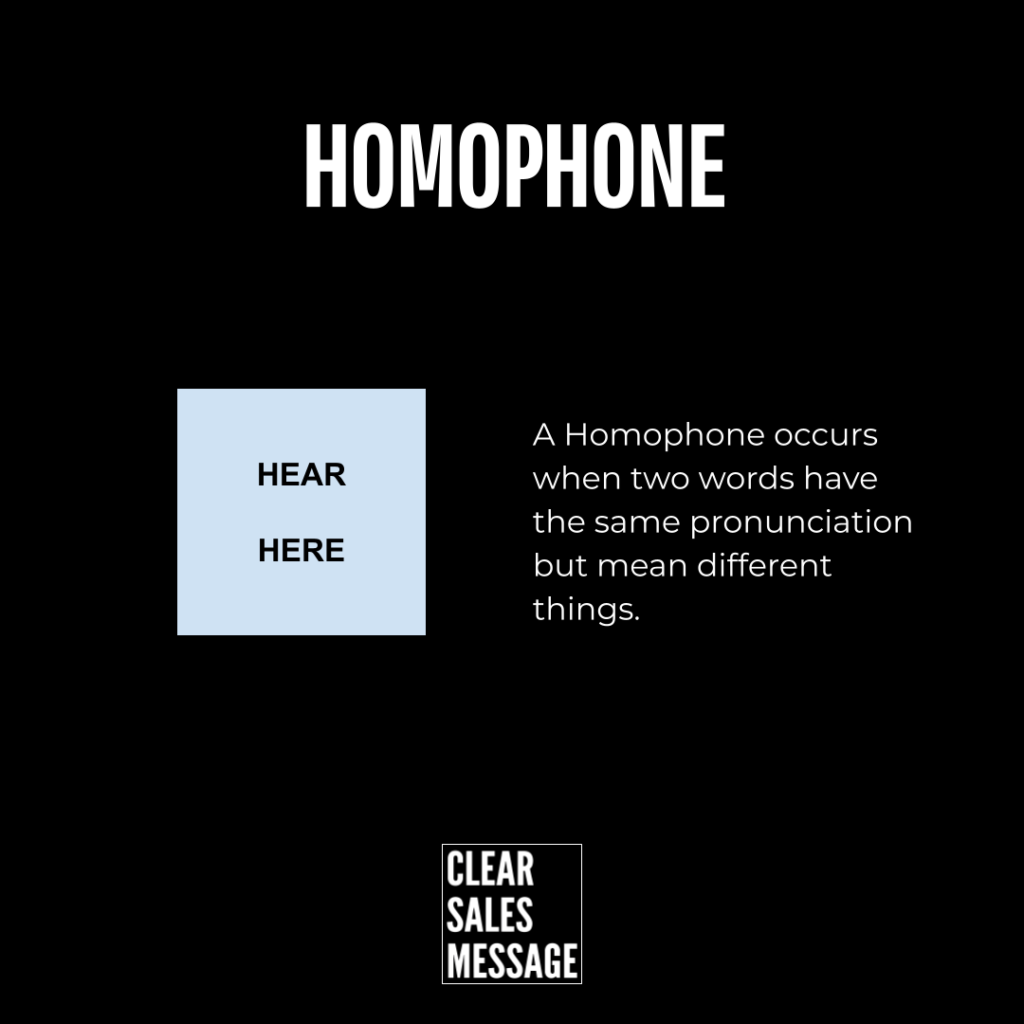
A homophone occurs when two different words sound exactly the same. Their meanings are completely different, and they’re often spelled differently too. English is full of them, and once you start noticing a few, you spot them everywhere in ordinary speech.
Why Does It Work
It works because it makes the reader or listener think. They hear two words that sound the same, but the meaning has to be worked out. That small pause is what stops someone skimming straight past your message. A sentence that could mean two things forces a tiny moment of attention, and attention is the whole point of good wordplay.
How Can You Use It
It can be used to create playful puns and phrases designed to make people think. A homophone leans on sound rather than spelling, so it works especially well in spoken content, taglines, and headlines. Anywhere the words get heard or read quickly.
Homophone – Examples
Here are some homophones with varying levels of cheesiness. A food brand might promise their steaks are a rare treat, well done every time. A real estate company could help you find your home sweet home, not roam alone.
A fitness brand might promise to help you weigh less while valuing your way of life. A finance company could offer to help you make sense of your cents. Travel brands often lean on sea the world with us, your adventure awaits. A fashion label might promise sole mates for your feet, shoes you’ll love.
Tech companies sometimes invite you to byte into the future with smarter solutions. Education providers might promise that right from the start, they’ll help you write your success story. An automotive brand could say they’re driven to meet your needs, wherever the road leads. A beauty brand might tell you to nail your look and feel a cut above.
When It Works Best
This works best in short, punchy lines, taglines, headlines, and single sentences. It doesn’t suit long stretches of text, since the trick wears thin fast. It also works best when both meanings are genuinely relevant to what you’re selling, not a clever pun bolted onto an unrelated point.
When It Becomes Dangerous
It backfires if the pun feels forced, or if nobody gets it without an explanation. A homophone that needs decoding out loud has already lost the moment it was meant to create. It also becomes risky if you use too many at once. A page stuffed with wordplay starts to feel like a comedy routine, not a sales message.
Overusing the technique across every single line dilutes its impact too. Save it for the one line you most want remembered, rather than scattering it throughout the whole piece.
Common Mistakes
Forcing a pun that doesn’t genuinely connect
Forcing a pun where the two meanings don’t genuinely connect is a common mistake. It reads as clever for its own sake, rather than clever in service of the message.
Explaining the joke afterward
Explaining the joke afterward is another one, since a homophone that needs unpacking has already failed. It needed to land in the moment, without help.
Stacking too many homophones at once
Using several homophones in the same short piece can overwhelm the reader. It turns a sharp line into a cluttered one.
See also