Practical Sales Training™ > Wordplay > Spoonerism
Spoonerism
What Is It
You meant to say pouring with rain. It came out roaring with pain instead. Nobody’s sure why, but somehow the mixed-up version is funnier.
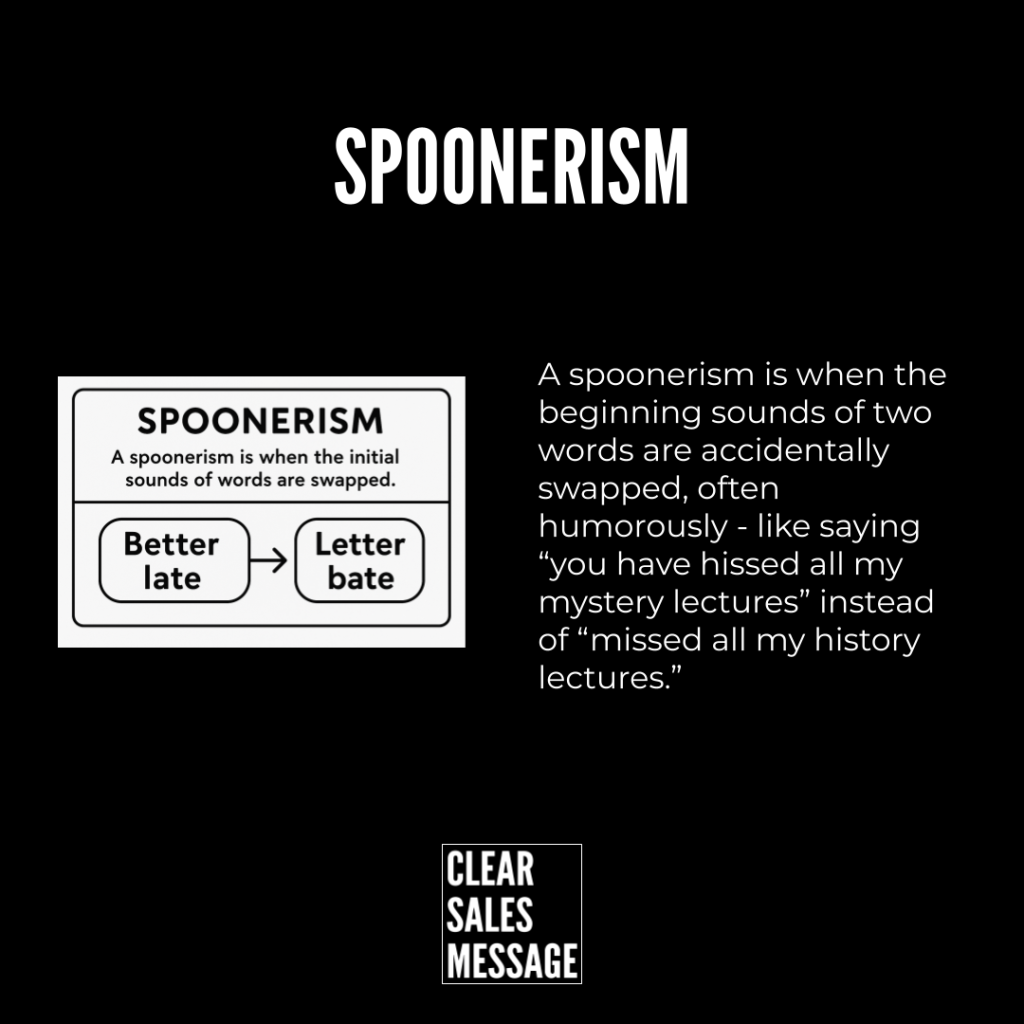
That’s a Spoonerism. It’s when the first sounds of two words swap places by accident, usually with a funny result. Named after Reverend William Spooner. Nobody’s sure if he actually said the classic lines, but his name stuck anyway. You have hissed all my mystery lectures, instead of missed all my history lectures. A lack of pies, instead of a pack of lies. It usually happens in fast or nervous speech. Sometimes it’s deliberate.
Why Does It Work
It works because it takes something familiar and twists it in a way that catches the ear. The listener expects one thing.
They’re playful, since swapping sounds makes ordinary language feel more fun. So they’re surprising too, and that mental glitch is exactly what makes people remember it. Even by accident, it adds personality. Used on purpose, it becomes a genuine tool.
How Can You Use It
In Comedy Or Conversation
So use spoonerisms in comedy or conversation. Is it customary to cuss the bride. The Lord is a shoving leopard. You’re occupewing my pie. Lines like these suit characters, dialogue, or a speech that could use a bit of levity.
In Branding Or Content
Use one in branding or content too. Snack to the futcher for a retro campaign. Get bussed and flrilliant for a playful launch. So the swap is unexpected enough to actually grab attention.
In Language Learning Or Wordplay
They’re also useful in language learning, since a spoonerism shows how tiny sound changes shift meaning entirely. It teaches phonetics playfully.
When It Works Best
This works best in casual, spoken contexts, where a slip feels natural rather than forced. A live audience feels the timing.
It also works well when everyone already knows the phrase you’re twisting. So the joke depends on people recognising what the swap replaced.
When It Becomes Dangerous
This becomes confusing if the audience doesn’t know the original phrase at all. So an unfamiliar spoonerism just reads as a typo, not a joke.
It also falls flat if you force the swap onto words that don’t naturally suit it. It draws attention to the effort.
Common Mistakes
Overusing The Device
Some writers overuse the device until every line feels gimmicky rather than clever. So one well timed swap beats five competing for the same laugh.
Picking A Swap Too Obscure
Others pick a swap so obscure that only the writer finds it funny. So test it on someone else before you commit to it in print.
Using It In The Wrong Context
Some writers use a spoonerism in a serious context where it undercuts the tone entirely. Match the device to the moment.
Spoonerism – An Example
Hissed All My Mystery Lectures
Reverend William Spooner supposedly told a student, you have hissed all my mystery lectures. He meant missed all my history lectures. So the swap is so clean it barely registers as wrong at first. That confusion is exactly what makes it funny, and exactly why his name became the word for the whole pattern.
See also: