
Practical Sales Training™ > How To Get Attention > The Big Number Effect

The Big Number Effect
Numbers tell a story. But the same fact can produce a very different reaction depending on how you frame it. The Big Number Effect is about choosing the unit of measurement that makes your number land as hard as possible.
This is not about misleading anyone. It is about presenting a true figure in the way that creates the most impact. Because if two numbers describe the same thing and one is far more impressive, there is no good reason to use the smaller one.
So before you quote a number in your pitch, your proposal, or your marketing, ask yourself: is this the biggest honest version of this figure?
What Is The Big Number Effect?
The Big Number Effect is the practice of reframing a number so it carries more weight — without changing what it actually describes. You keep the fact true, but you choose the unit of measurement that produces the largest, most meaningful figure.
For example, you could describe the same result in units, in years, in total revenue, or in hours saved. Each version is accurate. But some versions hit much harder than others.
The goal is to find the framing that your buyer feels, not just understands. Because a number that lands emotionally is far more persuasive than one that simply passes through.
Why Does The Big Number Effect Work?
Bigger numbers create more impact. That is not just instinct — it is how buyers process information. A large figure demands attention in a way that a small one does not.
It also works because of scale. When a buyer hears a big number, they make an instant judgement about your size, your experience, and your track record. A large number signals that a lot has happened — and that matters when a buyer is deciding who to trust.
However, the number must be meaningful. If your buyer cannot relate to the unit, the size of the number does not help. In fact, a confusing big number is worse than a clear small one — because it makes the buyer feel lost rather than impressed. So always pair a big number with a unit your buyer already understands.
How Can You Use The Big Number Effect In Sales?
Reframe your experience in total value
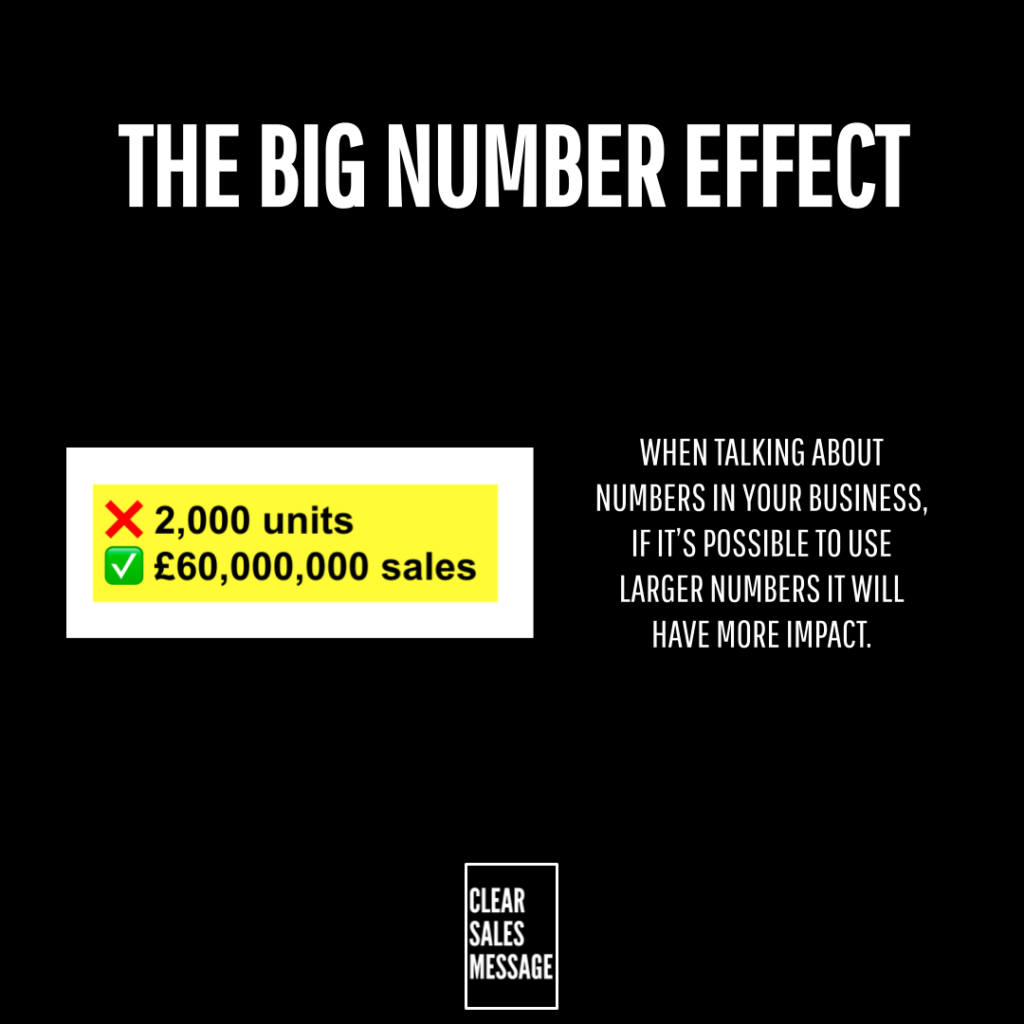
Instead of saying you have sold 2,000 units a year for 12 years, say you have managed £600M in sales. Both are true. But one is a much bigger number — and also more relatable to a buyer thinking in commercial terms. As a result, it creates a stronger impression of scale and credibility.
Express time in the smallest unit that still sounds big
If you have been in business for three years, that is also over 1,000 days of experience. If you have helped clients for a decade, that is more than 500 weeks of work. Choose the unit that produces the biggest honest number your buyer can easily picture.
Use total volume rather than averages
Averages shrink numbers. Totals grow them. So instead of “we help around 50 clients a year”, consider “we have worked with over 400 businesses.” The average sounds modest. The total sounds substantial. Both can be accurate at the same time.
Convert to a unit your buyer cares about
If the technical unit of measurement is unfamiliar, use equivalence to translate it. “1 million kW/h” means nothing to most buyers. But “enough power for 9,354 TVs” lands instantly. Because the buyer can picture the second version and not the first.
Apply it to savings and results too
The Big Number Effect is not just for your credentials. Use it on the outcomes you deliver. Instead of “saves you about an hour a week”, try “saves you over two full working days a year.” Same result. Much bigger number. And therefore a much stronger reason to buy.
When The Big Number Effect Works Best
It works best early in a conversation, when you need to establish credibility fast. A big, clear number cuts through in a way that a vague claim never will. So use it in your opening lines, your proposals, and anywhere a buyer is forming their first impression of you.
It also works well in written content — websites, brochures, email signatures, and LinkedIn profiles. Because in those formats, the buyer has no chance to ask a follow-up question. The number has to do the work on its own.
When The Big Number Effect Becomes Dangerous
It becomes a problem when the number is technically true but practically misleading. Choosing a unit specifically to confuse or exaggerate crosses a line — and buyers who later work out what the number actually meant will not forget it.
It also fails when the number is big but irrelevant. A huge figure in a unit your buyer does not care about does nothing. Worse, it can make you sound like you are trying too hard. So always ask: does this number mean something to this specific buyer, in this specific context?
Common Big Number Effect Mistakes
Using a unit the buyer does not understand
A big number in a confusing unit does not impress — it alienates. Always choose a unit your buyer already knows. If they have to stop and think about what the number means, the moment is lost.
Forgetting to check the alternatives
Most sellers just use the number they thought of first. However, a few minutes of reframing can turn a weak figure into a powerful one. Before any pitch or proposal, run through the alternatives and pick the biggest meaningful version.
Going so big it loses credibility
There is a point where a number sounds inflated rather than impressive. If your buyer’s instinct is to doubt the figure, it hurts you rather than helps you. So keep the number honest and be ready to explain exactly how you arrived at it.
Using it once and forgetting about it
Your numbers change over time. A total that was impressive two years ago may be far more impressive today — but only if you update it. Because a stale number suggests you stopped keeping track, which is not a confidence-builder.
The Big Number Effect – An Example
James describes his own sales experience as £600M rather than 2,000 units a year for 12 years. Both figures describe the same career. But £600M is a much larger number — and also more relatable, because buyers think in revenue terms.
The smaller version sounds like a steady job. The bigger version sounds like a serious commercial track record. So that is the one worth using.

See Also
- Descending Number List
- Ascending Number List
- Small Number Effect
- 100+ ways to seize buyer attention
- 100+ ways to be more memorable