Practical Sales Training™ > Wordplay > The Contrast Effect

The Contrast Effect
Most sales messages say too much. They list features, stack benefits, and hope something lands. But buyers do not have time for that.
The Contrast Effect is different. It uses just two words or phrases, placed next to each other, to show buyers exactly what you offer and why it matters.
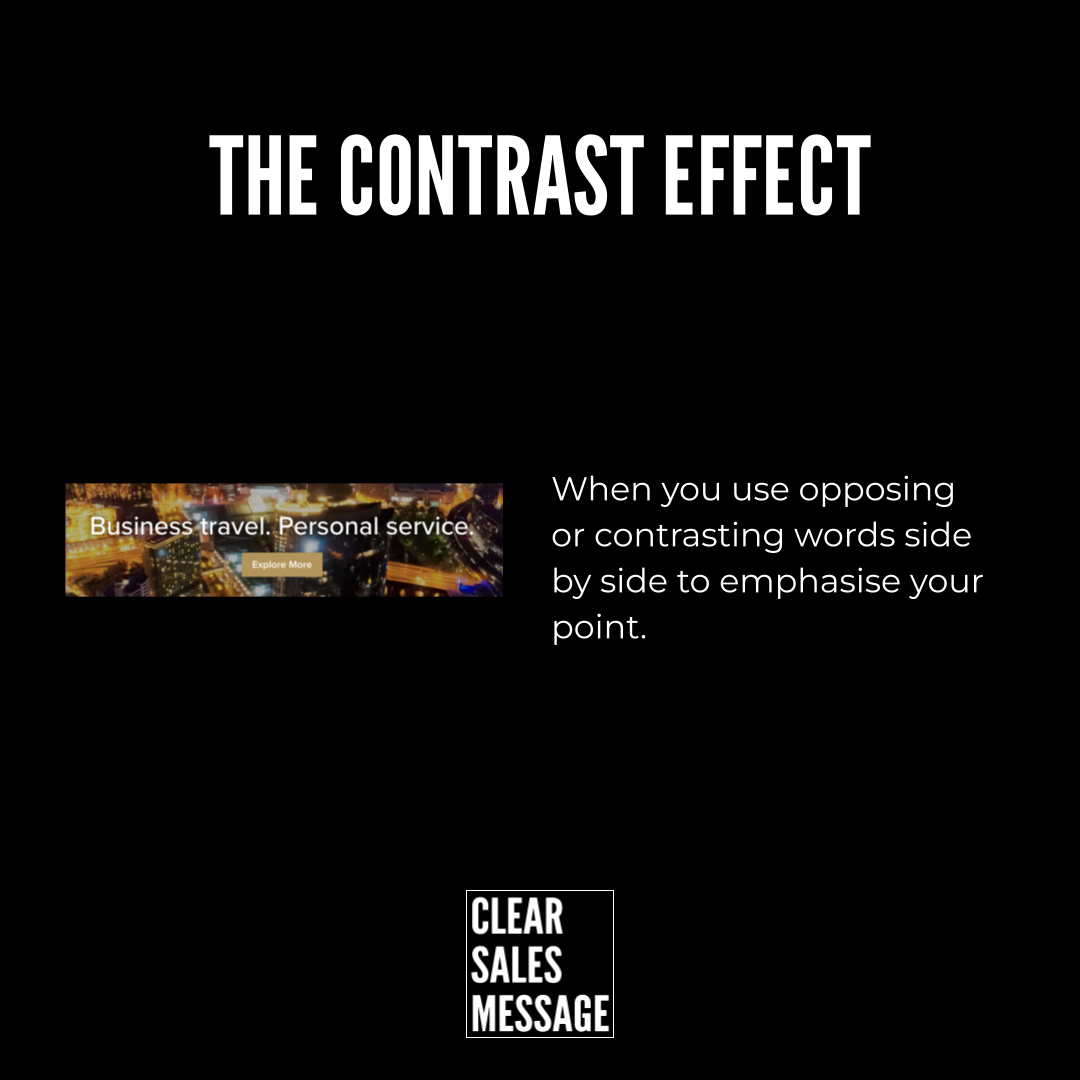
Used well, it cuts through noise fast. Business travel. Personal service. That is four words and a complete message.
What Is the Contrast Effect?
The Contrast Effect is a wordplay technique that puts two different or opposite ideas next to each other so your main point stands out. It works because our brains notice differences more than they notice more of the same.
You are essentially saying one of three things. “We are this, but not that.” Or “you get the benefit without the usual pain.” Or “you can have both things that normally do not come together.”
Each version creates a small tension in the reader’s mind. That tension makes them pay attention, because the brain wants to resolve it.
Why Does the Contrast Effect Work?
Opposites are interesting. When you put two contrasting ideas side by side, the reader’s brain lights up because it has to process the difference. That moment of processing is also a moment of engagement.
It also creates clarity fast. Instead of explaining at length what makes you different, a contrast pair shows it in a breath. Buyers understand the point without having to work for it.
There is a positioning benefit too. You can contrast your way of working against the old or painful way, without naming a competitor. As a result, you look like the obvious upgrade without saying a word against anyone.
How Can You Use the Contrast Effect In Sales?
Headlines and taglines
A contrast pair makes a strong headline because it is short, punchy, and easy to remember. For example: “Clear pricing. No surprises.” says everything a buyer needs to know in four words.
Opening a pitch or proposal
Start with a contrast pair to frame your offer before you go into detail. It gives buyers a hook to hang the rest of your message on. So when you explain the specifics, they already know where you are going.
Social media and adverts
Short contrast pairs work well in paid ads and social posts because they stop the scroll. “Fewer clicks. More sales.” takes less than a second to read, but it lands a real point.
Positioning against the competition
You can use contrast to highlight what the market usually gets wrong. “Big agency results. Boutique agency attention.” tells buyers you offer both, without attacking anyone directly.
Simple Contrast Effect Examples
Here are some contrast pairs you can use or adapt:
- Business travel. Personal service.
- High tech. Human support.
- Global reach. Local care.
- Big savings. Zero hassle.
- Fast setup. Lasting results.
- Fewer clicks. More sales.
- Clear pricing. No surprises.
- Smart automation. Human control.
You can apply the Contrast Effect to how you work, what clients experience, how your offer differs from the market, or how you remove a pain while keeping the benefit.
When the Contrast Effect Works Best
It works best when there is a genuine tension in your market. If buyers always have to choose between speed and quality, for example, a contrast pair that promises both is powerful. It speaks directly to the trade-off they are used to making.
It also works when you need to say a lot in a small space. A contrast pair is ideal for business cards, email signatures, social bios, and the top line of a proposal. Short is not lazy. Short is hard to write and easy to remember.
Similarly, it works well when your buyer is confused about what you do. Two well-chosen words can replace a paragraph of explanation.
When the Contrast Effect Becomes Dangerous
The risk is writing a contrast pair that sounds good but means nothing. “Simple solutions. Complex results.” feels punchy but tells the buyer very little. So always check that both sides of your pair are specific and real.
There is also a credibility problem if the contrast feels too bold. Claiming “Lowest price. Highest quality.” may feel like an overclaim. Buyers will push back internally, even if they do not say so out loud.
Overuse is another danger. One strong contrast pair in a message lands well. Three or four starts to feel like a trick, because it draws attention to the technique rather than the idea.
Common Contrast Effect Mistakes
Making it too vague
The best contrast pairs are specific. “Better service. Less stress.” is weaker than “One contact. No chase.” because the second version shows exactly what the buyer gets. Specific beats general every time.
Forcing the contrast
Not every message needs a contrast pair. However, when the two ideas do not naturally sit in tension, the phrase feels awkward. If you have to explain why the two halves contrast, they probably do not contrast enough.
Getting the rhythm wrong
A contrast pair lives or dies on how it sounds. Read it out loud before you use it. Short words and equal-length phrases land best. So if one half is three syllables and the other is nine, rewrite until they balance.
How to Build Your Own Contrast Pairs
Step 1: Pick one idea you want buyers to remember
Choose something specific: personal service, clear pricing, speed, simplicity, or results. This is your anchor.
Step 2: Find the opposite or the usual pain
Ask what buyers normally have to put up with to get that thing. For example, personal service usually means slow. Clear pricing usually means less flexibility. That gap is your contrast.
Step 3: Compress into a two-part phrase
Put both sides next to each other and cut every word you do not need. Useful structures include: [Thing they want]. [Thing they fear losing.] Or [Outcome]. [Without the usual pain.]
Step 4: Test it out loud
Read several versions aloud. You are listening for short words, strong rhythm, and a phrase that is easy to say and easy to repeat. Pick the one that sounds clean and confident.
The Contrast Effect – An Example
For a client in the business travel space, I used this contrast pair to sum up their whole approach in four words. It captures the tension between the corporate and the personal, and it does it without a single wasted word.

See Also
- 25+ wordplay techniques that work (and sell)
- 100+ ways to seize buyer attention
- 100+ ways to differentiate