Practical Sales Training™ > How To Get Attention >The Stroop Effect

What is it?
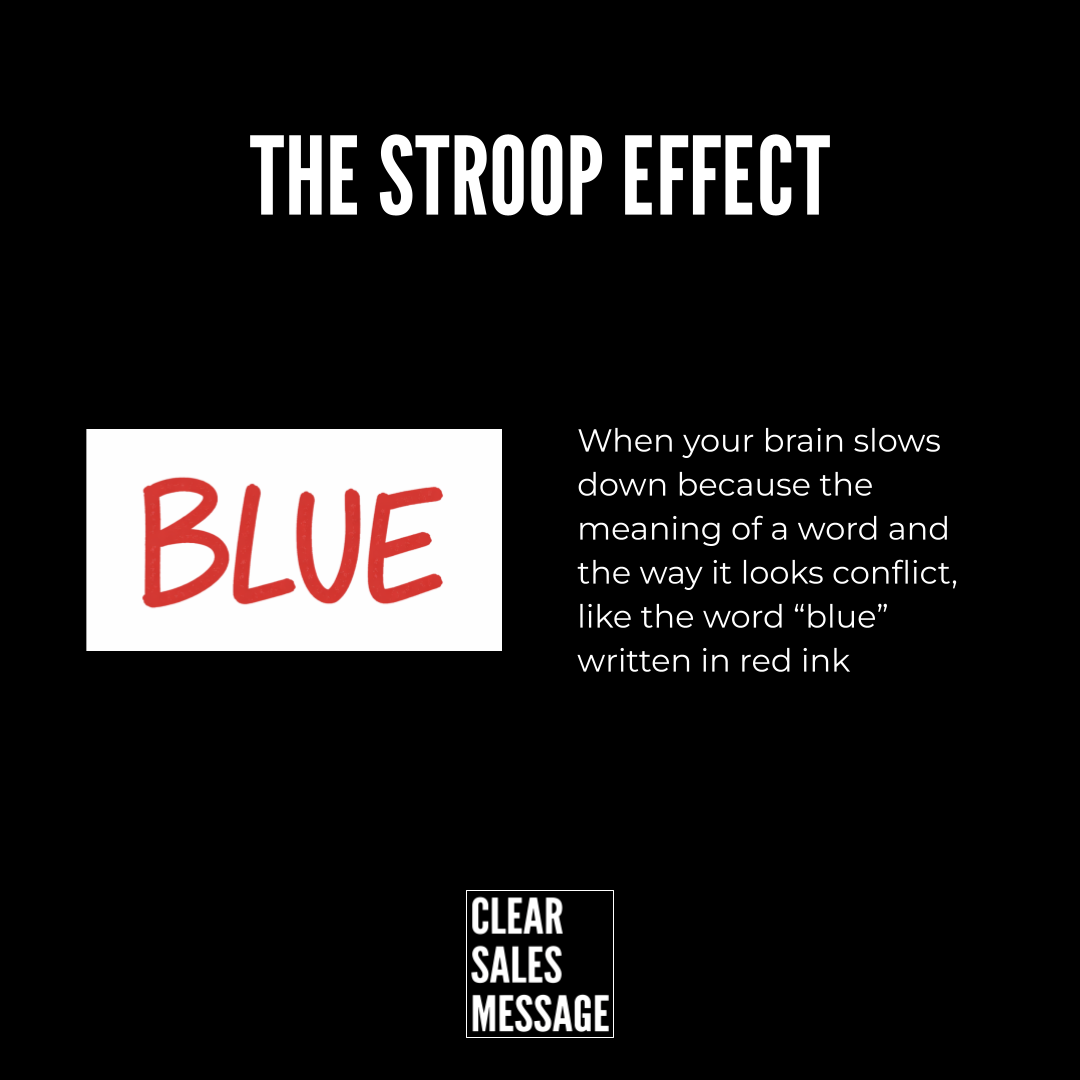
The Stroop Effect describes what happens when the meaning of something conflicts with how it appears, causing the brain to slow down.
A classic example is the word “blue” written in red ink. Your brain automatically reads the word, but at the same time it tries to process the colour. Those two signals clash, and the result is hesitation.
In sales and messaging, this effect shows up whenever what you say and how you present it don’t quite align.
How does it work?
The brain likes consistency. When information agrees with itself, it flows smoothly and feels easy to process. When signals conflict, even slightly, the brain has to pause and resolve the mismatch.
That pause is the Stroop Effect in action.
In a commercial context, this can happen when confident language is paired with uncertain design, when premium pricing is presented with budget visuals, or when a promise sounds simple but the explanation feels complex. The buyer may not consciously identify the problem, but they feel it.
That feeling often shows up as hesitation, rereading, or delay. Not because the offer is wrong, but because the signals don’t agree with each other.
How can you use it?
You use an understanding of the Stroop Effect to remove friction and protect attention.
The goal is alignment. Your words, visuals, tone, and structure should all tell the same story. When they do, the buyer doesn’t need to think about whether something makes sense. It simply feels right.
If you want to slow someone down deliberately, conflicting signals can be useful. Surprise, disruption, or contrast can draw attention when used intentionally. But in most buying situations, clarity converts better than cleverness.
The moment a buyer has to stop and reconcile mixed messages, momentum weakens. When everything points in the same direction, decisions feel easier and more confident.
The Stroop Effect is a reminder that confusion isn’t always loud. Sometimes it’s just a quiet pause that costs you the sale.
See also