Practical Sales Training™ > How To Convert > Hotelling’s Law
Hotelling’s Law
Have you noticed how petrol stations always seem to appear next to each other? Or how every bank on the high street offers nearly identical products? That’s not a coincidence. It’s economics.
Hotelling’s Law explains why competition creates sameness rather than variety. Once you understand it, you start seeing it everywhere. More importantly, you can use it to your advantage.
The businesses that resist the pull toward the middle are the ones buyers remember. They’re the ones buyers choose. And they’re the ones buyers come back to.
What Is Hotelling’s Law?
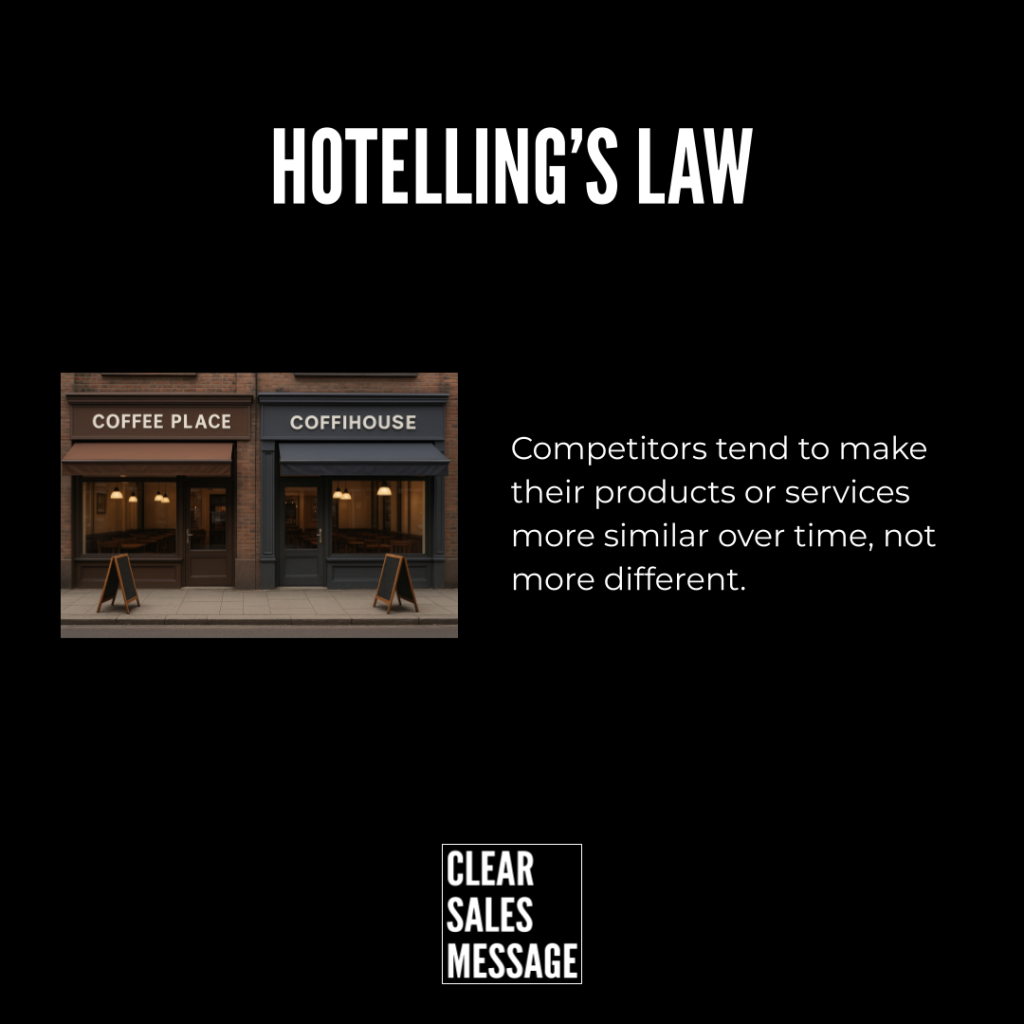
Hotelling’s Law is a principle from economics that explains why rivals often end up looking and sounding the same. Instead of spreading out, they move closer together. Products converge. Messages converge. Prices converge. As a result, buyers struggle to tell them apart.
It’s sometimes called the Principle of Minimum Difference. The classic example is two ice cream sellers on a beach. Rather than standing at opposite ends to serve different parts of the crowd, both sellers drift toward the middle. Each one tries to capture more foot traffic. But the result is that they end up side by side, with no clear reason for anyone to choose one over the other.
In short, Hotelling’s Law shows that competition tends to create sameness. Sameness is a conversion problem. When buyers can’t see a difference, price becomes the deciding factor. And a race to the bottom on price helps nobody except the buyer.
Why Does Hotelling’s Law Happen?
Moving toward the centre feels safe. If you stand too far from the mainstream, you risk missing the biggest group of buyers. So each rival edges a little closer to the middle, follows the others, and before long the whole market clusters in the same spot.
In location, this means rival stores open next to each other. In products, features and prices converge until everything looks the same. In marketing, brands copy each other’s ads and slogans because they don’t want to miss what seems to be working.
The irony is that the strategy each business uses to capture more market share makes them less distinct. They work harder, spend more, and convert less. Buyers have no clear reason to choose any one of them over another.
How Can You Use Hotelling’s Law In Sales?
Understanding Hotelling’s Law gives you a real edge. If you know that most businesses drift toward sameness, you can choose a different direction. Here’s how to apply it.
Stand Out in Your Message
Audit what your rivals say and find the words and claims they all use. Then say something else. When every business leads with “quality service” and “tailored solutions,” a specific and different message cuts through without any extra effort. The contrast does the work for you.
Move Away From the Centre
Instead of competing in the crowded middle, place your offer where buyers see real contrast. This doesn’t mean being extreme. It means being clear about who you are and who you’re for. Buyers who match your angle choose you quickly and with confidence, rather than comparing you against five identical options.
Avoid the Price War
When products look the same, price becomes the only variable. However, when you stand apart on value, you take price out of the centre of the conversation. Buyers who see a real difference will pay more for it. So standing out is also the most effective long-term pricing strategy.
Look For the Gap
When the whole market clusters in the middle, the edges become underserved. That’s an opportunity. The niche your rivals have left behind in their race to the centre is where a clear, distinct brand can own strong loyalty. Buyers at the edges often feel ignored by the mainstream. They reward the brand that speaks directly to them.
Use It to Brief Your Team
Hotelling’s Law is a useful concept to share with anyone who writes copy, designs campaigns, or builds pitches. When a team understands why markets drift toward sameness, they start making more deliberate choices. The concept earns its keep not just as theory but as a practical creative brief.
When Hotelling’s Law Matters Most
It matters most in crowded, mature markets. The more players there are, the stronger the pull toward the centre. Each new entrant copies the existing players to feel credible. So the gap between clustered rivals and a clearly distinct brand is wide. That gap is a real commercial advantage.
It also matters when buyers compare before buying. When someone searches Google or reads a category page, they see multiple options side by side. If yours looks like all the others, price decides. But stand out on angle or message, and you move onto a different short list entirely.
Similarly, it matters in markets where word of mouth drives growth. People don’t pass on the average option. They pass on the one that stands out. So being distinct isn’t just a conversion tool. It’s also the most reliable source of referrals.
When Hotelling’s Law Becomes a Trap
It becomes a trap when you measure your angle against rivals rather than against buyer needs. Moving away from what others say is not enough. You also need to move toward what buyers actually want. Otherwise you end up being different in a way that helps nobody.
There’s also a timing element. A new entrant sometimes needs to prove it understands the category before it challenges the norms of that category. Moving to the edge works best once buyers understand what you do. Too early, and a highly distinct angle can feel odd rather than appealing.
And it can mislead if you confuse surface-level change with genuine contrast. A different colour scheme is not a different value offer. Hotelling’s Law operates at the level of what you sell and who you sell it to. Superficial changes don’t move the needle.
Common Hotelling’s Law Mistakes
Copying Rivals Without Realising
Most businesses don’t consciously copy rivals. But because everyone reads the same content and responds to the same market pressures, messages converge anyway. Do a regular audit of what your rivals say. Make a list of phrases and claims you want to avoid. Because Hotelling’s Law operates quietly, and the only defence is active awareness.
Treating Sameness as Safety
Looking like the market leader feels safe. However, it means competing on their terms, in their space, for the same buyers. Instead, find the space they’re not in. There, you’re not competing at all. You become the only option for the right buyer.
Standing Out on the Wrong Thing
Not all contrast is equally valuable. Standing out on something buyers don’t care about doesn’t help. So before you invest in a point of difference, check whether it matters to your specific buyer. Being distinct only converts when it’s relevant to the person making the decision.
Giving Up When It Feels Hard
Finding a genuine point of difference takes more effort than copying the market. Many businesses drift back toward the centre when the creative work gets difficult. However, that difficulty is exactly what creates the edge. If standing out were easy, everyone would do it. The fact that most don’t is precisely why it works so well for those who commit to it.
Hotelling’s Law – An Example
Fast food is one of the clearest real-world examples. McDonald’s and Burger King often locate next to each other. Both sell burgers, chips, and drinks at similar price points. Both use similar deals and loyalty schemes. Each one believes being close to the other captures more buyers than being apart would.

The result is a market where buyers choose based on habit or minor preference rather than a clear reason. Neither brand gives most buyers a strong case for choosing it over the other. That’s Hotelling’s Law in action. And the most interesting opportunities in any market usually sit at the edges, where the clusters haven’t reached and real contrast is still visible.
See also