Practical Sales Training™ > Wordplay > Content Structures

Content Structures
Most sales messages fail because they’re written in the wrong order. The writer knows what they want to say, so they say it. But the reader doesn’t follow the same logic. They lose interest before the point lands.
Content structures solve this. They give your message a shape that mirrors how buyers think and decide. Instead of hoping your message works, you follow a framework that has been tested and refined for decades.
The structures below are used by marketers, salespeople, and copywriters every day. Each one is simple. But using even one of them consistently will make your content sharper and your results better.
What Are Content Structures?
Content structures are proven frameworks for shaping your message so it grabs attention, builds interest, and drives action. Instead of writing freeform and hoping for the best, you use a structure that guides the flow and increases impact.
They work because they mirror how people naturally think and make decisions. Each framework moves your audience through a logical sequence: highlight the problem, show the stakes, present the solution, and make the next step clear.
By following a structure, you reduce the risk of confusing your audience. You also increase the chance they’ll pay attention, remember your message, and take action. The structure does a lot of the persuasion work for you.
Why Do Content Structures Work?
Buyers don’t read everything you write. They scan, skim, and make quick decisions about whether something is worth their time. A well-structured message respects that. It puts the most important things first and makes the logic easy to follow without effort.
Structure also reduces cognitive load. When a message follows a familiar pattern, the brain processes it faster. The reader doesn’t have to work out what you’re trying to say. They just follow the flow. As a result, your message lands more clearly and is more likely to be remembered.
There’s also a credibility effect. A well-structured message signals that you’ve thought about what you’re saying. It feels considered rather than rushed. That impression matters in sales, because buyers are always assessing whether you’re worth their time and trust.
How Can You Use Content Structures In Sales?
Here are five of the most effective content structures you can use right away. Each one suits different contexts, so it’s worth knowing all of them.
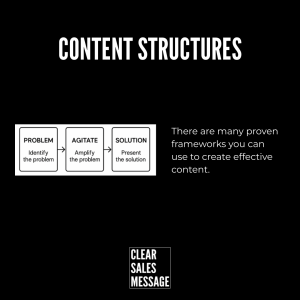
1. PAS: Problem, Agitate, Solution
Start by naming the problem your audience faces. Then agitate it: make the cost or urgency feel real. Finally, present your offer as the fix. PAS works because it meets buyers where they are, in their pain, before it moves them anywhere else.
Example: “Struggling to convert leads? Every week that passes, you’re burning more opportunities. That’s why we created Clear Sales Message™ to help teams convert with confidence.”
2. AIDA: Attention, Interest, Desire, Action
Hook with a bold statement to grab attention. Then explain why it matters to build interest. Show the benefits and outcomes to create desire. Finally, tell them what to do next. AIDA is one of the oldest frameworks in marketing, and it still works because it follows the natural arc of a buying decision.
Example: “97% of pitches fail to connect. Here’s how to make yours irresistible. Ready to sell with clarity? DM me the word CONVERSION.”
3. BAB: Before, After, Bridge
Describe life with the problem as it stands now. Then paint the better future your buyer wants. Finally, show how your solution bridges the gap between the two. BAB is especially useful in case studies, testimonials, and social content because it tells a story with a clear transformation at its heart.
Example: “Before: Your team chases leads with no response. After: They close with confidence. Bridge: Clear Sales Message™ makes that shift happen.”
4. FAB: Features, Advantages, Benefits
State what your product or service does. Then explain why that’s better than the alternative. Finally, spell out what it means for the buyer in their day-to-day. FAB stops you from talking only about features, which is the most common mistake in sales copy. Buyers don’t care what it does unless they can see what it does for them.
Example: “Our training includes role-play scripts (feature), so your team practises in real time (advantage), meaning they sell with confidence in the field (benefit).”
5. The 4Ps: Picture, Promise, Prove, Push
Open by painting the problem or the dream outcome vividly. Then make a clear promise about what you’ll deliver. Back it up with evidence or a testimonial. Finally, push with a strong call to action. The 4Ps work well for landing pages, email sequences, and sales presentations where you need to build conviction before asking for a decision.
Example: “Imagine your team closing confidently on every call. We’ll show you how to make that happen. Our clients see results within 30 days. Book a call today.”
When Content Structures Work Best
They work best when you’re writing for someone who doesn’t know you well yet. A cold email, a landing page, a LinkedIn post. These are the situations where you have seconds to earn attention and no existing relationship to fall back on. A structure gives your message the best chance of landing in that window.
They also work well when you’re writing at volume. If you’re producing regular content, proposals, or outreach messages, structures save time and maintain quality. Because instead of starting from a blank page each time, you have a proven framework to fill in.
Similarly, they’re useful when a message isn’t working and you can’t work out why. Mapping the existing copy against a structure often reveals exactly where the logic breaks down or where the reader is likely to drop off.
When Content Structures Become Dangerous
They become a problem when the structure is visible. If the reader can feel the formula, the message loses its humanity. The goal is to use the structure as a backbone, not a straitjacket. The words on top still need to sound like a real person talking to a real buyer.
They can also create a false sense of security. A message that follows AIDA or PAS perfectly can still fail if the underlying offer is weak, the audience is wrong, or the tone is off. Structure improves a good message. But it can’t rescue a bad one.
And over-reliance on one framework can make your content feel repetitive. If every email, post, and pitch follows the same pattern, buyers start to notice. So it’s worth mixing structures across different touchpoints to keep the communication feeling fresh.
Common Content Structure Mistakes
Picking the Wrong Structure for the Context
Each structure suits a different situation. PAS works well for cold outreach because it leads with pain. FAB works better in a proposal where the buyer already understands the problem. Using the wrong one for the context creates friction, because the message doesn’t follow the logic the reader expects at that stage.
Letting the Structure Show
A message that reads like a template feels impersonal. Buyers notice when they’re being processed rather than spoken to. So once you’ve written inside the structure, read it back and ask whether it sounds human. If it doesn’t, rewrite the language even if the shape is right.
Skipping the Call to Action
Every structure ends with a next step for a reason. Without it, even a perfectly crafted message leaves the reader unsure what to do. The call to action doesn’t have to be aggressive. But it does have to be clear. Tell people what to do next, or they won’t do anything.
Using Structure as a Substitute for Thinking
A structure tells you how to arrange your message. It doesn’t tell you what to say. The most common mistake is filling in the framework with generic content that doesn’t address the specific buyer. The structure is the container. But the insight, the relevance, and the understanding of the buyer still have to come from you.
Content Structures – An Example
Here’s the same core message written using three different structures, so you can see how the shape changes the feel.
PAS: “Most sales teams lose deals in the explanation, not the negotiation. Every unclear pitch costs you money you’ll never see. Clear Sales Message™ helps teams explain what they do so well that buyers say yes faster.”
BAB: “Before: Buyers nod along but don’t buy. After: They understand exactly what you do and why it matters to them. Bridge: Clear Sales Message™ is how you get from one to the other.”
FAB: “Clear Sales Message™ gives you a proven framework for your pitch (feature), so every team member says the same clear thing (advantage), meaning fewer confused buyers and more closed deals (benefit).”
Same offer. Different structures. Each one works in a different context. That’s why knowing all five is more useful than picking a favourite and sticking to it.
See also