Practical Sales Training™ > How To Convert > Delayed Sign Up

Delayed Sign Up
Most websites force people to register before they can do anything. Delayed Sign Up flips that. You let people use the product first, get value, feel invested and then ask them to sign up.
This dramatically increases conversions because people sign up to save what they already created. The motivation shifts from “should I try this?” to “I need to keep what I’ve built.”
It’s a small structural change to your onboarding. But the effect on sign-up rates can be significant, because you’re asking people to commit at the moment they’re most engaged rather than the moment they know least about you.
What Is Delayed Sign Up?
Delayed Sign Up is when you allow users to try the tool, build something, experience value and create progress before you ask them to register. The sign-up prompt comes later, once they’ve already done something worth keeping.
Examples include letting someone build a form before creating an account, edit a document before logging in, create a design before signing up or start a project before being asked for their details. In every case, the user arrives at the sign-up screen already invested in the outcome rather than being asked to commit to something they haven’t seen yet.
People become attached to the things they create. So when signing up is the only way to save their work, it stops feeling like a barrier and starts feeling like the obvious next step.
Why Does Delayed Sign Up Work?
1. People are motivated to finish what they started
This is the Endowment Effect at work. When someone creates something, they value it more because they made it. The time and effort they’ve put in makes the output feel like theirs. So if signing up is the only way to save that work, they almost always complete it. The investment creates the motivation.
2. You remove friction at the front
Most sign-up forms kill momentum before it starts. Form fields, password creation, email confirmation and the mental effort of deciding whether to commit all slow people down before they’ve seen any value. Delayed Sign Up removes all of that from the front door. You let people get into the product fast, and momentum does the rest.
3. You prove value before asking for commitment
Instead of saying “sign up and trust us,” you show them how it works, how easy it is, what they can build and what they’ll gain. They experience the value before committing to anything. As a result, the sign-up feels like a natural continuation rather than a leap of faith.
4. You shift from selling to supporting
The message changes completely. Instead of “please register so you can try it,” it becomes “you’ve already created something great, sign up to save it.” That reframe makes the sign-up feel helpful rather than pushy. You’re not asking them to take a risk. You’re helping them protect something they already care about.
How Can You Use Delayed Sign Up In Sales?
1. Let people do something meaningful before registration
The more progress a user makes before hitting the sign-up prompt, the higher your conversion rate will be. So let them design the first page of their website, build the first automation rule, load their first file, write their first document or create their first template. The more they’ve built, the more they have to lose by walking away.
2. Trigger the sign-up at the right moment
Timing matters. The best moment to ask is when they click save, try to export, add more than one item, want to share their work or try to continue beyond a set point. These are moments of peak investment, when the user most wants to keep going and has the most to lose by stopping. That’s when the sign-up prompt converts best.
3. Keep the sign-up as light as possible
Once they reach the sign-up screen, remove every possible barrier. A single email field, a social login option, no multiple steps and no distractions. The user should think “this is easy, I’ll just finish it” rather than feeling like they’ve hit another form to fill in. The harder you make it, the more of the goodwill you’ve built gets eaten up.
4. Use microcopy that reinforces their progress
The words around your sign-up prompt matter as much as the form itself. Phrases like “save your work,” “keep what you’ve created,” “don’t lose your progress” and “two seconds and you’re done” all shift the focus from the act of signing up to the value of keeping what they’ve built. That framing reduces resistance and increases follow-through.
5. Track what users build before they sign up
The pre-sign-up session is full of useful data. Tracking what users build and which actions lead to registration helps you identify the features that convert best, improve your onboarding flow and personalise the first experience after sign-up. Every click before registration becomes part of the sales process if you pay attention to it.
When Delayed Sign Up Works Best
Delayed Sign Up works best with tools where users can create or build something quickly. Form builders, website builders, document editors, design tools and project management apps all lend themselves to this approach because the output is tangible and personal. The user can see what they’ve made, which makes it worth saving.
It also works well when your product is genuinely easy to use. If someone can get real value from your tool in under five minutes without any guidance, Delayed Sign Up lets that experience do the selling. However, if your product has a steep learning curve, getting users to the point of investment before they give up becomes harder and you may need to guide them more actively through those first steps.
When Delayed Sign Up Becomes Dangerous
The approach can backfire if the sign-up wall appears too early. If you ask people to register before they’ve done anything meaningful, you haven’t earned the commitment and the effect is no different from a standard sign-up gate. The delay has to be long enough for real investment to form.
It can also create data and compliance issues if you’re storing user-generated content before you have any account details or consent. So make sure your legal and privacy setup covers anonymous sessions before you build this into your product flow.
Common Delayed Sign Up Mistakes
1. Asking too soon
If the sign-up prompt appears before the user has created anything meaningful, the Delayed Sign Up effect doesn’t exist. You need enough time and progress to build genuine investment. Test where in the journey your users feel most attached to their work and trigger the prompt there, not before.
2. Making the sign-up form too long
The goodwill you’ve built during the free session can disappear fast if the sign-up screen asks for too much. Keep it minimal. Every extra field is a reason to abandon. The user is motivated to sign up, but that motivation has a limit. Don’t test it with a twelve-field form.
3. Using weak microcopy at the sign-up moment
A generic “create an account” prompt wastes the investment the user has already made. Instead, remind them what they stand to lose. Reference what they’ve built. Make the sign-up feel like the logical next step in their own project rather than an interruption from yours.
4. Not tracking pre-sign-up behaviour
If you’re not recording what anonymous users do before they register, you’re missing some of the most valuable data in your funnel. Pre-sign-up behaviour shows you which features drive commitment, which moments cause drop-off and where your onboarding flow needs work. Build the tracking in from the start.
Delayed Sign Up – An Example
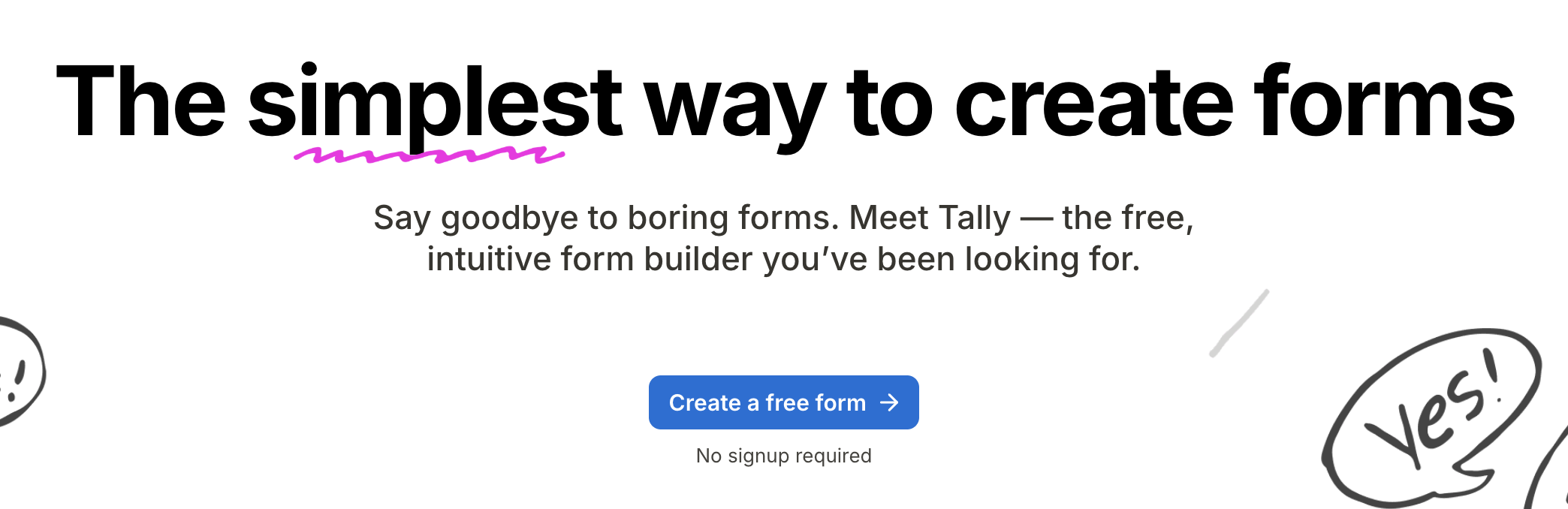
Tally.so: “No signup required”
Tally is a free form builder. Their homepage headline reads “The simplest way to create forms” and beneath the call-to-action button, in small text, it says: “No signup required.” That three-word line is doing a lot of work. It removes the biggest barrier to trying the product before the visitor has even clicked anything.
When a visitor clicks “Create a free form,” they go straight into the form builder. They start adding questions, choosing layouts and building something that feels like theirs. Only when they want to publish or save their form does Tally ask them to create an account. By that point, they’ve already invested time and creative effort into the form. Walking away means losing all of it.
As a result, the sign-up rate at that moment is far higher than it would be if Tally had asked for an account upfront. The product earns the commitment by proving its value first. That’s Delayed Sign Up working exactly as it should.
See also
- 180+ ways to improve conversion
- 100+ ways to get buyers to take action
- Pay Now Start Later
- Guest Checkout