Practical Sales Training™ > Wordplay > Collocation
Collocation
Some words just sound right together. Not because of grammar rules, but because people use them together so often that they feel like a natural pair.
Think of “salt and pepper,” “fish and chips” or “sales and marketing.” You hear the first word and your brain already expects the second. That’s Collocation at work.
In sales and messaging, this matters because anything that feels natural gets processed faster. And anything that feels “off” creates friction. So the words you choose, and how you pair them, can quietly make or break your message.
What Is Collocation?
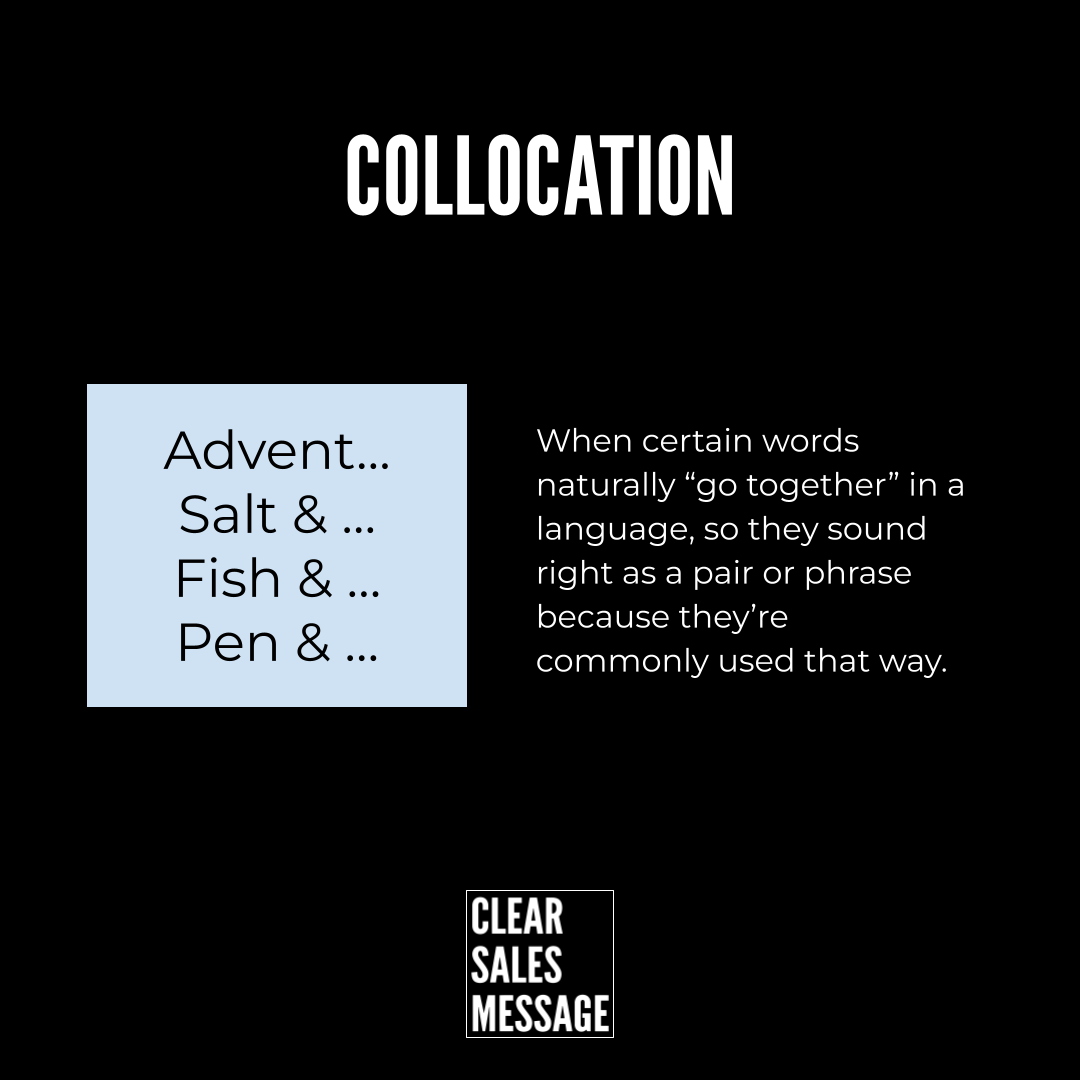
Collocation is when certain words naturally go together in a language. When you hear the first word, your brain already expects the second. These pairings fit because the language has trained us to see them as a unit.
Common examples include salt and pepper, fish and chips, pen and paper, black and white, advent calendar and sales and marketing. None of these pairs follow a special rule. They simply feel right because we’ve heard them together so many times.
When you use collocations in your copy, everything feels smoother and easier to read. As a result, your message takes less effort to process, which means buyers stay with it longer.
Why Does Collocation Work?
1. The brain loves patterns
People don’t read every word. They scan for familiar structures. Collocations are shortcuts the brain already knows, so when your message matches these patterns it feels natural, easy and instantly understood. This makes your messaging more frictionless, which is exactly what you want in sales.
2. Collocations trigger associations
When someone hears “sales and…” they think “marketing.” When they hear “time and…” they think “money.” These predefined pairs help you communicate ideas faster because the reader fills in the meaning before you even finish the sentence. That’s a powerful shortcut in any sales message.
3. They increase credibility
Natural phrasing builds trust. If your wording feels strange or forced, people slow down and something feels “off.” Using collocations makes your language feel fluent, your message feel confident and your brand sound more established. Good writing feels invisible, and collocations help you achieve that.
How Can You Use Collocation In Sales?
1. Use familiar word pairs in headlines
Familiar pairings make headlines easy to read and easy to remember. For example: “Sales and strategy made simple,” “Time and money-saving automation” and “Trust and transparency at every stage.” These work because the structure already feels known. The reader doesn’t have to work hard to get the point.
2. Use collocations to reinforce key ideas
If your audience already pairs certain words together, use those same pairs in your copy. For example: “Clear and consistent messaging,” “Fast and effective outreach” and “Simple and scalable systems.” This makes your message stronger without adding extra words, because the pairing does the heavy lifting.
3. Use them to create memorable positioning lines
Collocations help you build phrases that stick. “Better communication. Better conversion.” works as a tagline because the structure feels familiar. Similarly, “Simple systems. Serious results.” and “Practical skills. Predictable sales.” land well because the pairing feels right before the reader even thinks about why.
4. Use them to finish your buyer’s sentences
When you use a word that naturally creates an expected pair, the reader completes the meaning for you. For example: “From confusion to clarity,” “From leads to sales” and “From effort to results.” The mental shortcut does the work, so your message lands with less friction.
5. Use them to simplify complex explanations
Pairing concepts makes abstract ideas instantly clear. “Message and meaning,” “Cause and effect” and “Risk and reward” all reduce mental load because the pairs are already understood. As a result, your message feels more elegant and easier to act on.
When Collocation Works Best
Collocation works best in short, high-stakes copy where every word counts. Headlines, subject lines, taglines and opening sentences all benefit because the reader makes a quick decision about whether to keep going. Familiar word pairs lower that barrier.
It also works well when you want to sound established and fluent. A brand that uses natural, polished language feels more credible than one that sounds forced. So in pitches, proposals and sales pages, collocation quietly builds trust before the buyer has read a single argument.
When Collocation Becomes Dangerous
Collocation becomes a problem when you rely on it too heavily. If your copy is full of familiar pairs but says nothing new, it starts to feel generic. Buyers have heard “fast and effective” and “clear and consistent” so many times that those phrases now carry almost no meaning.
The fix is to pair collocation with specificity. Use the familiar structure but fill it with something real. “Fast and effective” is weak. “Fast enough to send before your next meeting and effective enough to get a reply” is strong. The structure helps. The substance sells.
Common Collocation Mistakes
1. Using pairs that feel forced
Not every pairing works. If you combine words that don’t naturally go together, readers notice the friction even if they can’t name it. Stick to pairs that already exist in your buyer’s vocabulary rather than inventing new ones.
2. Over-relying on worn-out pairs
Phrases like “tried and tested,” “safe and secure” and “quick and easy” have been used so often they’ve lost their power. They still feel natural, but they no longer stand out. So use familiar structure with fresh content rather than reaching for the same tired pairs.
3. Confusing collocation with cliche
A collocation is a natural word pair. A cliche is a worn-out phrase. The line between them is thin. However, the test is simple: does the pair add clarity or does it just fill space? If it’s the latter, cut it or rewrite it with something specific.
4. Ignoring your buyer’s language
The most powerful collocations are the ones your buyer already uses. If your market talks about “risk and compliance” or “cost and quality,” mirror those pairs back. Your message will feel familiar because it is familiar, and that builds trust faster than any clever line you could invent.
Collocation – An Example

The Tagline That Sticks
A sales consultant rewrites their website headline. The original says: “We help businesses improve their sales process and communication strategy.” It’s accurate but forgettable.
The new version uses collocation: “Better communication. Better conversion.” It works because both pairs feel natural and the structure is already familiar. Readers process it in under a second. They don’t need to think about what it means because the language does the work for them.
The message hasn’t changed. But it lands faster, sticks longer and sounds more confident, simply because the word pairs feel right.
See also