
Practical Sales Training™ > Selling Communication Basics > Schemas

Schemas
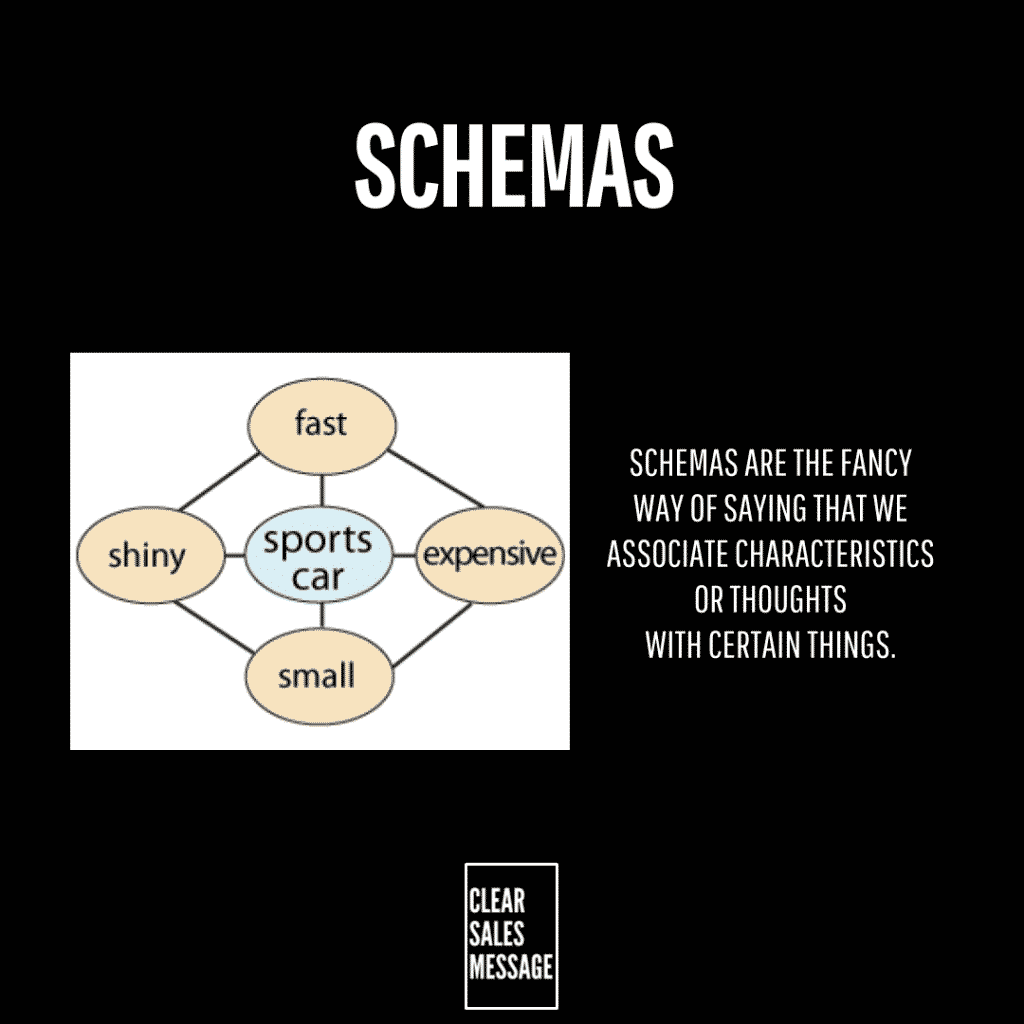
Three words. Red. Sporty. Fast. You already have a picture in your head. No description was needed. No spec. Just three familiar characteristics, and the image assembled itself.
That is schemas at work. Our brains store associations for everything we encounter. Colours, feelings, categories, textures. When the right word activates one of those associations, the whole picture builds on its own. The buyer does not need to be told everything. They just need the right cues.
In sales, that is very useful. Because buyers build their own picture from the words you give them, the right descriptive language can do more work than a full product description ever could.
What Are Schemas?
Schemas are mental frameworks. They are the associations, traits, and expectations our brains attach to things based on past experience. When we meet something new, we look for schemas to make sense of it fast. We match it to something we already know.
The word “luxury” activates a schema. Without any further detail, a buyer will link it to quality, exclusivity, and care. The word does not need to explain any of those things. The schema already holds them. So one well-chosen word can trigger a whole picture without any further work from you.
The same works for colours, textures, and categories. Each carries a set of associations the brain retrieves on its own. Because buyers use these links to form impressions and make decisions, the words you choose in your messaging shape how your offering is understood before you have said much at all.
Why Do Schemas Work in Sales?
They work because they give buyers a way to understand something new by linking it to something they already know. Instead of building a picture from scratch, the buyer maps your offering onto what they already hold in their head. That process is fast, low-effort, and far more likely to create a clear impression than a list of features.
There is also a personal ownership effect. When a buyer builds their own mental image using the cues you give them, that image belongs to them. Because they made it themselves, they trust it more than a description you imposed on them. The schema gives them the material and they do the rest. That act of building creates belief.
Schemas also reduce confusion. A technical explanation of what something does can leave buyers unclear about what it means for them. But describing an offering using familiar traits creates clarity almost at once. Because the brain finds familiar patterns easier to process, schema-based descriptions land faster and stick longer.
How Can You Use Schemas In Sales?
Think about the associations your buyers already hold that connect to what you offer. Then use those associations on purpose in your messaging. Here are the most effective ways to apply schemas.
Use Descriptive Words That Activate the Right Associations
Rather than describing what your product does, describe how it feels or what it is like. Words like “effortless,” “robust,” “sleek,” or “reassuring” all trigger schemas that carry far more meaning than the words alone suggest. Because each word opens a door to a wider set of links, choosing them well gives buyers a richer picture than a feature list ever would.
Draw Comparisons Using Equivalence
If your offering is like something the buyer already knows, say so. “It’s like having an accountant in your pocket” or “think of it as a PA for your inbox” both use equivalence to fire a schema. The buyer already has a clear picture of what an accountant or a PA does. So the comparison does the explaining in one line. You do not need to describe the product in detail. Find the right comparison instead.
Use Sensory Language
Sensory words activate schemas strongly because they connect to physical experience. “Crisp,” “smooth,” “heavy,” “warm,” “sharp.” Each triggers an immediate physical link that enriches the buyer’s sense of what you offer. Because sensory language is processed more vividly than abstract language, it creates a more memorable impression with less effort.
Name the Category
Telling a buyer what category your offering belongs to activates the schema for that whole group. If your product is premium, say premium. If your service is boutique, say boutique. The category name brings a whole set of expectations with it. So placing your offering clearly within one gives the buyer an instant frame for what to expect.
When Schemas Work Best
Schemas work best early in the sales conversation. A buyer who forms the right mental picture at the start will ask better questions, feel more confident, and be easier to close. Because the schema sets the frame for everything that follows, getting it right early pays off throughout the whole sale.
They also work well when your offering is complex or unfamiliar. When buyers have no existing frame for what you do, giving them one through familiar links is far more effective than a detailed explanation. Because the brain looks for patterns it already knows, anchoring a new idea to a familiar one is the fastest route to clarity.
Similarly, schemas work well in short written marketing where space is tight. A few well-chosen words can trigger a rich set of links that would take paragraphs to explain directly. So use them in headlines, taglines, and opening lines where the first impression matters most.
When Schemas Become Dangerous
The risk is activating the wrong schema. If the links your words trigger do not match the reality of your offering, buyers feel misled. A product described as “premium” that turns out to be mid-range creates real disappointment. Because the schema sets an expectation, failing to meet it causes more damage than if no expectation had been set at all.
There is also a cultural risk. Schemas are not universal. The links a word carries in one culture may be very different in another. So if you sell across different audiences, test your descriptive language with each group. Because the same word can trigger different pictures in different minds, never assume a shared association without checking.
Common Schema Mistakes
Describing Features Instead of Associations
A feature tells the buyer what your product has. A schema tells them what it feels like to use or own it. Most sales copy defaults to features because they are easy to list. But buyers do not buy features. They buy the picture those features create. So shift your language from what your offering does to what it is like, and let the schemas do the rest.
Using Generic Descriptors
Words like “great,” “excellent,” and “amazing” are so overused that they no longer activate any clear schema. Buyers read past them without forming a picture. So reach for more specific and vivid language. “Effortless” says more than “easy.” “Precise” says more than “accurate.” Because specificity activates stronger associations, the more vivid your words, the more clearly the buyer sees what you offer.
Activating a Schema Your Offering Cannot Deliver On
Only use descriptive language that reflects what buyers will actually find when they buy. Because a schema that sets the wrong expectation creates a let-down that plain language never would have, accuracy is as important as impact when choosing your words. If the schema does not match the reality, trust breaks down fast.
Schemas – An Example
Three words. See what picture they build in your mind.
RED
SPORTY
FAST
Click here to see if the prediction was right.
No description. No spec. No category. Just three traits that fired existing associations. Because the schemas were already there, the picture built itself. That is the power of choosing the right words in sales. You do not have to explain everything. Just give the buyer the right cues and let their mind do the rest.
See Also