Practical Sales Training™ > How To Convert > The Early Problem Effect

The Early Problem Effect
Most buyers wait too long. They know a problem exists. But it still feels manageable. So they leave it.
Small issues grow. Friction turns into real pain. And minor costs become major ones.
That is the Early Problem Effect. Act early and things stay simple. Wait too long and they get hard.
What Is The Early Problem Effect?
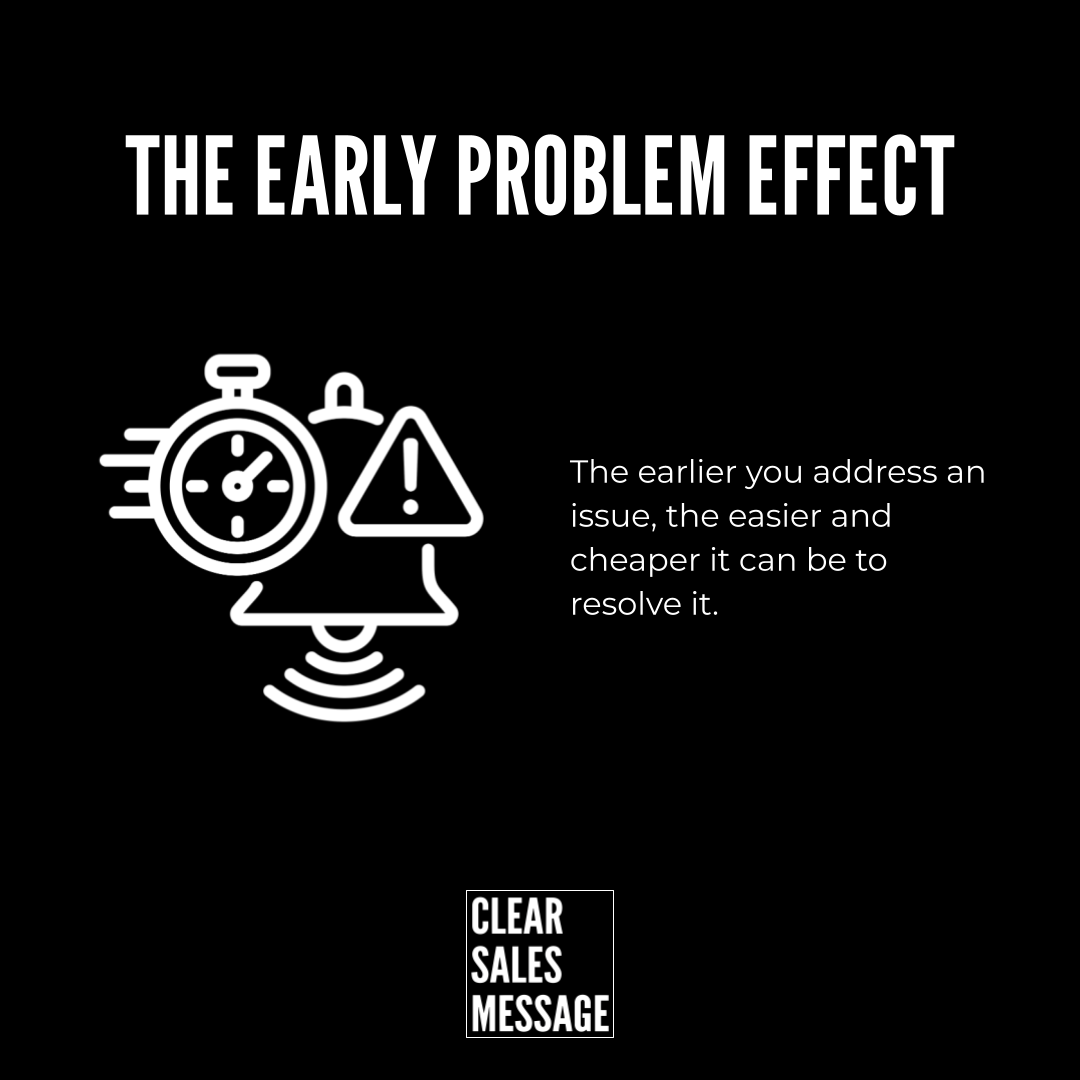
Problems are easier to fix when you catch them early. That is the core idea. It applies in business, finance, operations, and sales.
Small issues like customer frustration, weak messaging, or early staff disengagement are simple to fix at the start. But when ignored, they grow. And the longer they grow, the harder and more costly they become to deal with.
Early action is almost always cheaper than late action. In fact, it is rarely even close.
Why Does The Early Problem Effect Matter In Sales?
Buyers delay because the problem still feels survivable. The business is coping. The cost feels small. The consequences feel distant.
But delay has a price too. It compounds quietly in the background. And by the time the problem feels urgent, fixing it is far harder than it ever needed to be.
So helping buyers see the future cost of doing nothing is one of the most useful things a seller can do. Not through pressure – but through clarity.
How Does The Early Problem Effect Affect Buyer Psychology?
People adapt to problems when they grow slowly. Friction starts to feel normal. Poor systems become routine. Declining results stop feeling alarming.
Once something feels normal, urgency fades. That is the danger. Because the problem has not gone away – it has just become invisible.
So strong sales conversations go beyond the current problem. They also help buyers see where things are heading if nothing changes.
Small Problems Compound Quietly
Most problems grow slowly rather than suddenly. As a result, they are hard to spot until they are already serious. There is no single breaking point – just a slow build of cost, friction, and damage over time. Small issues repeated daily can become very large ones over months or years.
Early Action Preserves Options
Act early and you have choices. Wait too long and those choices narrow fast. Pressure builds, costs rise, and the damage is already done. So early action is not just about saving money – it is also about staying in control of the outcome.
How Can You Use The Early Problem Effect In Sales?
Help buyers see the cost of waiting. Not through fear – through visibility. Because delay is a decision too. And it usually costs more than people think.
Show them what grows if nothing changes. Future costs. Rising inefficiency. Lost ground to rivals. Accumulated damage that gets harder to undo. Make the cost of inaction real and tangible, and urgency follows naturally.
When The Early Problem Effect Becomes Most Important
This matters most when problems get worse over time. Health. Finance. Customer trust. Sales performance. These things do not just get slightly worse with delay – they can get a lot worse. So the longer a buyer waits, the steeper the climb back to where they should be.
Research Behind The Early Problem Effect
This effect links closely to loss aversion, compounding theory, and behavioural economics. Research shows that delayed action increases long-term cost and complexity across many areas. In other words, people regularly underestimate how expensive a small problem can become.
You can read more here: Loss Aversion
Common Early Problem Effect Mistakes
The biggest mistake is waiting until a problem hurts before doing something about it. But by then, the damage is usually already building.
Confusing “Manageable” With “Healthy”
Coping is not the same as working well. Many businesses normalise friction for years because the decline is slow and gradual. As a result, the real cost stays hidden. And by the time it becomes obvious, fixing it is a much bigger job than it needed to be.
Underestimating Compounding Damage
Small recurring problems look minor in isolation. But add them up over months or years and they become very costly. Compounding works negatively just as well as it works positively. So what looks small today is often a much bigger problem tomorrow.
The Early Problem Effect – An Example
A company notices its onboarding feels slow and confusing. It seems minor at first. But over time, frustration builds, support tickets rise, and customers start to leave.
Eventually the business needs a full overhaul. It is costly, slow, and disruptive. However, the original problem was small. It was the delay that made it painful.
See also

