
Practical Sales Training™ > How People Work > Cognitive Load

Cognitive Load
You’ve probably never heard of cognitive load. And why would you? It sounds like something from a psychology textbook, not a sales conversation. But it’s one of the most practical ideas in this whole library.
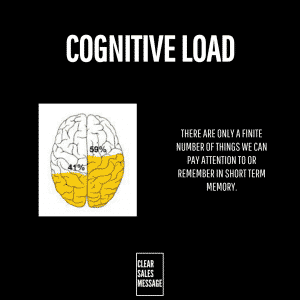
Cognitive load is about the limit on what the brain can process at any one time. When you give a buyer too much to take in, some of it simply doesn’t land. Not because they’re not trying. Because there’s no room left.
So if your pitch is too complex, your website too busy, or your proposal too long, you may be losing buyers at the point where you think you’re winning them. Less really does sell more.
What Is Cognitive Load?
Cognitive load refers to the total amount of mental effort being used in the working memory at any one time. In plain terms, it’s how much your brain is handling right now. And there’s a hard limit on that.
We are surrounded by things competing for our attention all day. But we can only focus on a few at once. This is partly down to something called the Reticular Activating System, a part of the brain that controls where you place your focus and filters out the rest.
In a sales context, this matters a lot. Because if your buyer’s brain is already full, your message won’t get through. It’s not that they don’t care. They just don’t have the capacity to process what you’re saying.
Why Does Cognitive Load Matter In Sales?
It matters because unclear or complex information gets ignored. Not rejected. Ignored. Your potential client may simply not have enough mental space left to really take in what you’re saying. So the sale dies quietly, and you never know why.
This shows up in a lot of ways. Overly complex products. Busy websites. Marketing with no clear message or call to action. Proposals that cover everything instead of the right things. Each one adds to the load. As a result, buyers switch off before they’ve made a decision.
The good news is that cognitive load also works in your favour when you get it right. A clear, simple message is easier to understand, easier to remember, and easier to say yes to. So reducing the load you place on buyers is one of the fastest ways to improve your conversion rate.
How Can You Use Cognitive Load In Sales?
The goal is to reduce the amount of effort your buyer needs to make in order to understand you. That means cutting down what you share at any one time and making what remains as clear as possible.
Use steps
Break complex processes into single, numbered actions. A step-by-step format reduces the mental load of a complicated task. Each step is small enough to understand on its own. Together, they build a clear picture without overwhelming the reader.
Remove distractions
Look at everything you present and ask whether each element is necessary. Words, images, bullet points, sections. If something adds no value to the buyer’s understanding, take it out. What’s left will land harder because it has less competition for attention.
Lead with the simplest version first
Give buyers the short version before the detailed one. A one-line summary at the top of a proposal, email, or pitch lets the reader grasp the key idea immediately. Then they can choose to go deeper. But the core message is already in, even if they don’t.
Cut your word count
More words mean more load. So say what you need to say and stop. A shorter email, a simpler slide, a tighter proposal. Each one reduces the effort required to understand you. And lower effort means a faster, easier yes.
Use visuals where they help
A good diagram or simple image can replace a paragraph of explanation. However, a cluttered or irrelevant visual adds load rather than reducing it. So only use images that make the idea clearer. If they don’t add clarity, leave them out.
When Cognitive Load Thinking Works Best
It works best when your offer is genuinely complex. The more moving parts your product or service has, the more your buyer’s brain has to work. That’s where reducing load makes the biggest difference. Strip it back to what the buyer needs to know to say yes. Save the rest for later.
It also works well in written sales materials. Proposals, website copy, and emails all benefit from a cognitive load review. Ask yourself whether a buyer reading this for the first time could follow it easily. If the answer is no, cut and simplify until it is.
Similarly, it matters in face-to-face selling. If you cover too many points in a meeting, buyers leave confused rather than convinced. Therefore, decide in advance what the two or three things are that you want them to remember and build your whole pitch around those.
When Cognitive Load Thinking Becomes Dangerous
Simplifying too far can lose important detail. Some buyers need depth before they commit. If you strip your message back too aggressively, you may leave them with questions that stop the sale. So the goal is the simplest version that still covers what matters.
There’s also a risk of being too brief in writing. A very short email or proposal can feel thin or rushed. Buyers may wonder whether you’ve really understood their situation. So simple doesn’t mean minimal. It means clear and focused.
And cognitive load thinking can become an excuse to avoid the hard work of explaining a genuinely complex offer properly. But some things do require explanation. In those cases, the answer isn’t to say less. It’s to structure what you say so each part is easy to take in on its own.
Common Cognitive Load Mistakes
Sharing everything you know
Sellers often share too much because they’re proud of their knowledge or worried about missing something out. But more information doesn’t build confidence. It builds confusion. Pick the points that matter most to this buyer and lead with those.
Designing for yourself, not the buyer
A proposal or website that makes sense to you may be overwhelming to a buyer seeing it for the first time. Always review your materials from the buyer’s point of view. If a fresh pair of eyes finds it hard to follow, it needs simplifying.
Using jargon to sound credible
Technical language adds cognitive load instantly. Buyers have to decode the words before they can even engage with the idea. Instead, use plain language. Simple words that mean the same thing are always better. Credibility comes from clarity, not complexity.
Ignoring the visual load
A busy slide or a cluttered webpage adds load even before the buyer reads a single word. So look at the visual experience too. White space, clear fonts, and simple layouts all reduce the effort required. Design is part of the message.
Cognitive Load – An Example
This advert talks about so many benefits at once that it’s not clear what the item does or why you’d need it. Sorry, Dusker!

Too many claims. No clear focus. The buyer’s brain doesn’t know where to look. As a result, the message doesn’t land. That’s cognitive overload in action. Because when everything is emphasised, nothing is.
See Also