
Practical Sales Training™ > How People Work > Attention Span

Attention Span
What Is It?
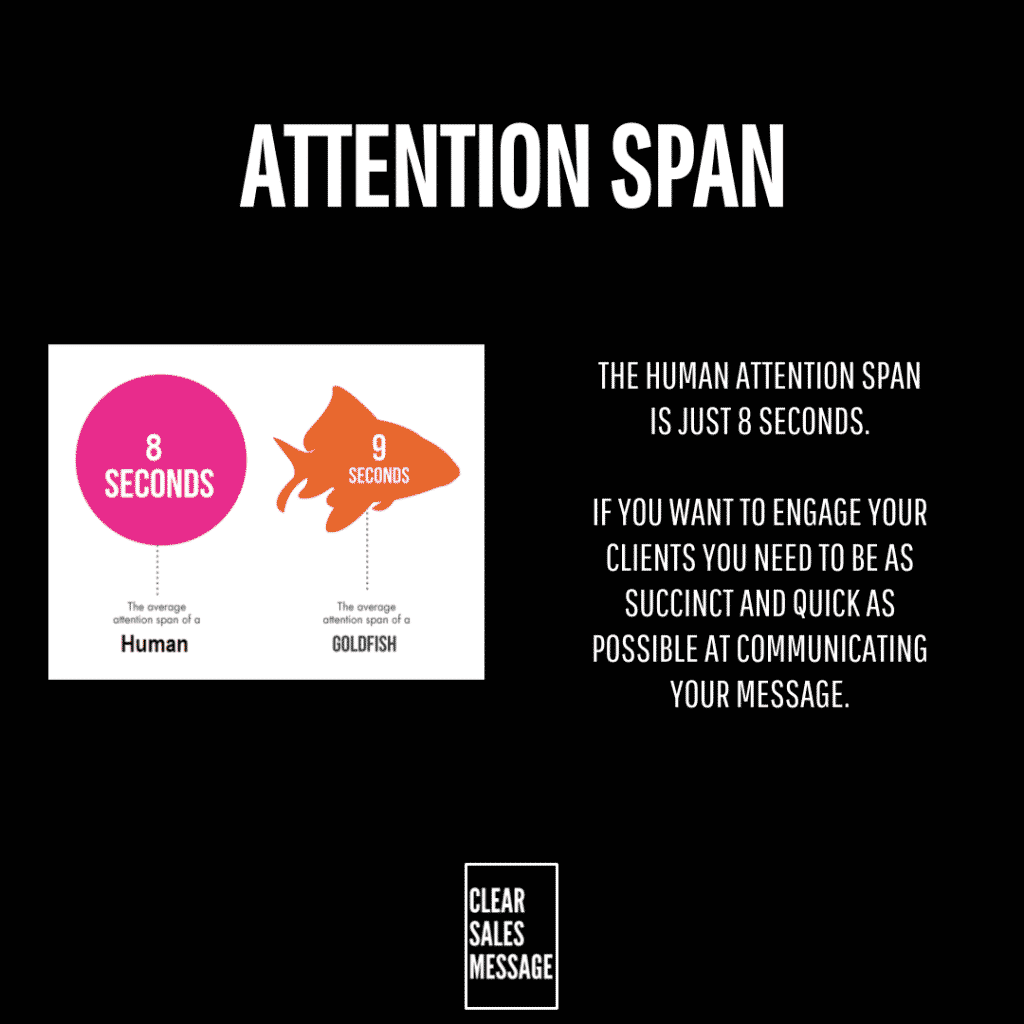
The human attention span is just 8 seconds. That’s all the time you get to capture someone’s attention and start to engage them. After that, they’ve already moved on.
Why Does It Work?
At second 9, everything is lost. So your communication needs to recognise how fickle attention actually is. It has to grab someone fast, or it won’t grab them at all.
How Can You Use It?
Assume your reader or listener is busy and drowning in information. Because of that, they’ll ruthlessly prioritise where their limited attention goes. So cut through the noise. Be succinct, bold, and C.L.E.A.R in everything you say. Too much text, or too much waffle, costs you more than attention. It costs you the business itself.
When It Works Best
This matters most in an email’s first line, or a call’s opening seconds. It also applies to the headline on a page. It also matters more the busier your audience already is, since a distracted reader forgives nothing.
When It Becomes Dangerous
This becomes a problem if you assume people will read past a slow start. They won’t. A weak opening line loses the reader before your best point ever arrives.
Common Mistakes
Burying The Main Point
Don’t bury your main point under three sentences of preamble. Say the important thing first, then explain it, not the other way round.
Assuming Attention Is Owed
Never assume your reader owes you their attention. They don’t, and they’ll prove it by skimming past anything that takes too long to get going.
Attention Span – An Example
Two Versions Of The Same Email
A recruiter sends two versions of the same email to different candidates.
“I hope this finds you well. I wanted to reach out regarding an opportunity that recently opened up at our company, which I believe might be of interest to you given your background.”
“We’re hiring a Head of Marketing at £85k. Interested?”
The second version gets three times the replies. It says everything that matters inside the first 8 seconds. Nobody has to wait to decide if it’s worth their time.
See also