Practical Sales Training™ > How to connect with your buyer > The Product Code Effect
The Product Code Effect
What Is It
If you have a large offering, using codes or short codes helps buyers navigate it with a minimum of fuss. Instead of long product names, they use a short reference instead.
It sounds like a small admin detail. It isn’t. A code turns a confusing catalogue into something a buyer can hold in their head.
Once a code exists, it becomes the shared language between you and the buyer. No more describing, no more guessing which item they mean.
Why Does It Work
It’s a variation of The Path of Least Resistance. Product codes are a simple but powerful convenience that make your offering easier to understand.
Buyers don’t want to work hard to buy from you. A code removes the effort of remembering, describing, or double checking a product name. So the whole transaction gets faster on both ends.
It also cuts down on mistakes. A misheard product name can mean the wrong order arrives. A misheard code is far easier to catch and confirm.
How Can You Use It
Pick a system that scales with your range
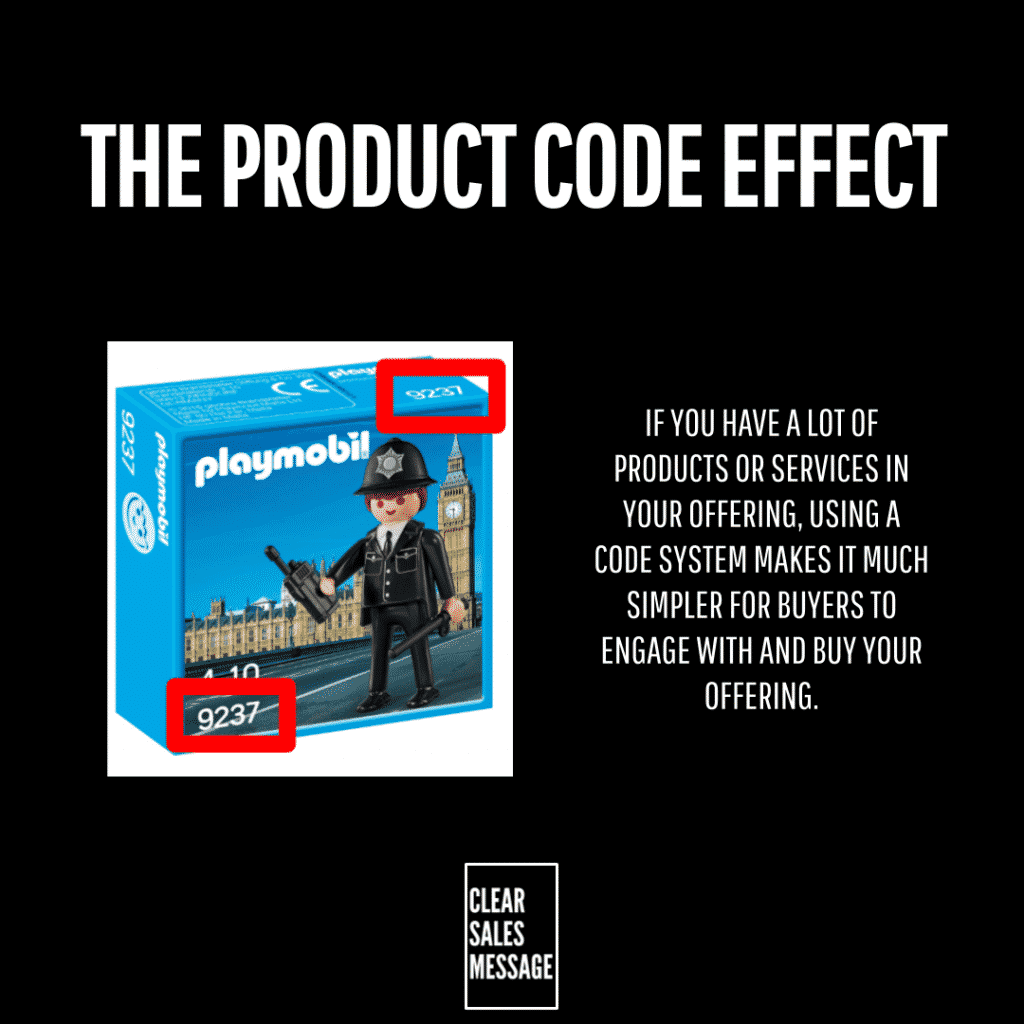
Depending on your offering, if you have a large number of things to offer, choose a 2, 4, or 5 digit system. Use either alphabetical or numerical codes, just like Lego and Playmobil do.
Make the codes mean something
Use meaningful codes that help categorise your range. For example: CH for Chair, TB for Table, SO for Sofa. Then add a number, like CH102, to keep it consistent and scalable.
A code that hints at the category is far easier to remember than a purely random string. So build in that logic from the start, rather than bolting it on later.
Use the same codes everywhere
Your catalogue, website, and customer service should all reference the same codes. If one team uses a different system, the whole benefit falls apart fast.
When It Works Best
This works best when you have a genuinely large range, dozens or hundreds of similar items that are hard to tell apart by name alone.
It also works best with repeat buyers. A code only pays off once someone’s ordered before and can quote it back to you with confidence.
When It Becomes Dangerous
It backfires if the codes feel arbitrary to the buyer. A string of random letters and numbers with no logic just adds a new thing to memorise, on top of the product itself.
It also becomes risky if your team doesn’t use the codes consistently. A customer service rep who doesn’t recognise the buyer’s code creates more friction than the codes were meant to remove.
Overcomplicating the system causes problems too. If codes need a manual to decode, you’ve built a barrier instead of a shortcut.
Common Mistakes
Changing the system halfway through
Switching code formats partway through your range confuses returning buyers instantly. Pick a system early, and stick with it as you grow.
Hiding the codes instead of surfacing them
If the code only appears buried in an invoice, buyers never learn to use it. Show it clearly on the product page, the catalogue, and the confirmation email.
Making codes too long to be useful
A code that’s longer than the product name it replaces defeats the entire purpose. Keep it short enough to say out loud without checking a screen.
The Product Code Effect – An Example
A Lamp Catalogue
Let’s say you sell 150 different lamp designs. Rather than asking buyers to remember names like “Vintage Bronze Reading Lamp with Curved Arm,” you assign each product a simple code like LB204 (Lamp Bronze, style 204). Your catalogue, website, and customer service all reference the same codes.
Why it works in practice:
A returning customer might call and say:
“Hi, I want to reorder LB204 and also get two of the LB208 in black.”
This is faster, easier, and reduces miscommunication compared to describing products in full each time. It also adds a professional, streamlined feel to your offering, especially when customers are browsing or comparing multiple items.
See also