Practical Sales Training™ > Wordplay > Ablaut Reduplication

Ablaut Reduplication
What Is It
Say tock-tick out loud. It sounds wrong, even though nobody ever taught you why. That instinct is Ablaut Reduplication doing its quiet work.
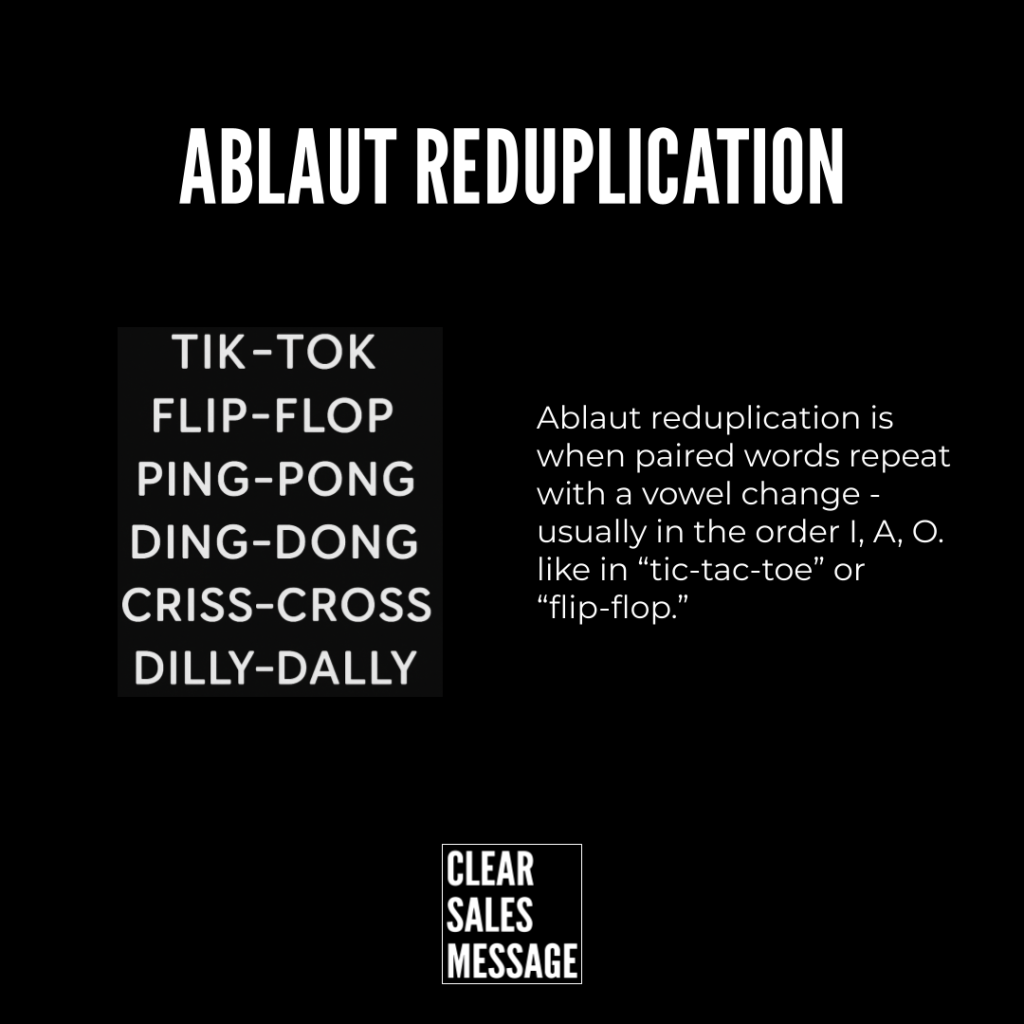
It’s when a repeated word changes its vowel in a set order, usually I then A then O. That’s why we say tick-tock, not tock-tick. Mish-mash, not mash-mish. Flip-flop, not flop-flip. No grammar book forces this. Native speakers just follow it, because it’s built into the rhythm of English itself.
Why Does It Work
It works because the sound genuinely flows. So the shift from I to A to O mimics a rise and fall our ears actually enjoy. Our brains love a pattern.
It feels playful too, which is why these pairs show up so often in casual, catchy contexts. So it’s not really clever wordsmithing. It’s instinct, something we all follow without ever learning the rule.
How Can You Use It
Brand Naming
So use it when naming a brand. Tic Tac, KitKat, and Hip Hop all lean on this exact rhythm. That repeating structure makes a name easier to recall, and more fun to actually say out loud.
Marketing And Messaging
Use it in headlines and taglines too. No fuss, no muss. From ping to pong. Not just a zig-zag, but a whole new direction. Each one adds punch that a flat, literal phrase never could.
Everyday Communication
It also works in everyday language, the kind buyers actually speak. A bit wishy-washy. The old ding-dong routine. A total flip-flop decision. So used well, it makes your message feel more human and more memorable.
When It Works Best
This works best on short, punchy names and phrases where rhythm carries most of the weight. So shorter phrases pull more weight.
It also works well in casual, informal contexts, since the playful tone suits the pattern naturally. Formal brands get far less.
When It Becomes Dangerous
This becomes forced if you bend a real word just to fit the vowel pattern. So the rhythm should feel discovered.
It also falls flat if the phrase doesn’t actually mean anything once the novelty wears off. So substance still matters most.
Common Mistakes
Forcing The Pattern
So some brands force the pattern onto words that don’t naturally fit it. So if it takes real effort to say, skip it entirely.
Overusing It
Others overuse it until every headline starts to sound the same. So save it for the one line that actually needs the punch.
Skipping The Read-Aloud Test
Some brands use it without checking how it reads out loud first. So always say the phrase aloud before you commit to it in print.
Ablaut Reduplication – An Example
KitKat’s Built-In Rhythm
KitKat leans on this exact rhythm, moving from a short I sound to a flatter A. That shift makes the name stick. So decades of ads never had to explain the name. The sound alone did the work.
See also: