Practical Sales Training™ > How to connect with your buyer > Conflict Of Interest
Conflict of Interest
One of the fastest ways to lose trust in sales is making the buyer feel like your advice is really about your gain, not theirs. The moment buyers suspect a recommendation is shaped by commission, targets, or hidden motives, doubt sets in fast.
That does not mean businesses should not make money. It means buyers want to feel the advice still makes sense for them too.
What Is a Conflict of Interest?
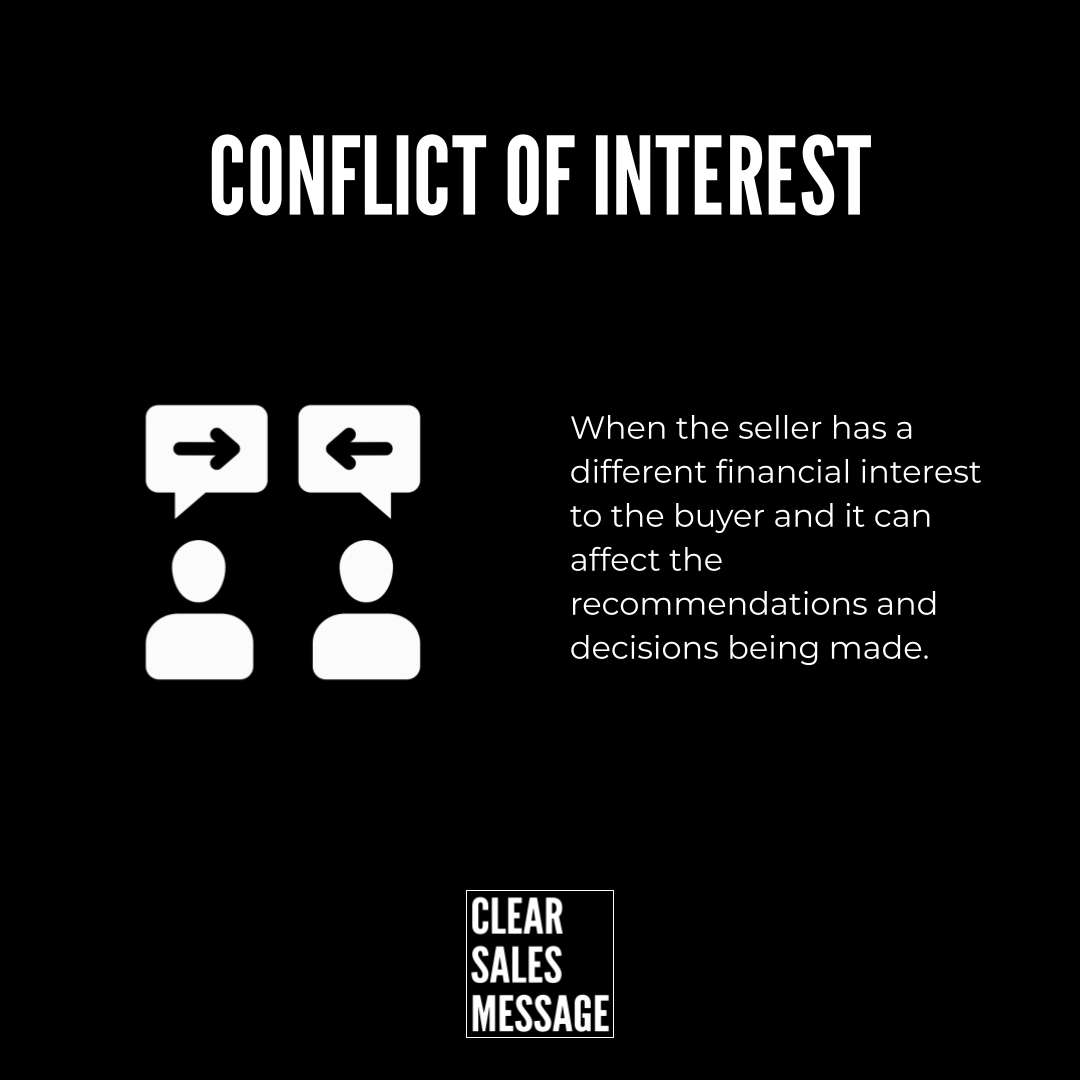
A conflict of interest happens when someone involved in a decision has competing motives that could shape their advice. In sales, that usually means the buyer suspects the seller’s recommendation is driven more by commission, targets, or personal gain than by what actually suits the client.
The important thing is that buyers do not need proof of this to pull back. Suspicion alone is often enough to slow or kill the sale.
How Does Conflict of Interest Affect Buyers?
Buyers constantly ask themselves whether a recommendation is genuine or self-serving. “Are they saying this because it suits me – or because it suits them?” The more doubt surrounds that question, the more cautious buyers become.
This matters most in industries where buyers already expect pressure or hidden motives. For example, financial services, recruitment, property, and car sales all carry a high level of built-in doubt. So trust is harder to earn and easier to lose in those spaces.
How Can You Reduce Conflict of Interest in Sales?
The best way to reduce it is to be more open, more honest, and more focused on what genuinely suits the buyer. People trust recommendations that feel balanced far more than those that sound perfect.
Put suitability first
Buyers often become more trusting when businesses openly admit trade-offs or flag when something may not be the best fit. That kind of honesty tends to increase trust rather than reduce it. Because it shows the advice is not just shaped by what earns the most. People trust balanced views more than perfect ones.
Explain the logic behind your advice
The clearer the reason behind a recommendation, the easier it is for buyers to feel it makes sense rather than just serving your interests. So show your working. Explain why this option, why now, and what it does for them. Clarity reduces doubt. And doubt is what kills deals.
Be open about how you get paid
Most buyers already know businesses need to make money. What damages trust is pretending that has no bearing on your advice. So if there is a financial link to a recommendation, say so. Buyers respect honesty. They do not respect being managed.
When Conflict of Interest Matters Most
It matters most when the buyer has to rely heavily on your guidance because they lack the knowledge to judge for themselves. For example, complex B2B sales, financial advice, medical decisions, and technical work all put the buyer in a position of trust. The bigger the knowledge gap, the more buyers weigh up motive. So the more important it is to be seen as genuinely on their side.
When Conflict of Interest Becomes Visible
Sometimes businesses expose it through behaviour rather than words. For example, pushing upgrades too hard, brushing past cheaper options, avoiding honest comparisons, or creating fake urgency. Buyers tend to feel that shift before they can name it. And once trust drops, it is very hard to get back.
Common Conflict of Interest Mistakes
Most businesses assume buyers do not notice when advice is shaped by incentives. But they usually do – and faster than most sellers expect.
Always pushing the most costly option
When every sales chat ends up at the highest price point, buyers start to wonder why. That doubt weakens trust because the advice starts to feel less like guidance and more like a script. So if the most costly option is genuinely the best fit, show why. Do not just assume the buyer will take your word for it.
Hiding how recommendations are shaped
Pretending incentives do not exist tends to backfire. Buyers are not naive. What damages trust is not having a financial interest – it is appearing dishonest about it. So be upfront. In high trust sales especially, open beats hidden every time.
Conflict of Interest – An Example
A financial adviser suggests a complex product with high fees. The buyer later finds out the adviser earns far more commission on that product than on simpler options. Straight away, the buyer starts to question whether the advice was right for them or just right for the adviser.
The issue is not just the commission. The issue is that the trust around motive has now gone – and that is very hard to repair.
See also