Practical Sales Training™ > How To Convert > Goal Matching

Goal Matching
Most sales pitches talk about the product. Goal Matching talks about the buyer. That one shift changes everything about how your message lands.
Buyers don’t care about your features. They care about what they’re trying to achieve, fix, or avoid. So when your message speaks directly to that goal, it feels relevant. And relevant messages convert far better than generic ones.
Goal Matching is the practice of connecting what you sell to what the buyer actually wants. Do it well and the sale becomes obvious. Get it wrong and even a great product feels like it’s not quite right for them.
What Is Goal Matching?
Goal Matching is the process of linking your offer directly to a buyer’s specific goal. Instead of listing features, you show how those features help the buyer get to where they want to be.
If a buyer wants to save time, lead with the outcome. Say: “Our software saves you 10 hours a week.” That connects a feature to a goal. That’s Goal Matching.
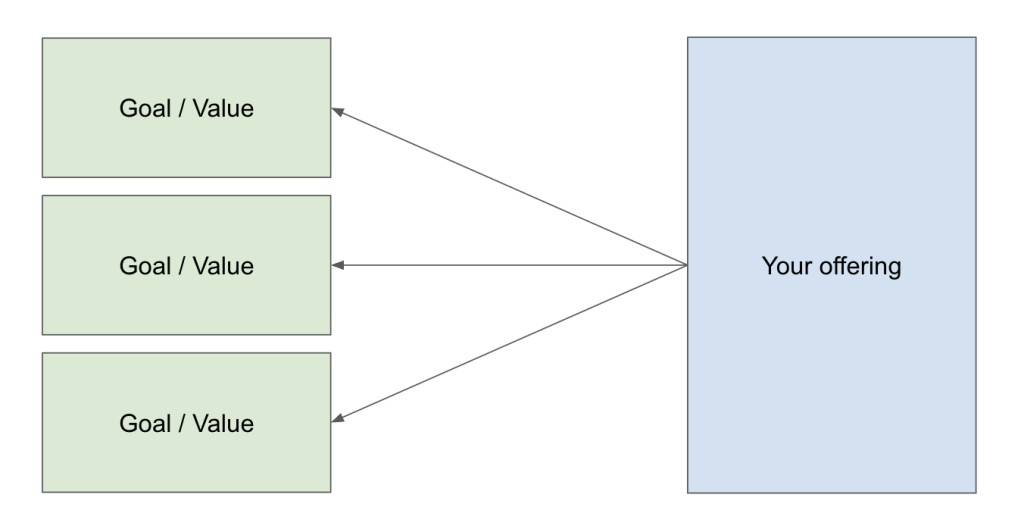
The diagram below shows how one offering can connect to multiple different buyer goals. Each arrow represents a match. The stronger the match, the easier the sale.
Why Does Goal Matching Work?
It works because buyers make decisions based on what helps them. When your message shows a clear line between their goal and your solution, the decision becomes much easier. There’s less to weigh up and less reason to hesitate.
It also builds trust. Talking about a buyer’s goals signals that you’ve listened and understood their situation. That matters more than product knowledge in many sales conversations, because buyers trust people who get them.
And it reduces friction. A buyer who can see exactly how your offer helps them reach their goal doesn’t need convincing. The connection does the persuasion for you.
How Can You Use Goal Matching In Sales?
Start with the goal, not the product
Before writing a message or preparing a pitch, ask yourself: what is this buyer actually trying to achieve? Then work backwards from that to the relevant features and outcomes.
Rewrite your product descriptions
Most copy leads with features. Instead, lead with the outcome the feature delivers. “Task boards” becomes “never miss a deadline.” “Automated reports” becomes “get your Monday mornings back.”
Ask questions before you pitch
In live conversations, ask questions before you pitch. Find out what the buyer wants to fix or achieve. Then position your offer as the route to that outcome. The pitch writes itself once you know the goal.
Use it in your content
Blogs, videos, and social posts that address specific buyer goals outperform generic content every time. “How to cut admin time in half” pulls far better than “features of our software.”
When Goal Matching Works Best
Goal Matching works best when you know enough about the buyer to match accurately. A vague goal like “grow the business” is too broad to work with. The more specific the goal, the more powerful the match. So ask deeper questions before you assume you know what the buyer wants.
It also works best when the match is genuine. Forcing a connection between your product and a goal it doesn’t actually serve will backfire. Buyers notice when the logic doesn’t hold, and that destroys credibility faster than any objection.
And it works best when used consistently. When your website, pitch, and proposal all talk about the same buyer goals, they create a coherent story. That kind of consistency is hard to say no to.
When Goal Matching Becomes Dangerous
The risk is assuming you know the goal without checking. Many sellers assume the goal rather than confirm it. They pitch to the goal they expect, not the one the buyer actually has. That disconnect is subtle but fatal.
There’s also a risk of over-matching. If every line of your pitch claims to solve every possible goal, it stops feeling tailored. It starts feeling like a template. Pick the two or three goals that matter most and focus there.
And if your product doesn’t genuinely match a goal, don’t try to make it fit. Overselling creates expectations you can’t deliver on. That leads to unhappy buyers, poor reviews, and churn.
Common Goal Matching Mistakes
Leading with features
A feature only earns its place in a pitch when it connects clearly to something the buyer wants. If you can’t name the goal a feature serves, leave it out of the conversation.
Using generic goal language
“Save time and money” applies to almost every product ever sold. Get specific instead. “Cut your monthly reporting time from four hours to thirty minutes” is Goal Matching. “Save time” is not.
Matching to the wrong person
In a complex sale, different stakeholders have different goals. The finance director cares about cost. An operations manager cares about process. Match to each one separately, because a pitch aimed at everyone lands with nobody.
Pitching before you’ve confirmed the goal
Many sellers skip straight to the pitch without confirming what the buyer actually wants. Always ask first. A pitch built on the wrong goal wastes everyone’s time and signals that you weren’t really listening.
Goal Matching – An Example
A company sells project management software. The buyer wants to reduce team miscommunication and missed deadlines. A generic pitch says: “Our software has task boards, calendars, and team chat features.”
A Goal Matching pitch says: “Our software ensures your team never misses a deadline. It sends automated reminders, assigns clear task owners, and gives you a live progress dashboard. So you spend less time chasing updates and more time delivering projects on time.”
Same product, same features. But the second version speaks to the buyer’s goal. So it feels like the obvious choice, rather than one option among many.
See also
- 180+ ways to improve conversion
- 100+ ways to get your buyer to take action
- Sell The Destination Not The Journey