Practical Sales Training™ > How to connect with your buyer > Group Names

Group Names
A flock of birds. A herd of cattle. A murder of crows. Group names, also called collective nouns, turn many separate things into one clear picture. And that picture sticks.
In sales, the same principle applies. Instead of listing five separate problems, you name them as one. Instead of describing a bundle of features, you give them a single memorable label. As a result, the buyer gets a cleaner, more vivid idea of what you’re talking about.
You don’t have to stick to the classics. You can invent your own. And when you do it well, a single group name can do more work than a full paragraph of explanation.
What Are Group Names?
Group names are words that describe a collection of people, animals, or things as a single unit. We know the classics: a herd of cattle, a flock of birds, a pack of wolves. Each one collapses many individual things into one sharp image.
In sales, you can use the same idea to make your message clearer and more commercial. Instead of saying “we help with leads, enquiries, and referrals,” you could say “we help you grow a pipeline of prospects.” The word “pipeline” is a group name. It’s simple, clear, and easy to picture.
You can also invent your own group names for the concepts, problems, and solutions in your world. In fact, a well-chosen made-up group name can be more powerful than a standard one, because it feels fresh and specific to you.
Why Do Group Names Work?
They work because giving a group an identity makes it easier to think about, talk about, and remember. Instead of holding five separate ideas in mind, the buyer holds one. That single label is lighter to carry. So it stays with them longer.
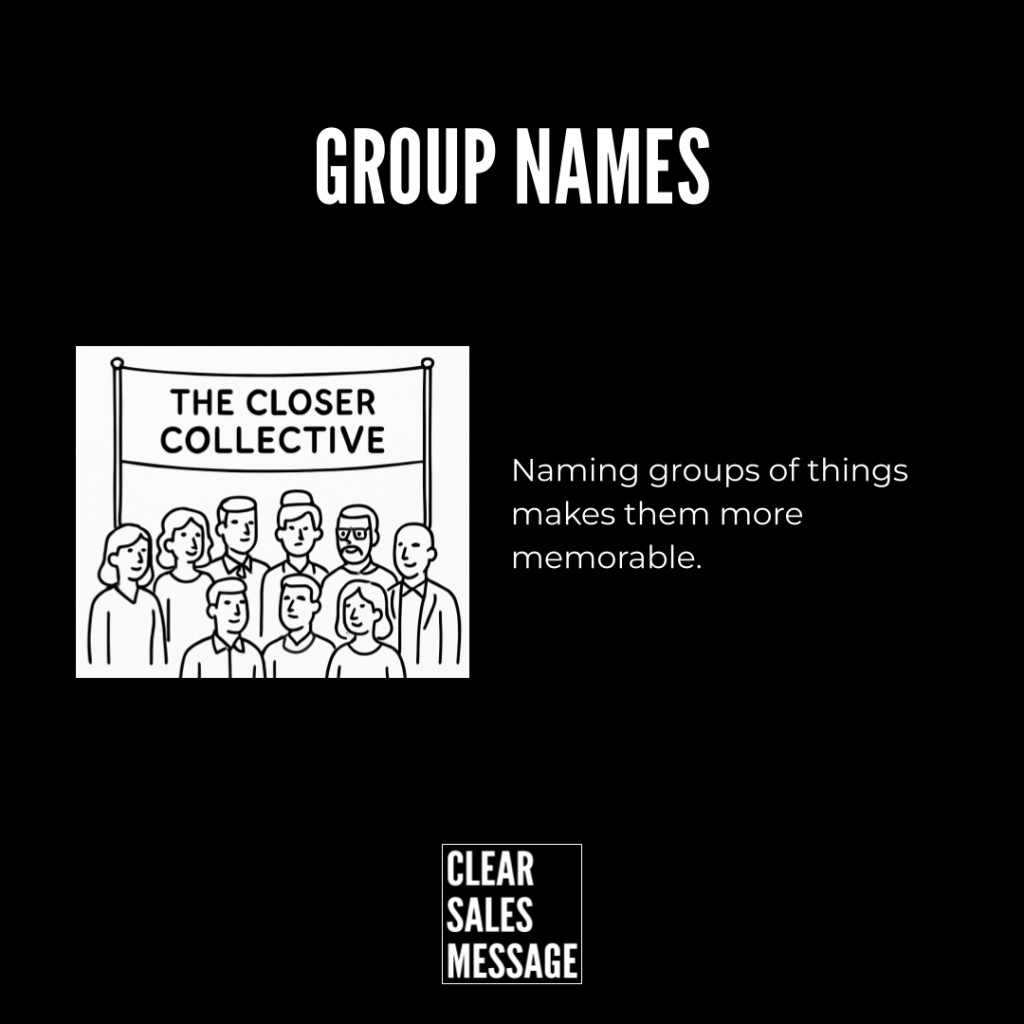
In sales and marketing, this matters in three specific ways. First, when you give your audience a group identity, they feel like they belong to something. Second, when you give a set of problems a group name, the pain feels more real and relatable. Third, when you give your solutions a group name, the outcome feels bigger and more tangible.
Group names also add personality to your message. A fresh or unexpected label makes buyers pause and engage. Because the phrase is unusual, it earns a second of attention that a plain description wouldn’t. And that second of attention is often the difference between a message that lands and one that gets forgotten.
How Can You Use Group Names In Sales?
Here’s a simple process for creating your own group names, followed by the main contexts where they work best.
How to Create One
Start by choosing what you’re naming a group of. Then think about the traits of that group. What’s the mood or vibe? Fast, heavy, noisy, surprising? Next, pick a tone: playful, serious, or elegant. Then find a word that matches those traits, something like “murmur,” “flock,” “storm,” or “spark.” Put it together as “a [word] of [subject].” Say it out loud. If it flows and feels right, you’ve got it.
For example: subject is ideas, traits are fast and surprising, word is “spark,” result is “a spark of ideas.”
Naming Problems
Group a buyer’s frustrations into one vivid phrase. “You’re probably dealing with a flood of admin tasks” is more memorable than listing five separate tasks. “Most salespeople face a silence of prospects after the first call” makes the pain feel real and relatable. Because the image is concrete, the buyer feels understood rather than described.
Describing Benefits
Turn your solution into a positive collective image. “With us, you’ll enjoy a spark of ideas every week” or “our software creates a wave of opportunities.” The outcome feels alive rather than flat. As a result, the buyer can picture what success looks like, which makes it easier to say yes to.
Framing Social Proof
Use group names to describe your client base or community. “We’ve helped a chorus of entrepreneurs simplify their sales” or “join the growing flock of businesses already using Clear Sales Message™.” These phrases give a sense of belonging. Because the buyer sees themselves as part of a group rather than an individual transaction, the connection feels warmer.
Branding and Offer Names
Group names work well in product names, course titles, lead magnets, and campaigns. “The Bundle of Breakthroughs,” “A Toolkit of Tactics,” and “A Vault of Value” all make the intangible feel tangible. Because the name itself creates a picture of what’s inside, the buyer’s interest is engaged before they’ve seen a single feature.
Storytelling and Content
Group names are strong in posts, headlines, and hooks. “Do you have a tangle of leads but no clear next step?” or “I’ll show you how to turn a trickle of enquiries into a river of sales.” They grab attention because they sound fresh and unusual. Similarly, they work well as repeated phrases in a piece of content, because the image builds each time the reader encounters it.
When Group Names Work Best
They work best when the collection you’re naming has a clear mood or character. A group name lands hardest when the word you choose reflects something real about the thing being named. “A flood of admin tasks” works because admin genuinely feels overwhelming. “A spark of ideas” works because ideas genuinely feel quick and surprising. So the more accurately the name captures the feeling, the more it resonates.
They also work well in spoken contexts. A well-chosen group name is easy to say and easy to repeat. So it travels well in conversations, presentations, and pitches. Because buyers carry the phrase away with them, it keeps working after the conversation has ended.
Similarly, they work well for building community identity. When you give a group of customers or followers a collective name, they feel part of something. That sense of belonging drives loyalty and word of mouth in a way that a plain description never could.
When Group Names Become Dangerous
They become a problem when the name is too abstract to create a real image. A group name only works if the word you choose connects to something the buyer can picture. If the phrase sounds clever but means nothing, it adds noise rather than clarity. So test every group name by asking: does the image this creates actually help?
They can also misfire when forced or overused. One strong group name in a message is memorable. Five group names in the same paragraph feel like a stylistic trick. The technique works because it’s unexpected. So use it sparingly enough that each instance feels fresh rather than formulaic.
And they can go wrong when the tone doesn’t match the context. A playful group name in a formal proposal can feel out of place. So match the tone of the name to the tone of the conversation. Because a phrase that works brilliantly in a social post may feel odd in a board-level pitch.
Common Group Name Mistakes
Choosing a Word That Doesn’t Fit the Feeling
The word has to match the character of the group it names. “A murmur of complaints” works because complaints feel quiet and persistent. “A storm of complaints” works because they feel sudden and heavy. But “a sparkle of complaints” doesn’t work, because the word carries the wrong emotional tone. So always check that the image the word creates matches the feeling you want to convey.
Using It Too Often in the Same Piece
Group names earn attention by being unexpected. However, if every sentence contains one, the novelty disappears fast. Use one or two strong ones per piece of content. Let them stand out. Because the contrast between plain language and a vivid group name is exactly what makes the technique work.
Making It Too Complicated
The best group names are simple. They don’t require explanation. If you have to spend two sentences unpacking what your group name means, it’s too abstract. So aim for phrases that land in a second. A group name that needs a footnote has missed the point entirely.
Forgetting to Say It Out Loud
A group name that looks good on a page but sounds awkward when spoken creates friction. Because group names travel through conversation, they have to work as spoken language, not just as written copy. So before you commit to one, say it out loud in a full sentence. If it sounds natural, it’s ready. If it doesn’t, keep working on it.
Group Names – An Example
Consider two ways to describe the same sales problem. Version one: “We see a lot of businesses struggling with inconsistent leads, poor follow-up, and no clear message.” Version two: “Most businesses we talk to are drowning in a fog of missed opportunities.” The second version uses a group name. It’s shorter. It’s more vivid. And it sticks.
Now try it with a benefit. Version one: “Our training gives your team better skills, more confidence, and clearer language.” Version two: “Our training gives your team a toolkit of tactics they can use from day one.” The group name makes the outcome feel concrete and immediate. As a result, the buyer can picture what they’re getting before they’ve signed anything.
That’s the power of a well-chosen group name. It turns a list into a picture. And pictures sell.
See also
- 150+ ways to connect with your buyer
- 100+ ways to be more memorable
- Named Behaviour
- The People Like You Effect