Practical Sales Training™ > Wordplay > Kangaroo Words
Kangaroo Words
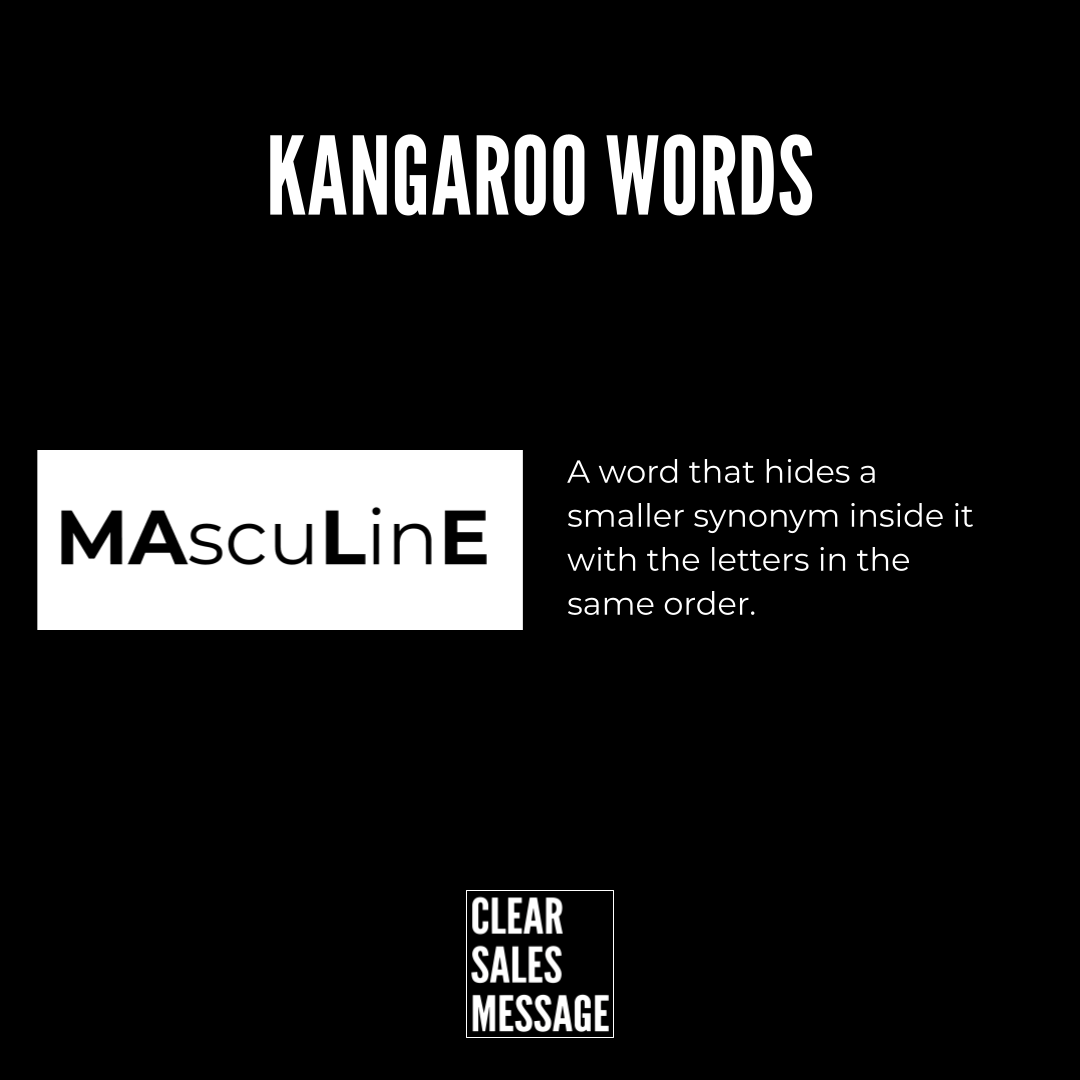
Some words carry more than they appear to. Look closely at masculine and you will find male hiding inside it. Hidden inside chicken is hen. And buried in resign is sign.
These are Kangaroo Words – words that contain a smaller word with a similar meaning, like a joey in a pouch. In wordplay for sales, you surface that hidden word visually so readers see two layers of meaning at once.
It is a subtle technique, but it creates a small moment of delight that makes your message stick in a way plain text rarely does.
What Are Kangaroo Words?
A Kangaroo Word is a word that contains a smaller word inside it that means almost the same thing. The inner word sits hidden within the letters of the outer word – related in meaning but invisible unless you look for it.
In sales and marketing, the technique goes further. You highlight the hidden word visually through capitalisation, colour, or bold weight, so readers see both meanings at once. The outer word carries your main message, while the inner word adds a layer of emphasis, benefit, or wit.
The result is two meanings for the price of one. Because the reader notices the hidden word themselves, it creates a small personal moment of discovery that plain copy cannot replicate.
Why Do Kangaroo Words Work?
Our brains are wired to spot patterns. When a reader notices the hidden word inside a larger one, there is a tiny “aha” moment – a flash of recognition that makes the message feel clever rather than just informative. That feeling increases engagement and helps the message stick.
There is also an efficiency gain. Instead of adding more copy to layer in a second meaning, the Kangaroo Word does it visually inside a single word. So the message stays tight while the depth increases – which makes it ideal for headlines, slide titles, and social posts where space is limited.
The visual styling also guides attention naturally. By changing the case or colour of the inner letters, you direct the reader’s eye without adding any extra punctuation, brackets, or explanation. As a result, the design does the work your copy does not need to.
How Can You Use Kangaroo Words In Sales?
Headlines and taglines
Look for a key word already in your headline and check whether it contains a smaller word worth surfacing. A fitness brand using the word trAIning could highlight AI to signal tech-led training without adding any extra copy. The hidden word does the heavy lifting quietly, so the headline stays clean.
Product names and sub-brands
Build names where the inner word reinforces the core benefit, then style it so buyers notice. cAREful surfaces ARE as a signal of attentiveness. Even when the inner word is not a strict linguistic match, the visual layering still creates intrigue and makes the name more memorable than a plain alternative.
Visual hooks in graphics and slides
Take a key word in a slide title or social graphic and capitalise, colour, or bold just the inner letters. This adds a visual layer to the word without cluttering the design. Social carousels, website hero images, and deck section dividers all benefit from this approach – because a single strong word can carry more meaning than a sentence when it is styled well.
Hidden easter eggs in branding
Use Kangaroo Words as a quiet reward for attentive readers. A slide series where every title hides a relevant inner word, or a campaign where the hidden word always points to the core benefit, creates a consistent thread that engaged audiences will notice and remember. People who spot it feel clever – and that feeling attaches to your brand.
When Kangaroo Words Work Best
They work best when you need to say more in less space. In a headline, a social caption, or a slide title, you cannot always add words to deepen the message – but a Kangaroo Word gives you a second layer of meaning without adding a single character to the word count.
They are also effective when you want to signal intelligence or craft in your brand voice. A well-placed hidden word tells readers you think carefully about language, and that attention to detail reflects well on everything else you do.
Visual formats where typography is part of the design suit this technique particularly well. When the styling of the hidden letters is deliberate and clean, the result looks considered rather than gimmicky – so the execution matters as much as the word choice itself.
When Kangaroo Words Become Dangerous
The risk is forcing it. Not every word contains a useful hidden word, and trying to make one work when it does not creates confusion rather than delight. If you have to stretch the meaning to make the connection, the reader will feel the effort and the technique will fall flat.
Overuse is another danger. One clever Kangaroo Word in a campaign is memorable, but if every headline and every slide title uses the technique, it starts to feel like a formula. The spark of discovery that makes it work disappears when the audience starts to expect it.
Visual execution matters too. Clumsy or inconsistent styling of the inner letters draws attention to the design rather than the message – and a badly executed Kangaroo Word looks like a typo rather than a deliberate choice. Always test the visual version before publishing.
Common Kangaroo Words Mistakes
Choosing a hidden word that confuses
The inner word should reinforce or complement the outer word’s meaning – not contradict it or send the reader somewhere unexpected. Always check that both layers work together before you commit, because a hidden word that creates a mixed message undermines the whole point of the technique.
Making it too hard to spot
The visual styling needs to be clear enough that readers actually notice the inner word. If the colour difference is too subtle or the capitalisation too faint, the hidden word stays hidden and the technique adds nothing. Test it at small sizes and on different screens to make sure it lands clearly.
Prioritising cleverness over clarity
Kangaroo Words should add to the message, not replace it. If the outer word is unclear without the inner word, the technique has become a puzzle rather than a hook. People who notice the hidden word should feel rewarded – but people who do not should still receive a clear, simple message.
Kangaroo Words – An Example
Here are some Kangaroo Words in action. In each case, the inner word is highlighted to show how the technique works visually – and how a single word can carry two meanings at once:
- male… masculine – contains male
- chen… chicken – contains hen
- reSIGN – contains sign
- trAIning – highlights AI for a tech-led fitness brand
- cAREful – surfaces ARE as a signal of attentiveness
People who notice the inner word get a small moment of delight. Those who do not still receive a clear message. Either way, the Kangaroo Word has done its job without getting in the way of the sale.
See Also