

Practical Sales Training™ > How To Get Attention > Matryoshka Words
Matryoshka Words
A Matryoshka doll contains a smaller doll inside it. And inside that, another. Matryoshka Words work the same way. A larger word hides a smaller one inside it, and when you reveal that connection, you get a moment of clever surprise that sticks in the mind.
In sales and branding, that moment of surprise is worth a great deal. Most words wash over people. A word that makes someone look twice, think for a second, and then smile is far harder to forget.
Matryoshka Words take effort to find, but when they work, they do the job of a whole tagline in a single term.
What Are Matryoshka Words?
Matryoshka Words are words that contain a second, smaller word within them. That inner word carries its own meaning and connects directly to what the brand or product does. So the outer word and the inner word work together to say two things at once.
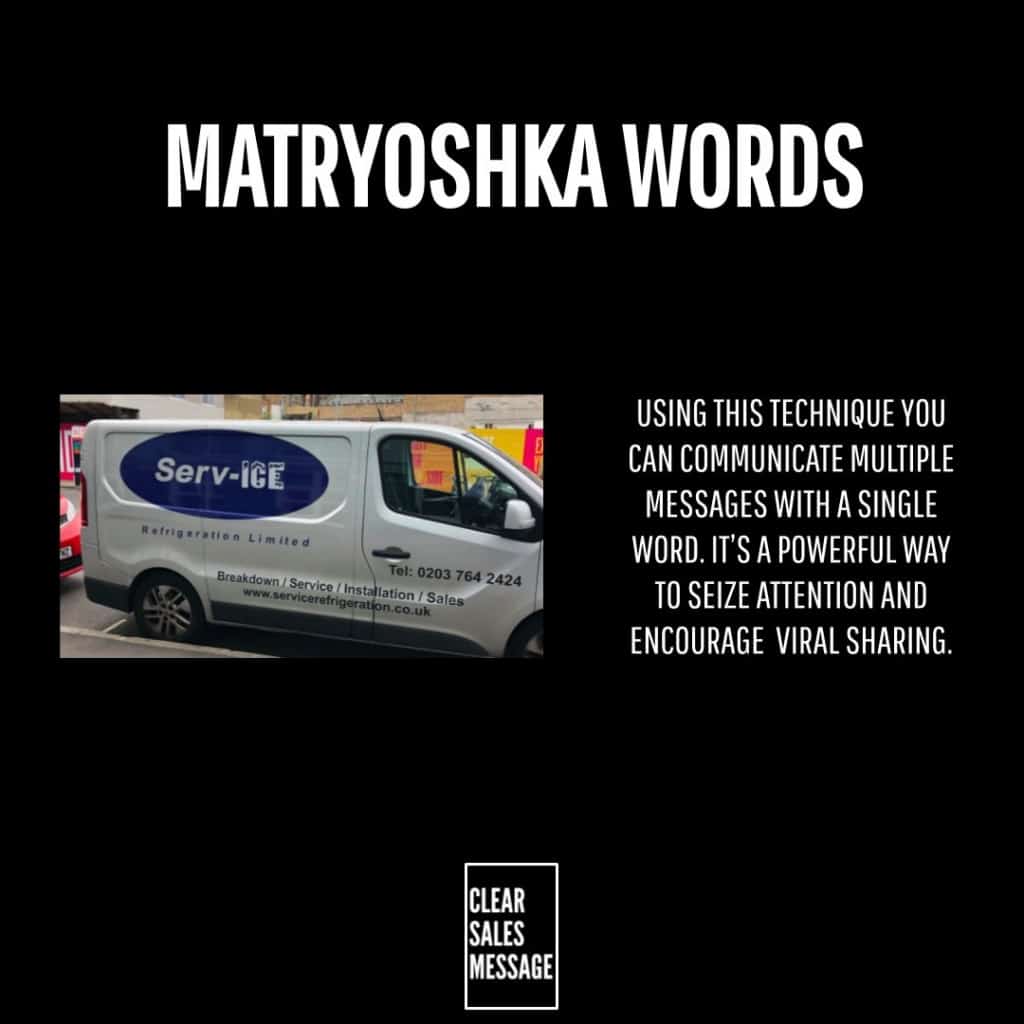
A classic example is a company called “Serv-ICE” that sells cold drinks. The word “service” already describes what they do. But “ICE” sits hidden inside it, highlighted with a hyphen, pointing directly at the product. Both meanings land in a single word. That kind of double meaning is hard to achieve and very effective when it works.
You find Matryoshka Words in brand names, taglines, logos, and headlines. Any context where a single word needs to do more than one job is a good candidate for the technique.
Why Do Matryoshka Words Work?
They work because they catch the eye and hold the mind. Most copy passes by in a blur. But a word with a hidden word inside it creates a small puzzle. The reader notices something unusual, stops, and takes a second look. That pause is valuable. Because attention is what every brand is competing for.
Matryoshka Words also work because of The Bizarreness Effect. We remember unusual things better than ordinary ones. A word that reveals a hidden meaning is unusual by definition. So it stays in the memory longer than a straightforward brand name or plain descriptive word ever would.
Also, clever wordplay creates a sense of wit and confidence. When a brand name or tagline shows that kind of intelligence, buyers tend to assume the same standard applies to the product itself. So Matryoshka Words do not just get attention. They also build a positive impression of the brand behind them.
How Can You Use Matryoshka Words In Sales?
Finding a good Matryoshka Word takes patience. But the process is straightforward once you know where to start.
Start With Your Pivotal Word
Begin with the most important word in your offering. This is the word that defines what you do or who you serve. For a cold drinks company, that word is ICE. A fitness brand, it might be FIT. A legal firm, it could be LAW. Once you have that word, you have your building block. Everything else flows from finding a larger word that contains it naturally.
Search for Words That Contain It
Once you have your pivotal word, search for all the words that contain it. Tools like TheFreeDictionary let you search for words that start with, end with, or contain any sequence of letters. Run your pivotal word through that search and review the results. You are looking for a word that is already relevant to your business, product, or message. Not every match will work. But when the right one appears, it is usually obvious.
Reveal It Visually
The hidden word only works if the reader can see it. Use capitalisation, a different colour, a hyphen, or a bold weight to make the inner word visible. Without that visual cue, the double meaning stays hidden and the effect is lost. So the design is as important as the word itself. Work with a designer to find a treatment that highlights the inner word without making the outer word look broken or forced.
Use It in Logos, Names, and Taglines
Matryoshka Words work best in places where a single word or short phrase carries the most weight. Brand names, product names, straplines, and headline copy are all strong candidates. Social media posts and email subject lines can also benefit from the technique when the hidden word adds genuine meaning. Avoid forcing it into long-form copy where it can feel contrived rather than clever.
When Matryoshka Words Work Best
They work best when the connection between the inner word and the outer word feels natural and inevitable. If the reader has to be told why the two meanings relate, the effect fails. Good Matryoshka Words make the connection obvious the moment the reader spots it. That instant of recognition is where all the value lies.
Also, they work best when the outer word is genuinely useful on its own. If the only reason the word exists is to contain the hidden one, the whole thing feels like a trick. But when the outer word already does a job for the brand and the hidden word adds an extra layer on top, the result is intelligent rather than gimmicky.
For logos and visual branding, they are especially powerful. A word mark that rewards a second look builds familiarity and interest every time someone sees it. So over time, the brand name becomes something people notice and remember rather than something they scroll past.
When Matryoshka Words Become Dangerous
The main risk is forcing a connection that does not quite work. If the hidden word requires a stretch of logic to connect to the product, the reader feels confused rather than clever. Confusion does not build brand affinity. So if the match is not clean and obvious, it is better to keep searching than to use something that almost works.
There is also a risk of obscurity. If the hidden word is too subtle, nobody spots it. Then the Matryoshka effect is invisible, and all you have is a slightly unusual word with no payoff. So always test the word with a fresh pair of eyes. Ask someone who has not been involved whether they notice the hidden meaning without any prompting.
However, the biggest danger is overusing the technique. One well-placed Matryoshka Word in a brand name or tagline lands with impact. Multiple attempts across all your copy start to feel like a puzzle book rather than a brand. So use it once, in the place where it matters most, and let it do its work.
Common Matryoshka Word Mistakes
Choosing a Pivotal Word That Is Too Obscure
One common mistake is building around a word that buyers do not immediately associate with the product. Your pivotal word needs to be the first or second word a buyer would use to describe what you do. If it is a technical term, an internal word, or something only insiders recognise, the hidden meaning will not land. So always start with the word that matters most to your buyer, not the word that matters most to you.
Not Making the Hidden Word Visible
Another mistake is finding a great Matryoshka Word and then doing nothing to reveal the hidden element. In plain text with no visual treatment, the double meaning disappears entirely. So always apply a clear visual cue. Whether that is capitalisation, colour, weight, or a hyphen, make sure the inner word jumps out. Because a Matryoshka Word that nobody notices is just a word.
Settling for a Forced Match
A third mistake is using a word that almost works because finding the perfect match is taking too long. A Matryoshka Word that requires explanation defeats its own purpose. Keep searching until the connection is clean, relevant, and immediately obvious. Because a clever word that clicks instantly is worth ten times more than a strained one that needs a footnote.
Matryoshka Words – An Example
A company that sells cold drinks calls itself “Serv-ICE.” The word “service” already tells you what they do. But “ICE” sits inside it, highlighted by a hyphen, connecting the name directly to the product they sell. Both meanings land at once. Neither one requires explanation.
An eco-friendly packaging company could achieve the same effect with “comPLANETary solutions”. The word “complementary” already works. But PLANET sits inside it, making the environmental message impossible to miss.
A tech security firm might use “InSURance”, with SUR highlighted to suggest “Secure.” Again, the outer word is already relevant. The inner word adds a second layer of meaning that reinforces the brand’s core promise.
In each case, the technique works for the same reason. Two meanings land in one word, the reader notices the cleverness, and the brand becomes more memorable as a result. That is what a well-executed Matryoshka Word delivers every time someone sees it.
See Also