Understand Your Buyer > Wordplay > Lipogram
Lipogram
Most sales messages try to say everything. Every feature, every benefit, every reason to buy. But sometimes what you leave out is more powerful than what you put in.
A lipogram is writing where a letter is left out on purpose. It sounds like a party trick. However, the idea behind it is directly useful in sales.
When something is missing, people notice. And noticing is the first step to buying.
What Is a Lipogram?
A lipogram is writing that leaves out a specific letter. For example, a story written with no letter E at all. It is a form of constrained writing, where the restriction itself becomes the creative driver.
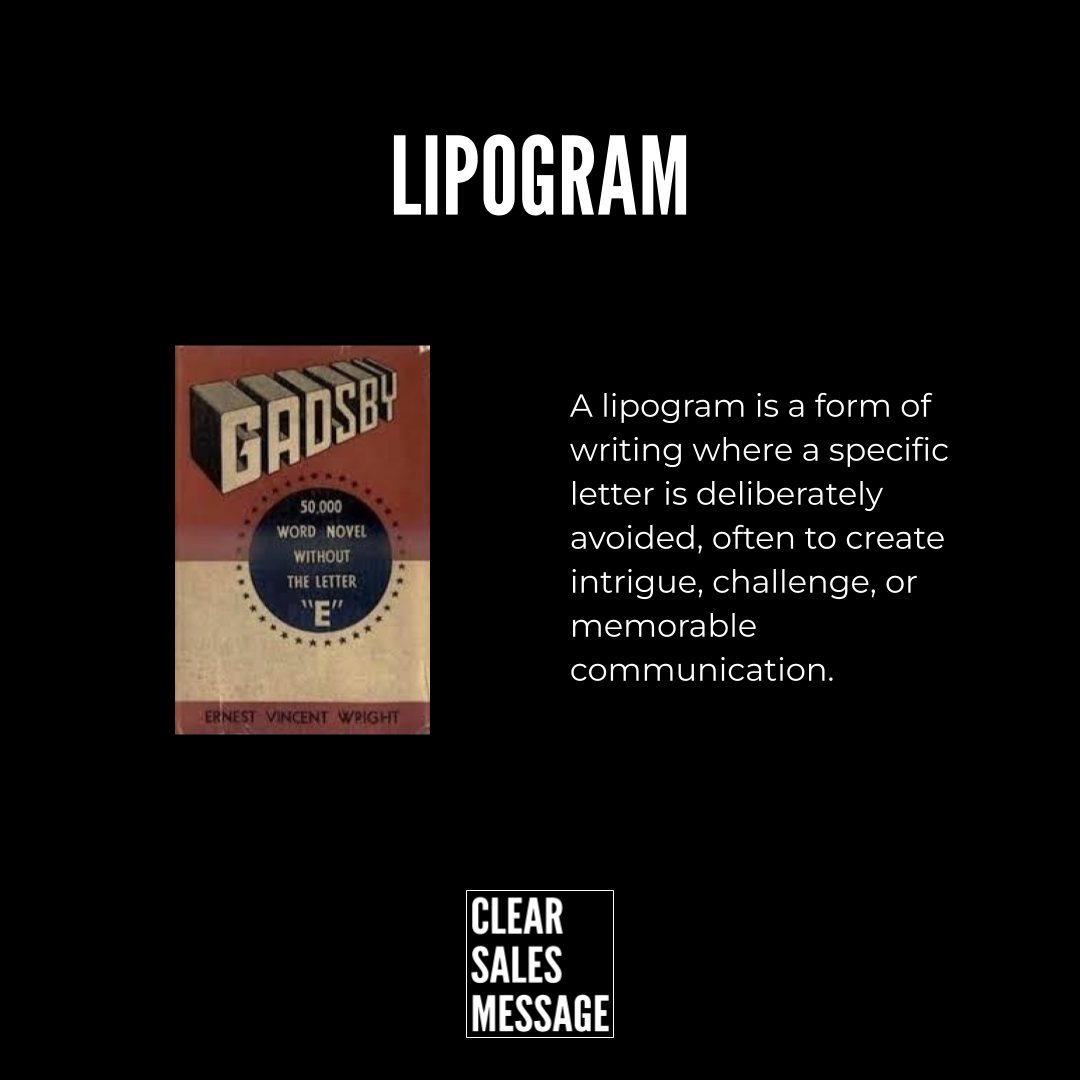
Georges Perec wrote a 300-page novel without using the letter E. Similarly, Ernest Vincent Wright wrote his 50,000-word novel Gadsby without one either. Neither feels broken. In fact, both feel clever and deliberate.
That is the point. A good lipogram does not feel like something is missing. Instead, it feels like something is different. And different gets attention.
Why Do Lipograms Work?
Constraints force creativity. When common words are off-limits, you find new ways to say things. As a result, the restriction produces fresh thinking that would not have existed otherwise.
For buyers, the effect is similar. Once they know something is missing, they start looking for it. That curiosity keeps them engaged. And because engagement leads to understanding, it also leads to buying.
There is also a memorability factor. A message with a deliberate quirk sticks far longer than a plain claim. Memorable messages get repeated. And repeated messages sell.
How Can You Use Lipograms In Sales?
The lipogram principle is not about avoiding letters in your proposals. Instead, it is about using intentional omission to spark curiosity and make your message stick.
So think about what you leave out. Then use that absence as a hook.
Use omission to create curiosity
A subject line that leaves something out. A headline that stops before the punchline. A post that hints without naming. All of these use the lipogram principle – the gap pulls people in. For example, “This email contains no buzzwords. See if you agree.” That is a challenge. And because it is a challenge, people read to find out if you are right.
Use constraints to sharpen your message
Try writing your pitch without using the word “we”. Or alternatively, describe what you do without using your industry’s most common jargon. The constraint forces clearer language. In fact, most businesses find their message improves significantly when they remove the words they lean on most.
Use it as a content hook
A post or email built around a lipogram challenge is easy to share. For instance, “This product description has no adjectives” or “We wrote our about page without using the word passionate.” Both create intrigue and invite engagement. As a result, that engagement builds awareness without feeling like a pitch.
When Lipograms Work Best
When you need to stand out and straight messaging is not cutting through. Lipograms work well in content, social media, and email subject lines. They also work well as a creative exercise – especially when your message feels stale or generic.
When Lipograms Become Dangerous
When the trick becomes the point. If people remember the gimmick but forget what you sell, it has worked against you. So the omission has to serve the message, not replace it. It also has to feel intentional – otherwise it just looks like a mistake.
Common Lipogram Mistakes
Most people either dismiss lipograms as gimmicks or go too far with them. However, both approaches miss the point.
Making it too obscure
If the audience does not notice what you have done, the effect is lost. So the constraint has to be visible enough to create curiosity, but not so complex that it confuses. A missing letter in a long paragraph will not land. A missing word in a short headline, however, will.
Prioritising cleverness over clarity
A lipogram that makes your message harder to understand works against you. Clarity always comes first. So if the constraint forces awkward phrasing, drop it. Be clear, not clever. Clever is a bonus, not a strategy.
Lipogram – An Example
A marketing agency rewrites their homepage. The new version reads: “Our work wins awards, attracts clients, and builds brands. No buzzwords or jargon. None of the waffle you see everywhere else.”
The deliberate omission of typical agency language makes the page feel different. As a result, visitors stay longer and trust it more. The absence of the expected becomes the most compelling thing on the page.
See also