Practical Sales Training™ > Wordplay > Malapropism
Malapropism
What Is It
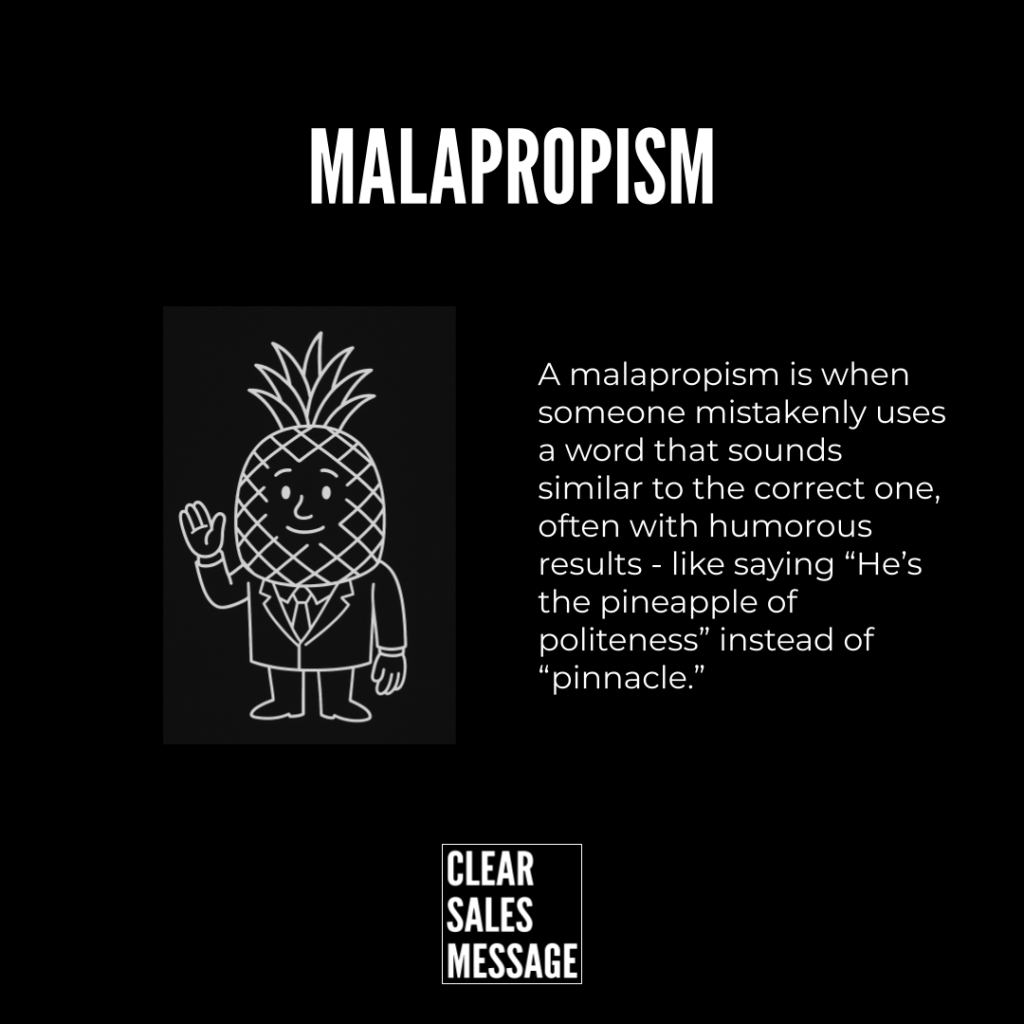
Someone reaches for an impressive word, and grabs the wrong one entirely. He’s the pineapple of politeness, they say, meaning pinnacle. Nobody corrects them, because it’s somehow funnier than the word they meant.
That’s a Malapropism. It’s when someone swaps in the wrong word for one that just sounds similar. We cannot let terrorists hold us hostile, instead of hostage. Texas has a lot of electrical votes, instead of electoral. It’s usually unintentional, slightly off, and often quite funny. It happens when someone reaches for a big word and grabs the wrong one that merely sounds close.
Why Does It Work
It works because it reveals something genuinely human. So we all misstep with language sometimes, and these slips feel both relatable and entertaining.
They’re surprising, since the unexpected word creates a small jolt. So they’re funny too, because the gap between intent and result is often absurd. They’re revealing as well, adding charm or vulnerability to whoever said it. In the right context, a malapropism doesn’t just entertain. It creates connection.
How Can You Use It
In Humour Or Storytelling
So use malapropisms in humour or storytelling. It’s a mute point. He’s the escape goat. They’re going to the suppository of history. Lines like these give a character a distinct voice, and usually earn a smile.
In Branding Or Content
Use one in branding or content too. We go the extra mild. The perfect illusion of control. So this works best when your audience is clearly in on the joke.
In Teaching Or Explaining
They’re also useful for teaching, since a malapropism highlights the gap between two similar-sounding words. A lighthearted mistake teaches fast.
When It Works Best
This works best when the audience already knows the word you’re twisting. So the humour depends entirely on people spotting the gap themselves.
It also works well in character voice, where a slip adds personality rather than confusion. Consistency reads as charm.
When It Becomes Dangerous
This becomes a problem if people think the mistake is genuinely yours, not a deliberate choice. An unclear one damages credibility.
It also falls flat if the audience doesn’t know the correct word at all. So the joke needs a shared reference point to land.
Common Mistakes
Forcing It Where It Doesn’t Fit
Some writers force a malapropism where a normal word would actually work better. So save it for the moment that genuinely benefits from the twist.
Overusing The Device
Others overuse the device until every line feels like a bit, rather than a genuine character trait. So pace it out across the piece.
Borrowing A Slip That Doesn’t Fit
Some writers borrow a malapropism from someone else’s voice without checking if it fits their own. Make sure the slip fits.
Malapropism – An Example
The Original Mrs. Malaprop
The term itself comes from Mrs. Malaprop, a character in an eighteenth century play who constantly reached for impressive words and missed. She meant pinnacle. She said pineapple instead. So the mistake was so memorable it gave the whole pattern its name. Nearly two hundred fifty years later, we’re still making the exact same slip.
See also: