

Practical Sales Training™ > How to connect with your buyer > Positively Ambiguous
Positively Ambiguous
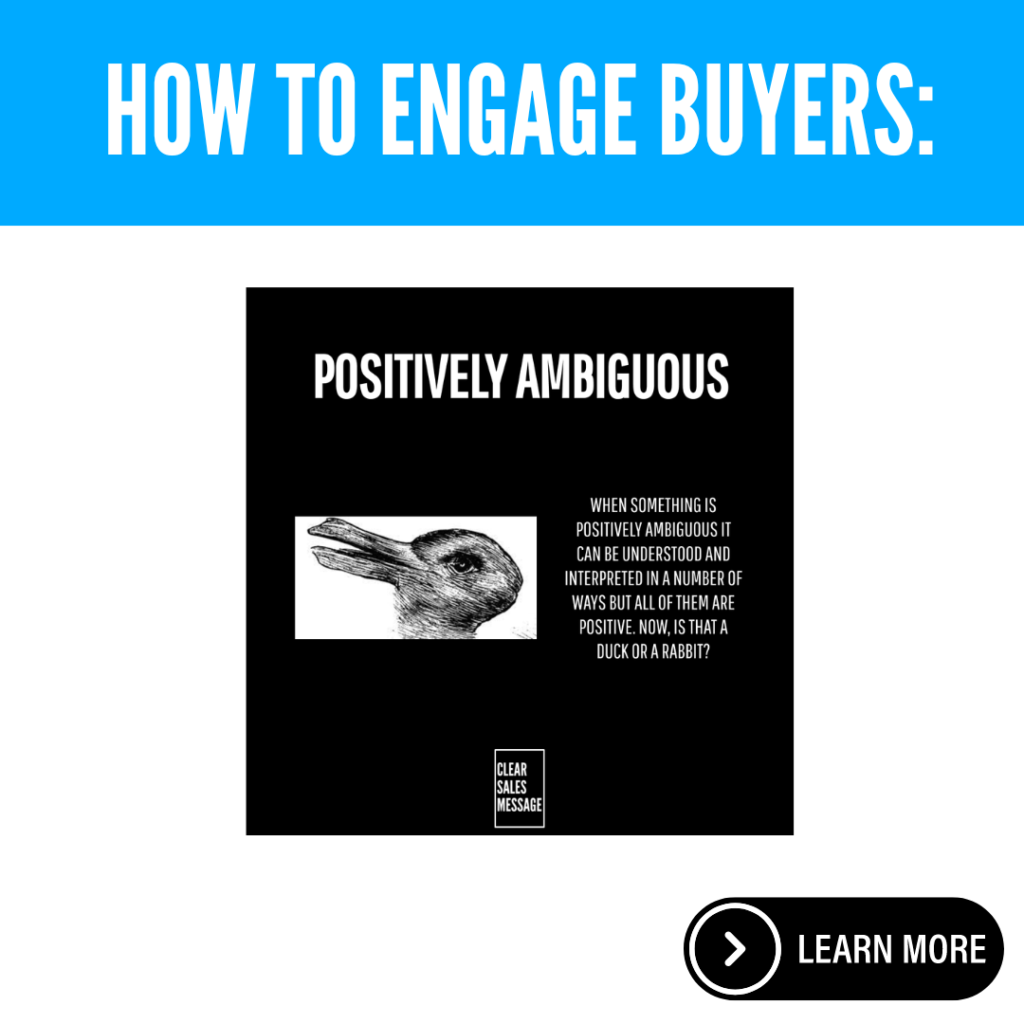
Some messages land with everyone. Not because they say something different to each person, but because each person reads something different into them. That is what being Positively Ambiguous looks like in practice. The words are open enough to fit many situations, but every fit feels good.
This is not vagueness for the sake of it. Vague messaging that could mean anything, good or bad, confuses buyers and loses sales. Positively Ambiguous messaging is different because every interpretation leads somewhere positive. The buyer brings their own meaning. Your message simply makes room for it.
It is a characteristic of great sales communication, not a trick. When you write in a way that is Positively Ambiguous, you are not hiding something. You are leaving space. And buyers, who are always looking for reasons to connect with what you offer, will use that space to convince themselves you understand them.
What Does Positively Ambiguous Mean?
Something is Positively Ambiguous when it can be understood in more than one way, but all of those ways are positive. The buyer reads it and thinks it applies to them. Another buyer reads it and thinks the same thing, even though their situation is completely different.
The key is that the ambiguity never creates doubt or confusion. It creates resonance. Because the buyer fills in the blank with their own context, the message feels tailored even when it is not. That feeling of being understood is one of the strongest drivers of connection in sales.
Think about phrases like “the best price possible” or “the service you would expect.” Neither of these pins down an exact promise. But both feel positive. Both give the buyer something to attach their own meaning to. So the message lands differently for different buyers, and it lands well every time.
Why Does Being Positively Ambiguous Work?
It works because selling is about finding a point of connection. Buyers do not need to hear every detail to feel understood. They need to feel that what you are saying applies to them. When your message is Positively Ambiguous, buyers do that work themselves. They map your words onto their world, and the fit feels natural.
There is also a psychological reason. When we make sense of something ourselves, we trust it more than when someone spells it out for us. A buyer who reads your message and thinks “that’s exactly what I need” has arrived at that conclusion on their own. Because it feels like their idea, it carries more weight than if you had simply told them the same thing directly.
Positively Ambiguous messaging also works across a wider audience. A specific promise will connect with some buyers and miss others. But a well-crafted Positively Ambiguous phrase connects with many buyers at once, because each one reads their own version of it. That breadth is valuable, especially in advertising or broad outreach where you cannot tailor every message individually.
Finally, it reduces the risk of alienating anyone. Overly specific claims can put buyers off if the detail does not match their situation. When your message is open enough to include them, however, they stay in the conversation long enough for the real connection to happen.
How Can You Be Positively Ambiguous In Sales?
The goal is to write phrases that feel meaningful and personal without locking the buyer into a single reading. Here are some ways to build this into your messaging.
Use Outcome-Focused Language
Focus on the result the buyer wants rather than the method you use. “Move your business forward” means something different to every business owner, but it feels relevant to all of them. Because the outcome is positive and the detail is left open, each buyer slots their own version of success into the phrase.
Reference Standards Without Defining Them
Phrases like “the service you would expect” or “the quality you deserve” work because they anchor to the buyer’s own standard, not yours. Every buyer has a view of what good service looks like. When you reference that standard without specifying it, the buyer assumes you share their definition. That assumption builds trust quickly.
Avoid Negatives in Your Ambiguity
The difference between ambiguity and Positive Ambiguity is that every reading must be good. So avoid phrases that could be read as a warning, a caveat, or a limitation. Any phrase that could land as bad news needs a rewrite. The message only works when all roads lead somewhere positive.
Test It on Different Buyer Types
Before you use a Positively Ambiguous phrase in your messaging, run it past a few different people. Ask them what it means to them. Good answers will vary but all feel positive. Any reading that feels flat or off means the wording needs work, so adjust it until every version lands well.
Use It in Headlines and Taglines
Positively Ambiguous phrases work especially well in short, high-visibility copy. A headline, a tagline, or the opening line of an ad is read quickly and broadly. Because there is no time for detail at that stage, a phrase that resonates with many readers at once gives you the widest possible reach before the buyer decides to look closer.
When Being Positively Ambiguous Works Best
This characteristic works best in broad messaging where you are speaking to many different buyers at once. Advertising, social media, website headlines, and email subject lines are all places where Positively Ambiguous language can do a lot of work. Because the audience is wide and varied, a message that can be read in multiple positive ways reaches further than one that is narrowly specific.
It also works well early in the sales process, when you are trying to create interest rather than close a deal. At that stage, buyers are not looking for fine print. They are looking for a reason to pay attention. A Positively Ambiguous message gives them that reason without demanding too much in return.
Similarly, it works when your product or service genuinely solves different problems for different buyers. If your offer has real breadth, Positively Ambiguous language reflects that honestly. It is not a stretch. It is simply an accurate way of saying that what you do applies in many ways.
When Being Positively Ambiguous Becomes Dangerous
The risk is in using it too late in the sales process. Early on, open language creates connection. But as a buyer gets closer to a decision, they need specifics. If your messaging is still Positively Ambiguous at the proposal or closing stage, it starts to feel evasive. Buyers who cannot get a straight answer begin to doubt you.
There is also a risk of overpromising without realising it. When a buyer fills in the blank with their own expectations and you fail to meet them, the result is worse than if you had never connected in the first place. So use Positively Ambiguous language to open the door, but make sure the conversation behind it can deliver on whatever meaning the buyer brought to it.
Finally, it can tip into meaninglessness if overused. If every line in your messaging is open and non-specific, buyers stop finding meaning in any of it. Use the characteristic selectively, where it earns the most. Reserve the specifics for the moments that need them.
Common Positively Ambiguous Mistakes
Confusing It With Being Vague
Vague messaging leaves buyers unsure what you mean. Positively Ambiguous messaging leaves buyers sure of what they want it to mean. The difference is intention and outcome. When a buyer reads your phrase and feels unclear or uncertain, it is not Positively Ambiguous. It is just unclear. Rewrite it until every reading leads somewhere good.
Letting It Replace Real Substance
Positively Ambiguous language works as an opener, not as a substitute for real value. If your entire pitch is built on open phrases with no detail behind them, buyers will eventually notice. Use this characteristic to attract attention and create connection, but back it up with something concrete when the buyer is ready to hear it.
Using It Without Thinking About All Possible Readings
Not every open phrase is positive. Some can be read as a warning, a hedge, or a sign of weakness. Before you use a phrase, think carefully about every way it could land. One negative reading is enough to undo the effect, so always check the full range of possible meanings before you commit to the wording.
Carrying It Into the Close
At the closing stage, buyers need clarity. They are about to make a decision and they want to know exactly what they are getting. Positively Ambiguous language at this point feels like a stall. So shift gears as the conversation develops. Open language gets buyers in the door. Specific language gets the deal done.
Positively Ambiguous – An Example
A fitness coach runs a Facebook ad with the tagline: “Get the results you deserve.”
Someone who wants to lose weight reads it as a promise of fat loss. Someone who wants to build muscle reads it as a path to strength. Someone who just wants more energy reads it as better stamina and fitness. Each person sees something different. But every reading is positive, and every reading feels personal.
The phrase works because it does not try to speak to one buyer. Instead, it leaves room for every buyer to speak to themselves. That is Positively Ambiguous messaging at its best. It does not shrink the audience. It expands it, while still feeling like it was written just for you.
See Also