Practical Sales Training™ > Selling Communication Basics > Signature Number
Signature Number
Buyers forget most of what you tell them. In fact, within a day, your clever pitch has faded into a blur of “it was good, I think.”
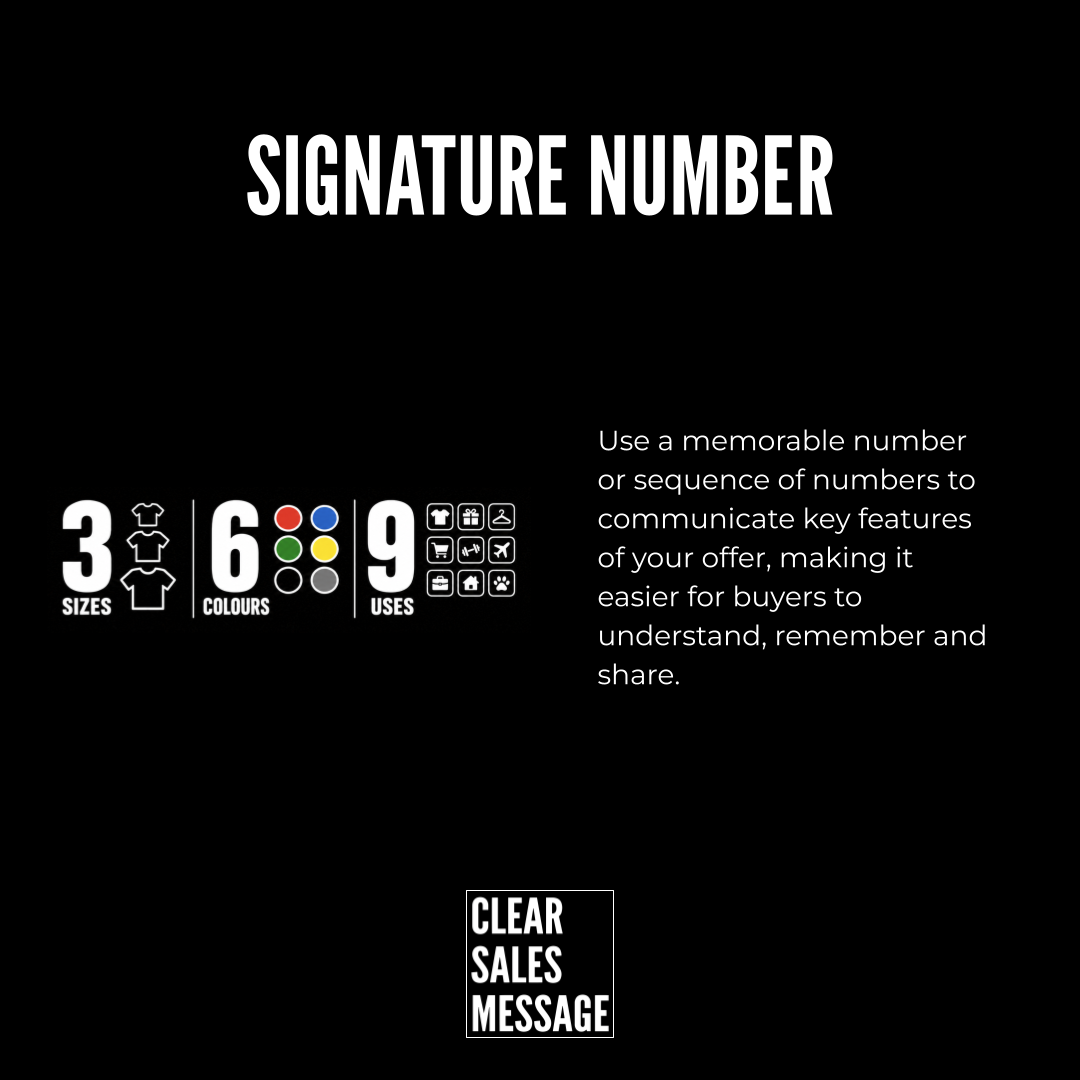
Numbers stick, though. Say “three sizes, six colours, nine uses” and the picture forms in a second. So give your offer a number to hang on. Then it becomes something people can repeat to the boss, a friend or the rest of the team.
What Is A Signature Number?
A signature number is one number, or a short run of numbers. It sums up your offer. Plus, it turns a list of features into a quick, tidy hook. For example, “3 sizes, 6 colours, 9 uses” tells you the range in six words.
It can sit in a headline, on the pack, in a pitch or in your name. Over time, it becomes a badge. In fact, the best ones end up as part of the brand itself.
Why Does A Signature Number Work?
Your brain loves a shortcut. A number feels exact, so it sounds like a fact instead of a claim. “Loads of options” is fluff. Yet “six colours” is real, and you can check it.
Numbers also give the buyer a frame. Once they know there are three steps, they relax. Now they can see the start, the middle and the end. As a result, the offer feels smaller, simpler and safer to say yes to.
And numbers travel well. Say a buyer has to sell your idea to their team. They need something short to repeat. “It’s the nine point plan” is easy to say in a meeting. So a good number does the selling for you, even when you’re not in the room.
How Can You Use A Signature Number?
Count what buyers care about
Pick the facts that answer the buyer’s real worry. Counting things just because you can wastes the number. If they fear a long setup, say “live in 7 days.” Or if contracts scare them, say “30 day rolling contract.” The number should land right on the thing that makes them hesitate.
Build a rhythm with a run of numbers
A sequence like 3, 6, 9 has a beat to it. As a result, it’s easier to remember. So if you have a few features to share, look for a run that climbs or repeats. Then line them up in order. The pattern does half the work of getting it to stick.
Name your method after a number
Services are hard to picture because you can’t hold them. So give your process a number. “Our 4 step review” or “the 90 day plan” turns fog into a shape. Now the buyer can see what they’re getting. Also, they can explain it to someone else without your help.
Use odd and specific numbers
Round numbers can feel made up. By contrast, an odd number like 7 or 57 feels like someone counted. So if your real figure is specific, use it as it is. Rounding it up to make it look bigger often makes it sound less true.
When Does A Signature Number Work Best?
It works best when your offer has lots of parts that blur together. A number pulls them into one clear idea. It also shines when buyers need to pass your pitch on. That’s because a number stays intact when people retell it.
And it suits busy places. On a shelf, a feed or a busy slide, a bold number catches the eye. After all, people read numbers first.
When Does A Signature Number Become Dangerous?
It turns risky when the number isn’t true. If you say “24 hour support” and nobody answers at night, trust goes fast. In fact, a precise number makes a broken promise feel worse, because it was so clear.
It also backfires when the number means nothing to the buyer. “Over 200 features” might impress your team. Yet to a buyer, it can sound like 200 things to learn. So always ask what the number says about their life, not yours.
And watch out for too many numbers. One signature number sticks. Five numbers in one line turn into noise.
Common Mistakes With A Signature Number
Picking a number nobody can feel
“Used by 10,000 firms” is a big number, but it’s hard to picture. Instead, try a number tied to the buyer’s day. “Saves 2 hours a week” is smaller, yet it lands harder. The buyer can feel those two hours.
Changing it every campaign
A signature number only becomes a signature if you keep using it. Yet plenty of brands find a great number, then drop it next quarter. So the buyer never gets the chance to remember it. Pick one, then repeat it until you’re sick of it. That’s usually about when buyers start to notice.
Hiding it in the small print
Some teams bury the number in the third paragraph. But a number only works if people see it. So put it where eyes land first. Think headlines, packaging, the top of the page and the first line of your pitch.
Forgetting to explain it once
A number with no context can confuse people. “The 5 Plan” sounds good, but five what? So explain it clearly the first time. After that, the number can stand alone.
Signature Number – An Example
Heinz 57
Few brands have used a number for as long as Heinz. In fact, the number 57 sits right on the bottle. Most people couldn’t name a single one of the “varieties.” Yet nearly everyone knows the number.
The story goes that the firm sold more than 57 products even then. Henry Heinz simply liked the sound of the number. So the point was never to count. Instead, it was to give buyers a short, odd, catchy hook that felt real.
That’s the power of a signature number. Pick one that’s easy to say. Then keep it in sight long enough, and it becomes part of who you are.

See Also