Practical Sales Training™ > How People Work > Skinner’s Law

Skinner’s Law
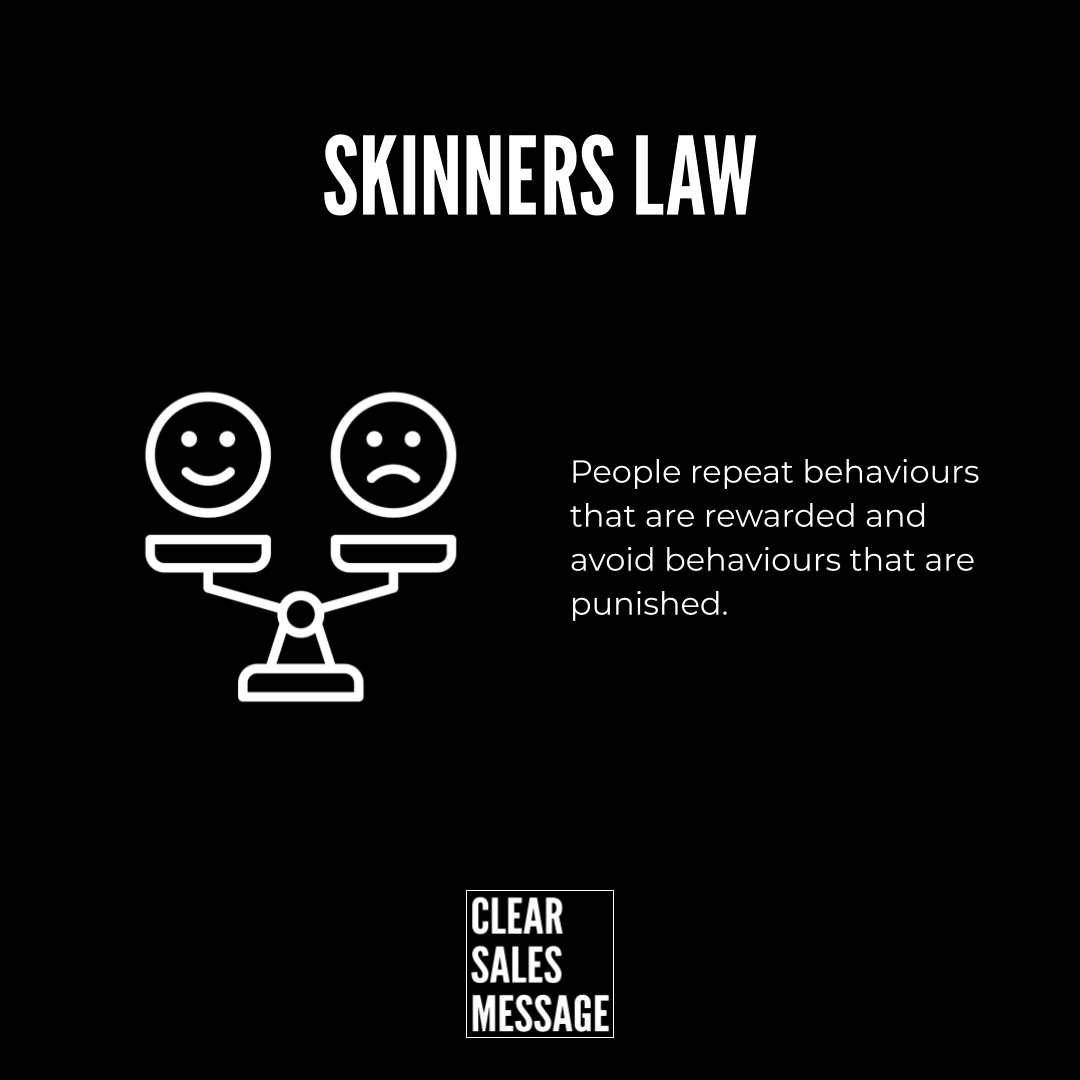
People do not just act on logic. They act on how things feel.
If something feels good, they do it again. But if it feels hard, they stop. That is the heart of Skinner’s Law, and it has a huge impact on how buyers behave.
Most businesses focus on what they sell. However, the way the buying process feels often matters just as much. Buyers who feel good keep moving forward, while buyers who feel frustrated quietly disappear.
What Is Skinner’s Law?
Skinner’s Law comes from the work of B.F. Skinner, a psychologist who studied how behaviour is shaped by outcomes. His core idea was simple: actions that lead to good outcomes get repeated, while actions that lead to bad outcomes get dropped.
He called this operant conditioning. In plain terms, it just means that people learn from what happens to them. Do something and it goes well? You do it again. Do something and it feels painful or hard? You stop.
This plays out in sales all the time. It helps explain why buyers go quiet, why they delay, and why they keep coming back. Behaviour follows reward more than most people think.
Why Does Skinner’s Law Matter In Sales?
Every step of your sales process either makes buyers want to go further or makes them want to stop. There is no neutral ground. Each touchpoint is either pulling buyers in or pushing them away.
Buyers move forward when things feel clear, easy, and safe. They pull back when things feel slow, confusing, or risky. And here is the problem: most buyers do not tell you when something feels wrong. They just go quiet.
As a result, many businesses lose deals they never even knew were at risk. Because the process felt bad, not the product.
How Does Reinforcement Affect Buyers?
Buyers are learning from every interaction, even if they do not realise it. Each time they engage with you and it goes well, they feel more at ease. But each time it goes badly, they pull back a little. Over time, those small moments add up.
A buyer who always has a good experience becomes loyal. One who keeps hitting friction starts to avoid the process, even if they like the product. So the feeling around the experience shapes behaviour just as much as the outcome does.
Positive Reinforcement Creates Momentum
Small wins matter. A clear reply, a quick result, a moment of reassurance – these all nudge the buyer forward. Each good moment makes the next step feel safer, so momentum builds not from one big event, but from lots of small positive ones. The experience around your process matters just as much as the product itself.
Friction Acts Like Punishment
A slow reply, a confusing form, an unclear price – these things feel like friction. And friction feels like punishment to the brain. Buyers may not complain, but they start to slow down, delay, or drift away. Because the process has started to feel like hard work, they lose the will to continue.
How Can You Use Skinner’s Law In Business?
Start by asking: what are we making easy, and what are we making hard? Whatever you make easy, buyers will do more of. And whatever you make hard, they will do less of.
Make it easy to say yes. Make progress feel visible and give buyers small wins early. Remove steps that cause delay or doubt. And remember: buyers do not just remember what they got. They also remember how it felt to get it.
When Skinner’s Law Becomes Most Important
This matters most when you need buyers to act more than once – for example in a subscription, a repeat purchase, or a long sales cycle. Getting the first action is one thing. Keeping buyers going takes consistent positive experience. Because people repeat what feels good, and they stop doing what does not.
Research Behind Skinner’s Law
Skinner’s work on operant conditioning showed how reward and punishment shape behaviour over time. It is one of the most well tested ideas in psychology, and the link between positive outcomes and repeated behaviour is strongly backed by research.
You can read more here: Operant Conditioning
Common Skinner’s Law Mistakes
Most mistakes come from not thinking about what behaviour you are actually rewarding. Good intent does not cancel out bad reinforcement.
Accidentally Rewarding the Wrong Behaviour
If you always drop your price when a buyer pushes back, you train them to push back. They learn that delay gets rewarded, so they delay. It is not their fault – you taught them it works. The pattern then repeats every time, and the problem gets worse the longer it goes on.
Ignoring How the Process Feels
Many businesses put all their effort into the product but very little into the experience around it. Buyers feel the process before they feel the product. So if onboarding is hard, support is slow, or steps are unclear, buyers start to pull away. Even a great product can lose to a smoother rival because of this.
Skinner’s Law – An Example
A software company wants more users to finish their onboarding. Instead of pushing them through a long setup all at once, they break it into small steps. Each step ends with a positive message and a visible sign of progress.
Users finish more often as a result. Not because the product changed, but because the process now feels good. Each small win makes the next step feel easy, so users keep going. That is Skinner’s Law at work.
See also
- 50+ ways that people work & make decisions
- Positive Feedback Loop
- Correlation & Causation
- Loss Aversion
- Goodhart’s Law

