Practical Sales Training™ > Wordplay > The Contrast Effect

The Contrast Effect is a simple sales messaging technique that uses opposites or contrasts side by side to make your message clearer, sharper and more memorable.
Think:
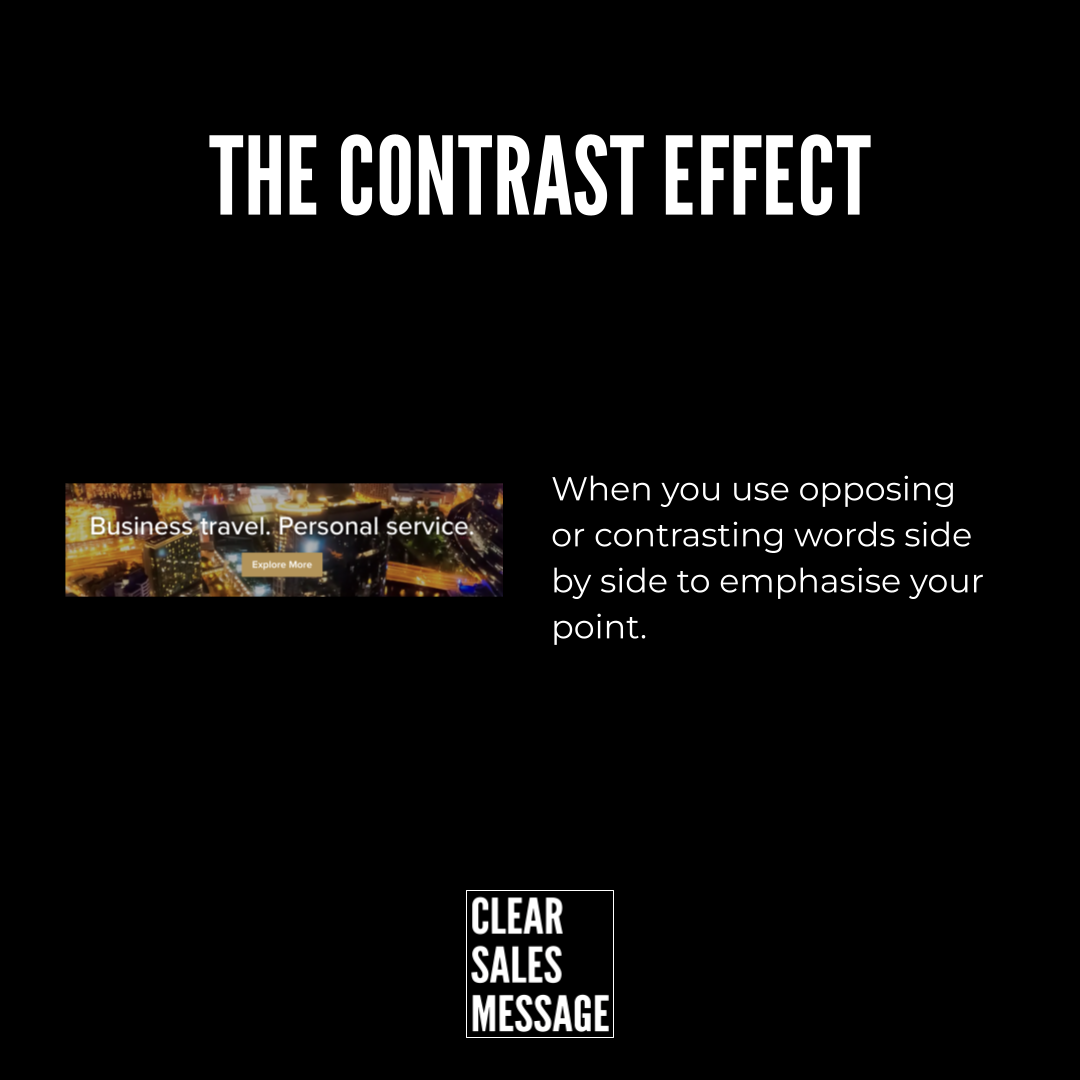
Business travel. Personal service.
High tech. Human help.
Big coverage. Small hassle.
Used well, the Contrast Effect helps your buyers understand what makes you different in just a few words.
What is the Contrast Effect?
The Contrast Effect is when you put two different or opposite ideas next to each other so your main point stands out.
You are saying:
-
“We are this but not that.”
-
“You get the benefit without the usual pain.”
-
“You can have both things that normally do not come together.”
It works because our brains notice differences more than they notice more of the same.
Why the Contrast Effect works in sales
The Contrast Effect helps your sales message because it:
-
Grabs attention
Opposites are interesting. Your brain wants to resolve the tension between them. -
Creates clarity
It shows buyers quickly what you are and what you are not. -
Positions you against the competition
You can contrast your way of working with the old or painful way. -
Keeps things short and punchy
You say more with fewer words, which is ideal for headlines, adverts and social posts.
Simple examples of the Contrast Effect
Here are some easy sales examples of contrast pairs:
-
Business travel. Personal service.
-
High tech. Human support.
-
Global reach. Local care.
-
Big savings. Zero hassle.
-
Fast setup. Lasting results.
-
Fewer clicks. More sales.
-
Clear pricing. No surprises.
-
Smart automation. Human control.
You can use the Contrast Effect to talk about:
-
How you work
-
What clients experience
-
How your offer is different from the market
-
How you remove a pain but keep the benefit
How to create your own contrast pairs
Use this simple 4 step process.
1. Decide what you want to highlight
Choose one key idea you want buyers to remember. For example:
-
Personal service
-
Clear pricing
-
Speed
-
Simplicity
-
Results
2. Ask “What is the opposite, or what is usually missing?”
You now find the contrast or tension.
Examples:
-
Personal service vs faceless service
-
Clear pricing vs hidden fees
-
Speed vs slow process
-
Simplicity vs complexity
-
Results vs empty promises
3. Compress into a 2 part phrase
Put the two sides next to each other.
Structure ideas:
-
[Thing they want]. [Thing they fear.] -
[Modern benefit]. [Traditional comfort.] -
[Outcome]. [Without usual pain.]
Examples:
-
Personal service. No call centres.
-
Clear pricing. No hidden fees.
-
Fast bookings. No fuss.
-
Simple system. Serious results.
4. Test different wordings
Try different pairs and read them out loud.
You are looking for:
-
Short words
-
Strong rhythm
-
Easy to say
-
Easy to remember
Pick the one that sounds clean and confident.