Practical Sales Training™ > Selling Communication Basics > The Feynman Technique

The Feynman Technique
What Is It?
The Feynman Technique strips your message down. So simple, a child could follow it.
It’s not about dumbing things down. It’s about cutting out the parts that only confuse.
Why Does It Work?
Clear messaging wins, because confused buyers don’t buy. They freeze instead.
When you strip your offer to its core, people actually understand what you sell. And once they understand it, they can say yes to it.
Most sales aren’t lost in negotiation. They’re lost in explanation, since jargon quietly kills trust before price ever comes up.
How Can You Use It?
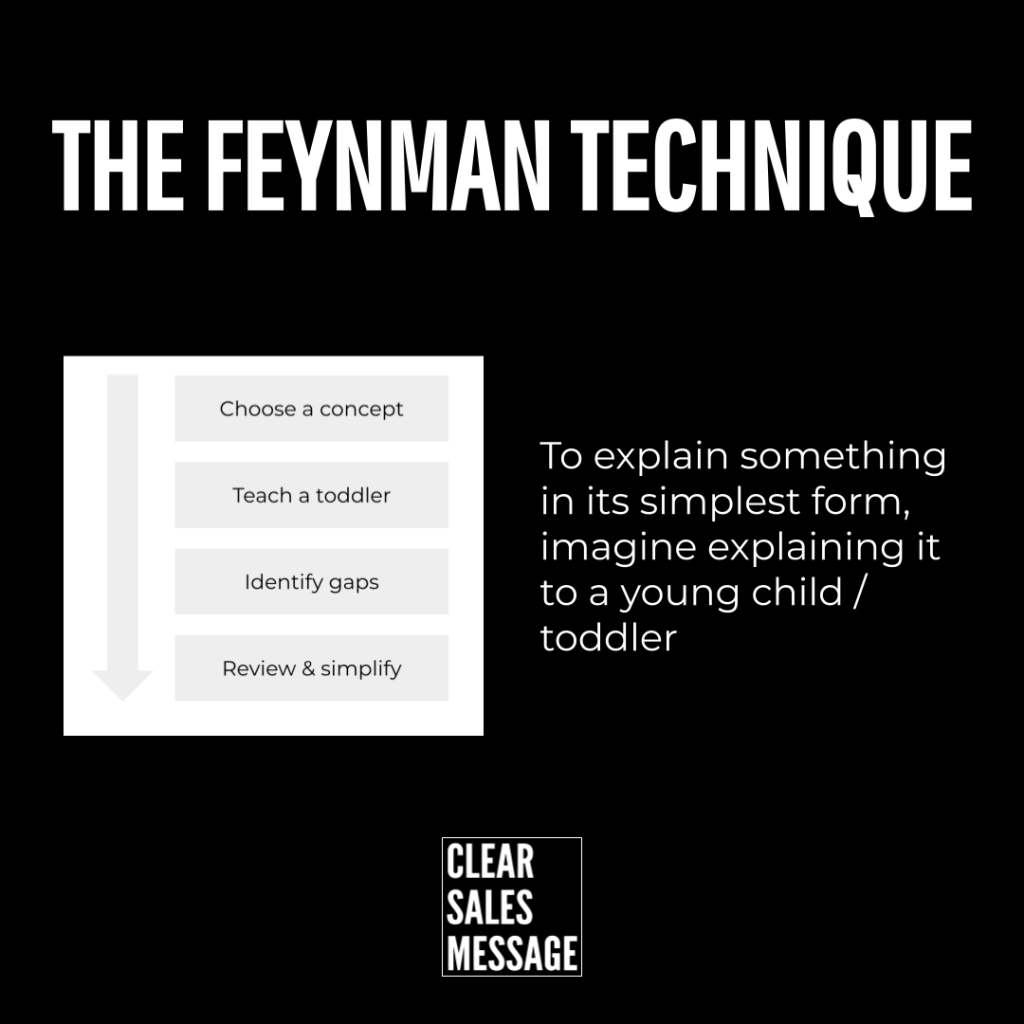
Pick The Concept
Start with one thing you need to explain. Just one. Trying to simplify everything at once usually means you simplify nothing well.
Explain It Like They’re New To It
Write it as if your buyer knows nothing about your industry. Because most of the time, they don’t. Skip the jargon and skip the insider shorthand entirely.
Find Where It Breaks Down
Read your explanation back. Any spot where you reach for a technical word is a gap. That gap is exactly where buyers will get lost too.
Simplify It Again
Go back and cut it further. Swap jargon for plain words and long sentences for short ones. Keep going until a stranger could repeat it back to you correctly.
When It Works Best
This works best in technical or complex industries, where jargon builds up fast. Software, finance and cybersecurity all fall into this trap easily.
It also works well in cold outreach. A stranger has no patience for confusion, so your first message needs to land instantly, not eventually.
When It Becomes Dangerous
The risk is oversimplifying something that genuinely needs nuance. Strip out too much, and you lose accuracy along with the confusion.
Some buyers also expect technical language, especially in expert to expert sales. So match your simplicity to your actual audience, not just the general rule.
Done badly, this technique can sound condescending. Done well, it just sounds clear.
Common Mistakes
Simplifying The Words But Not The Idea
Swapping jargon for plain words isn’t enough on its own. The underlying idea needs simplifying too, or the confusion just hides better.
Stopping After One Pass
Most first attempts still carry hidden complexity. So go back through it again, since the second pass usually finds what the first one missed.
Ignoring Who’s Actually Reading It
Simplicity that suits a beginner might annoy an expert. So always check the message against the real audience, not just the rule.
The Feynman Technique – An Example
The Cybersecurity Rewrite
A cybersecurity company used to say: “We offer enterprise-grade, end-to-end encrypted, zero-trust network access solutions.” It’s accurate. It’s also unreadable to most buyers.
After applying the Feynman Technique, they changed it to: “We help keep your business safe online, so hackers can’t get in, and your team can work securely from anywhere.”
The second version sounds like something you’d explain to a 10 year old. That’s exactly the point. It’s clear, human and instantly understandable.
Nothing about the product changed. Only the explanation did. And that change alone made it easier to buy.
See also
- Average Reading Age
- The Clear Sales Message™ Test
- 25+ Selling communication basics
- 140+ ways to be easier to buy from