
Practical Sales Training™ > How To Convert > The Happy Hour Effect

The Happy Hour Effect
What Is It?
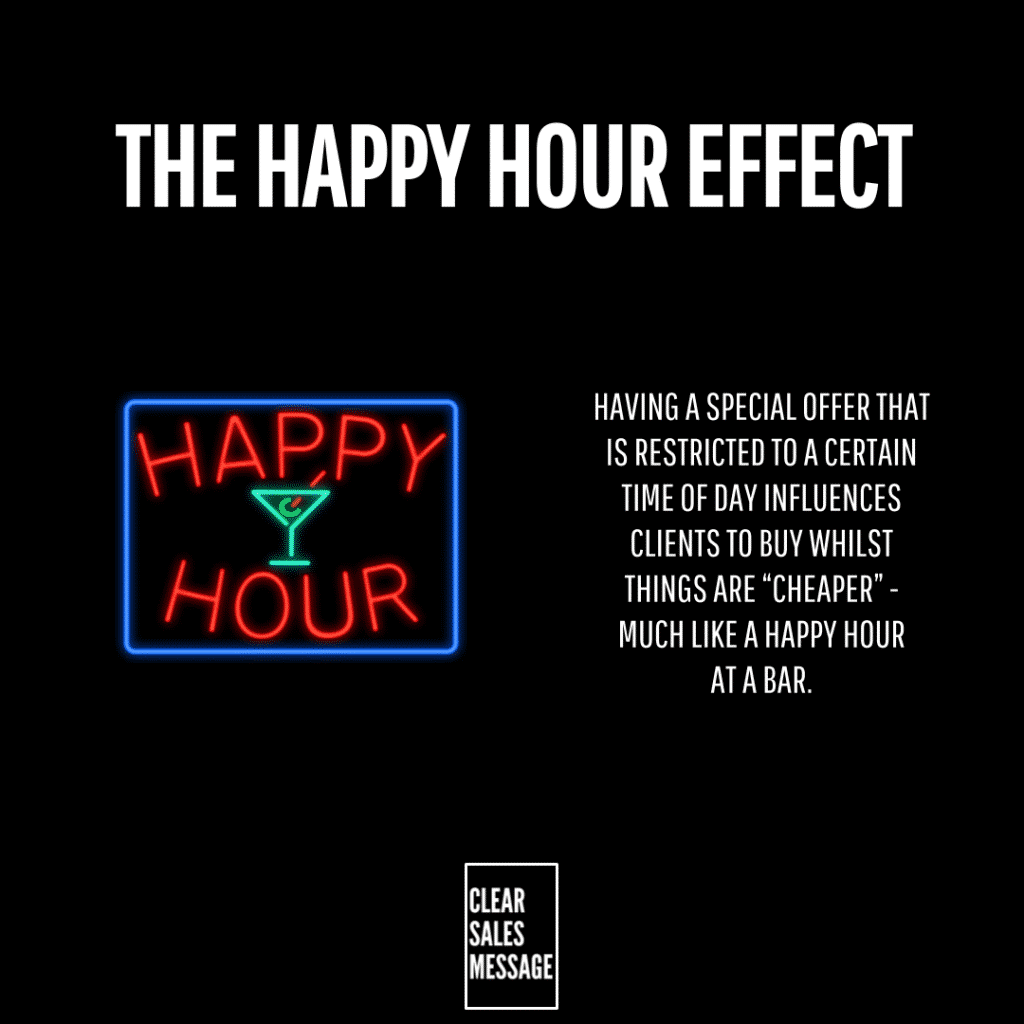
The Happy Hour Effect is simple. You give buyers a deal that only lasts for a set window of time. So if they buy now, they save. But if they wait, the price goes back up.
I’ve used this with clients selling everything from massages to machinery. Even so, the mechanic stays the same. Only the “hour” changes shape.
Why Does It Work?
Buyers always want the best deal for the least money. That’s not greed. It’s just how we’re wired.
So when you tell someone a price is only good until 2pm, something shifts. As a result, their brain stops treating the offer as optional. Instead, it starts treating it as scarce. And scarce things feel more valuable, even when nothing else has changed.
This is loss aversion at work. We hate losing out on a deal more than we enjoy getting one. Because of that, the Happy Hour Effect turns discomfort into action.
There’s also a subtler layer here. A time limited offer feels earned. So the buyer feels like they spotted a gap and jumped through it. That feeling matters just as much as the discount itself.
How Can You Use It?
Find Your Dead Hours
Look at your business and find the times nobody wants. Maybe it’s the 10am slot. Or maybe it’s the Tuesday afternoon lull. Every business has quiet patches already, whether you’ve named them or not.
Build A Real Incentive
Once you’ve found your quiet window, build an offer around it. A discount works well. So does a bonus extra, like a free upgrade. Still, make sure the incentive is big enough to notice. A 2% discount won’t move anyone. A saving that actually matters will.
Set A Hard Deadline
The clock is what makes this work. Without a real deadline, you just have a normal discount. But with one, you have urgency. So be specific. “12pm to 2pm, Monday to Thursday” beats “for a limited time” every time. That’s because vague deadlines don’t create pressure, while specific ones do.
When It Works Best
This works best in businesses with a clock already ticking. Think bars, restaurants, spas and salons. In these settings, buyers already understand that time and availability shift throughout the day.
It also works well for services with real quiet periods, such as appointment slots or anything booking based. So find a real gap in demand, and you can build an offer around it.
When It Becomes Dangerous
The risk here is training your buyers to wait. If your happy hour runs constantly, buyers catch on. As a result, the limited window stops feeling limited.
Once they realise the deal is always available, the urgency disappears. Even worse, buyers start delaying full price purchases on purpose, since they know a discount is coming.
Used too often, this effect stops driving action. Instead, it starts training patience, which is the opposite of what you want.
Common Mistakes
Making The Discount Too Small
A weak discount won’t beat inertia. If the saving isn’t obvious, buyers won’t bother changing their plans for it.
Leaving The Deadline Vague
“For a limited time” isn’t a deadline. It’s really just a suggestion. So buyers need a real cut-off point, or the pressure never lands.
Running It Too Often
If your happy hour never really stops, it stops working too. Scarcity has to be real, or buyers stop believing it.
The Happy Hour Effect – An Example
The Lunchtime Reset
A local spa runs a deal called The Lunchtime Reset. If you book any 30-minute treatment between 12pm and 2pm, Monday to Thursday, you get 20% off.
Midday slots are usually the quietest part of the spa’s week. So instead of leaving those hours empty, the spa fills them with a specific, time-limited offer.
As a result, clients get a clear reason to act now instead of putting it off. And because the deal only runs at set times, it feels like a real find. The client feels like they spotted it themselves.
That’s the whole effect in one small business. A quiet window, a real incentive and a deadline that actually means something.
See also