Practical Sales Training™ > How To Convert > The Flash Sale Effect

The Flash Sale Effect
Most buyers who like your product do not buy it today. They mean to come back, so they save the page, bookmark the link, or add it to their list. And then life happens and they never return. A flash sale addresses this directly by making today the best day to buy.
The Flash Sale Effect is built on a simple principle: a deal that expires pushes buyers to decide. That ticking clock turns passive interest into active consideration. Buyers who were vaguely interested become genuinely engaged. And some of them buy.
Done well, a flash sale also rewards your most loyal and attentive buyers. They get the best price because they were paying attention. That feels fair. And fair promotions build the kind of goodwill that keeps buyers coming back.
What Is The Flash Sale Effect?
The Flash Sale Effect is a short, time-limited promotion: 48 hours, a weekend, or a single day. What matters is that the deadline is real and the deal disappears when it ends.
It is a specific application of two powerful forces: FOMO and scarcity. FOMO drives buyers to act before the window closes. Scarcity reinforces the urgency by making the deal feel limited and exclusive. Together, they create a stronger pull than either would alone.
Flash sales can be time-limited, quantity-limited, or both. A sale limited to 48 hours creates urgency through the clock. One limited to the first 50 buyers creates urgency through supply. When you combine both, the effect is even stronger.
Why Does The Flash Sale Effect Work?
It works because of FOMO. Nobody wants to be too late for a deal they could have had. The thought of missing out on something genuinely valuable is uncomfortable. So when a buyer sees a deadline, they feel pressure to decide before the option disappears. That pressure turns inertia into action.
It also works because of scarcity. Limits create value. A product at its usual price might feel like it will always be there. The same product at a time-limited price suddenly has rarity attached to it. And rare things feel worth moving on.
There is also a psychological effect from the contrast between the regular price and the sale price. When buyers see the regular price next to the sale price, the gap makes the deal feel concrete. That visible saving is a strong motivator, especially for buyers who were already considering the purchase.
How Can You Use The Flash Sale Effect?
Set a real deadline and hold it
The flash sale only works if the deadline is genuine. When the clock reaches zero, the sale ends and the price goes back up. If buyers can access the deal after the deadline by complaining or messaging, the urgency evaporates. So set a deadline you will enforce, keep it short enough to create real pressure, and honour it every time.
Keep the window short
A flash sale that runs for three weeks is not a flash sale. The urgency depends on the constraint. So keep the window tight: 24 hours, 48 hours, or a weekend. The shorter the window, the stronger the pressure to act now rather than later. Buyers need to feel that waiting is a real risk, not a comfortable option.
Use a countdown timer for added impact
A countdown timer makes the deadline visible and visceral. Seeing the hours and minutes tick down is more urgent than reading a date. An animated countdown on your landing page or email creates a live sense of the window closing. This appeals to motion bias and makes the deadline impossible to ignore.
Communicate the sale clearly in advance
Buyers cannot act on a flash sale they do not know about. So announce it before it starts. Tell your list, your social following, and your warm prospects that a sale is coming. Build anticipation. Then send a reminder when the sale opens and another with a few hours left. Each message is a prompt for buyers who were thinking about it but had not yet decided.
When The Flash Sale Effect Works Best
It works best when you have a warm audience. A flash sale does not generate interest from scratch. It converts existing interest into purchases. So it works best with buyers who already know you and your offering. They just needed a push. The flash sale provides that push.
It also works well for digital products and services where delivery costs do not scale with the discount. The more margin you have to work with, the deeper the sale can go without hurting you. And a deeper sale creates a stronger pull.
And it works particularly well tied to a specific moment: a launch, an end of quarter, or a seasonal milestone. These occasions give the sale a purpose beyond discounting. That context makes the offer feel natural rather than random.
When The Flash Sale Effect Becomes Dangerous
The biggest risk is running flash sales too often. When every month has a sale, buyers learn to wait for the next one. The urgency disappears because buyers know it will always come back. So use flash sales sparingly. They are most powerful when they are rare enough to feel genuine.
There is also the risk of training buyers to never pay full price. If your flash sale price becomes the price people expect, your full price becomes the fake one. So keep a meaningful gap between your sale frequency and your standard pricing. Full price should feel like the default, not the punishment for missing the sale.
Finally, make sure your flash sale delivers real value. A 5% discount on a high-value product is not a flash sale. It is a gesture. The deal has to feel genuinely worthwhile or buyers will see through it quickly. If the saving is not worth the urgency you are asking them to feel, the whole thing falls flat.
Common Flash Sale Effect Mistakes
Not enforcing the deadline
The moment you let someone buy at the sale price after the deadline, the sale loses its power. Buyers who missed the window will find out. And next time, they will not bother acting before the deadline because they know you will make exceptions. So decide your policy in advance and stick to it. Be kind but firm. The integrity of the deadline is the engine that makes the whole thing work.
Making the window too long
A seven-day flash sale is not urgent. Buyers know they have plenty of time, so they defer. And deferral is the enemy of conversion. So keep the window short enough that delay feels risky. Two days is usually plenty. One day is even better for creating peak urgency. Test what works for your audience, but err on the side of shorter.
Running sales without building the audience first
A flash sale with no warm audience behind it will generate very little. The urgency only converts people who were already interested. So before you run a sale, invest in building the audience. Grow your list, stay in contact with warm prospects, and make sure your product is clear before starting. The bigger the warm audience, the bigger the return on the flash sale.
The Flash Sale Effect – An Example
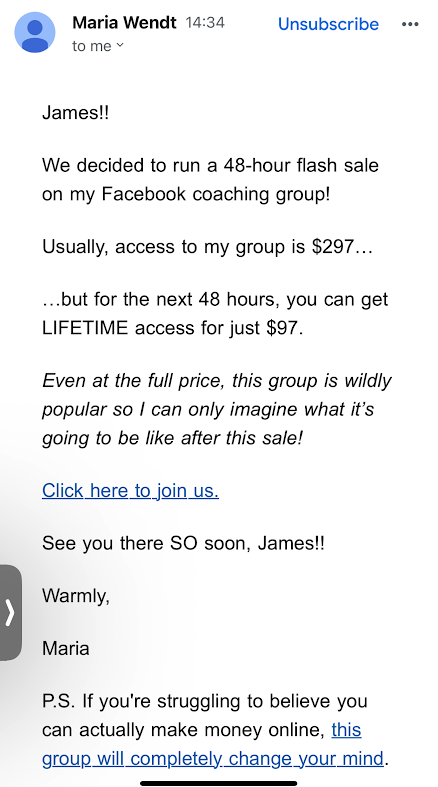
Maria Wendt’s 48-hour coaching group sale
Maria Wendt runs a 48-hour flash sale to encourage people to join her coaching group. The usual price is $297. For 48 hours only, the price drops to $97 for lifetime access. The email is personal, the deadline is clear, and the saving is substantial.
![]()

The email also notes the group is already popular at full price, adding social proof and another reason to act. Overall, the window is real, the deal is genuine, and the email does everything right. It uses first-name personalisation, a clear offer, a short deadline, and a strong reason to believe in the product.
See Also