Practical Sales Training™ > How to connect with your buyer > The Magic Wand Question

The Magic Wand Question
Most buyers lead with their constraints. Budget is tight. Time is short. The boss needs sign-off. So before you’ve even heard what they actually want, you’re already working around what they think is possible.
The Magic Wand Question changes that. It clears the noise for a moment and asks the buyer to describe their ideal outcome – no limits, no caveats. And because the constraints are gone, what comes back is usually far more useful than anything you’d get from a standard discovery question.
Good solutions start with a clear destination. So if you don’t know where the buyer actually wants to go, you’re just guessing at the route.
What Is The Magic Wand Question?
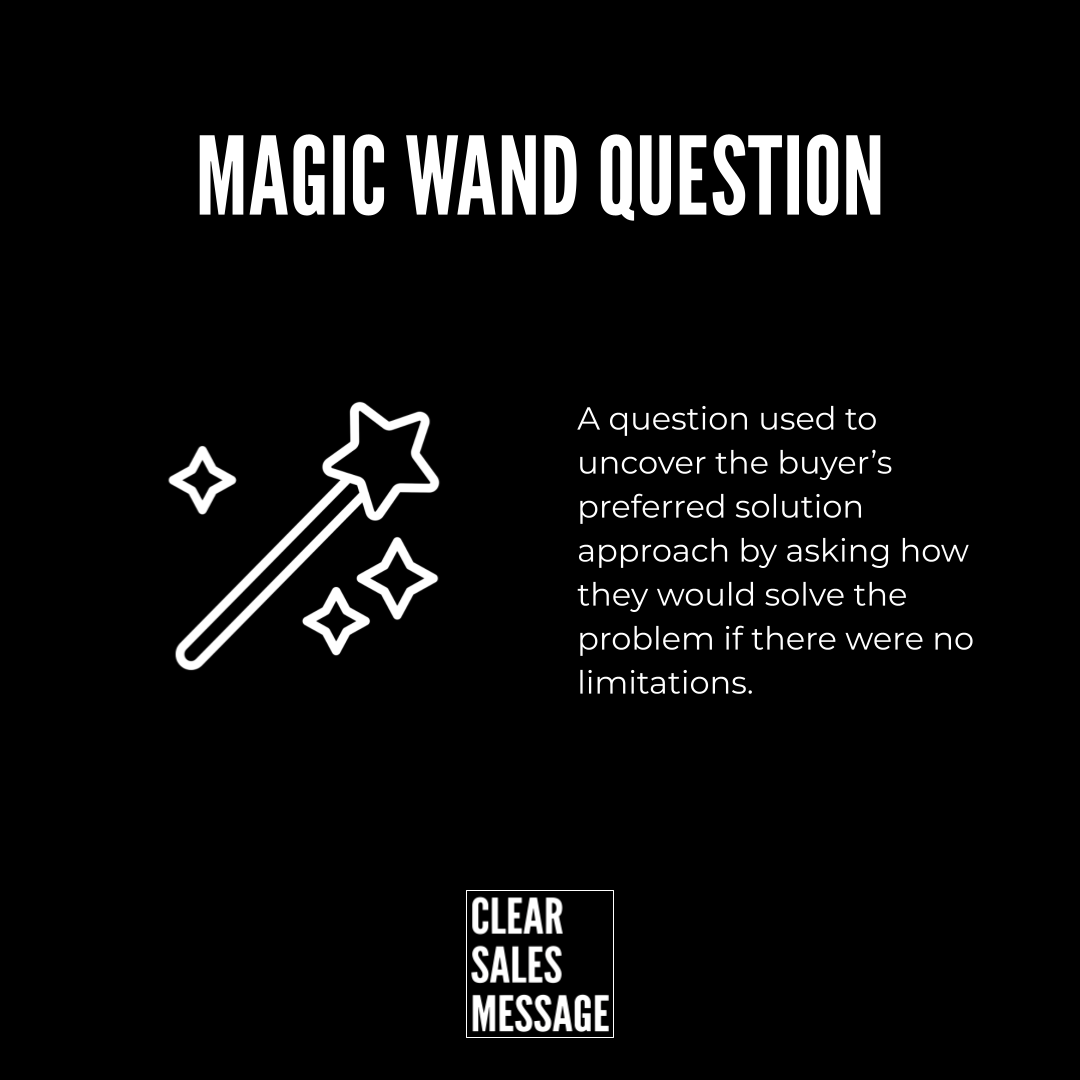
The Magic Wand Question is a discovery question that works by removing constraints from the conversation. It asks the buyer what they’d choose if budget, time, or internal limits weren’t a factor – so you hear their real goal before the practical barriers get in the way.
This matters because most buyers don’t start with their ideal outcome. They start with what feels achievable. As a result, you often end up solving a watered-down version of the problem instead of the real one.
The question itself is simple. However, the insight it produces is often the most useful thing in the whole conversation – because it tells you what success actually looks like to them.
Why Does The Magic Wand Question Work?
When constraints disappear, buyers stop editing themselves. They describe what they actually want – not what they think they can ask for. So you hear the real need, not the filtered version.
This connects to how good discovery works. Research in consultative selling shows that outcome-focused questions improve solution fit and buyer satisfaction. Because when you understand the desired end state, you can design toward it – rather than patching around a problem that was never fully described.
There’s also a trust element. Asking this kind of question signals that you’re interested in their actual goal, not just a quick sale. In fact, buyers often open up more after a Magic Wand Question than they do after several standard ones – because it feels like a different kind of conversation.
How Can You Use The Magic Wand Question In Sales?
It works best early – before the conversation narrows into specific solutions or pricing. The goal is to understand the outcome first, then work backwards to what’s realistic.
Use it in discovery calls
Early in a sales conversation, most buyers describe symptoms rather than goals. The Magic Wand Question shifts that. For example: “If this worked exactly how you wanted, what would be different?” That one question often reveals more than twenty minutes of standard questioning.
Use it in customer research
When you’re building a new offer or refining your positioning, this question helps you hear unmet needs that buyers wouldn’t normally think to mention. “If you could fix this perfectly, what would it look like?” gives you the kind of language that belongs in your messaging.
Use it when needs feel unclear
Some buyers genuinely struggle to explain what they want. They know something isn’t working, but they can’t articulate the goal. So instead of pushing them to define requirements they haven’t formed yet, ask what ideal looks like. The answer is usually much easier for them to give.
Use it to design better solutions
In consultative or expert-led sales, the Magic Wand Question shapes the recommendation. Once you know what success looks like to the buyer, you can position your solution as the path to that outcome – rather than a generic fix for a loosely defined problem.
When The Magic Wand Question Works Best
This question is most useful when the problem is complex, the need is vague, or the buyer is struggling to explain what they’re looking for. So it fits naturally in consultative sales, expert services, and any situation where the right solution depends on understanding the real goal.
It’s also valuable when you’re doing positioning research or offer design. Because the answers you get aren’t just useful for that one deal – they tell you how buyers think about the problem in their own words. And that language is gold for your messaging.
When The Magic Wand Question Becomes Dangerous
In simple transactional sales, the question can slow things down. If a buyer already knows exactly what they want and just needs to place an order, asking them to describe a constraint-free ideal can feel unnecessary. So read the situation – not every conversation needs this level of discovery.
It also shouldn’t replace the practical conversation. The purpose is direction, not fantasy. Once you understand the ideal outcome, you still need to return to reality and work out what’s achievable. However, knowing the destination makes that conversation much more focused.
Similarly, asking the question without using the answer is a wasted opportunity. If the buyer tells you their ideal and the conversation immediately jumps to a standard pitch, you’ve lost the insight. The answer should shape what you recommend.
Common Magic Wand Question Mistakes
Not using the answer
This is the most common mistake. The buyer describes their ideal outcome and the salesperson nods – then launches into a pre-planned pitch. As a result, the question becomes decoration rather than discovery. Whatever the buyer says should visibly shape what you say next.
Treating it as hypothetical
Some salespeople ask the question in a light, throw-away way – as if it’s a bit of fun rather than a serious diagnostic tool. But the answer is directional, not theoretical. So treat it that way. Write it down. Reference it. Build your recommendation around it.
Skipping the follow-up
The Magic Wand Question opens a door. However, the real insight often comes in the follow-up. “What would that mean for you?” or “Why is that the priority?” takes the answer deeper – and that’s usually where the decision driver is hiding.
Using it too late
By the time a conversation has settled into specific solutions and pricing, it’s hard to step back and ask an open future-state question. Therefore, use it early – before the scope narrows. The earlier you understand the ideal outcome, the more it shapes everything that follows.
The Magic Wand Question – An Example
A consultant is talking to a founder who says their lead generation is inconsistent. Instead of jumping to tactics, they ask:
“If you could wave a magic wand and your pipeline worked perfectly, what would it look like?”
The founder says: “We’d have a steady flow of qualified inbound leads instead of these unpredictable spikes.”
That one answer changes everything. The real need isn’t more leads – it’s consistency. So instead of pitching a lead generation campaign, the consultant proposes a system. The recommendation fits because the goal was understood first.
Most companies ask buyers what they want to buy. But the strongest discovery conversations focus on what the buyer is trying to achieve – and build the solution around that. The Magic Wand Question is simply the fastest way to get there.
See also