Practical Sales Training™ > How To Convert > The Message Screenshot Effect
The Message Screenshot Effect
A perfectly formatted testimonial on a clean website looks like marketing. And buyers know it. They have seen hundreds of them. The quotes get chosen carefully. The photo might be a stock image. So buyers read them with a degree of scepticism – even when the content is true.
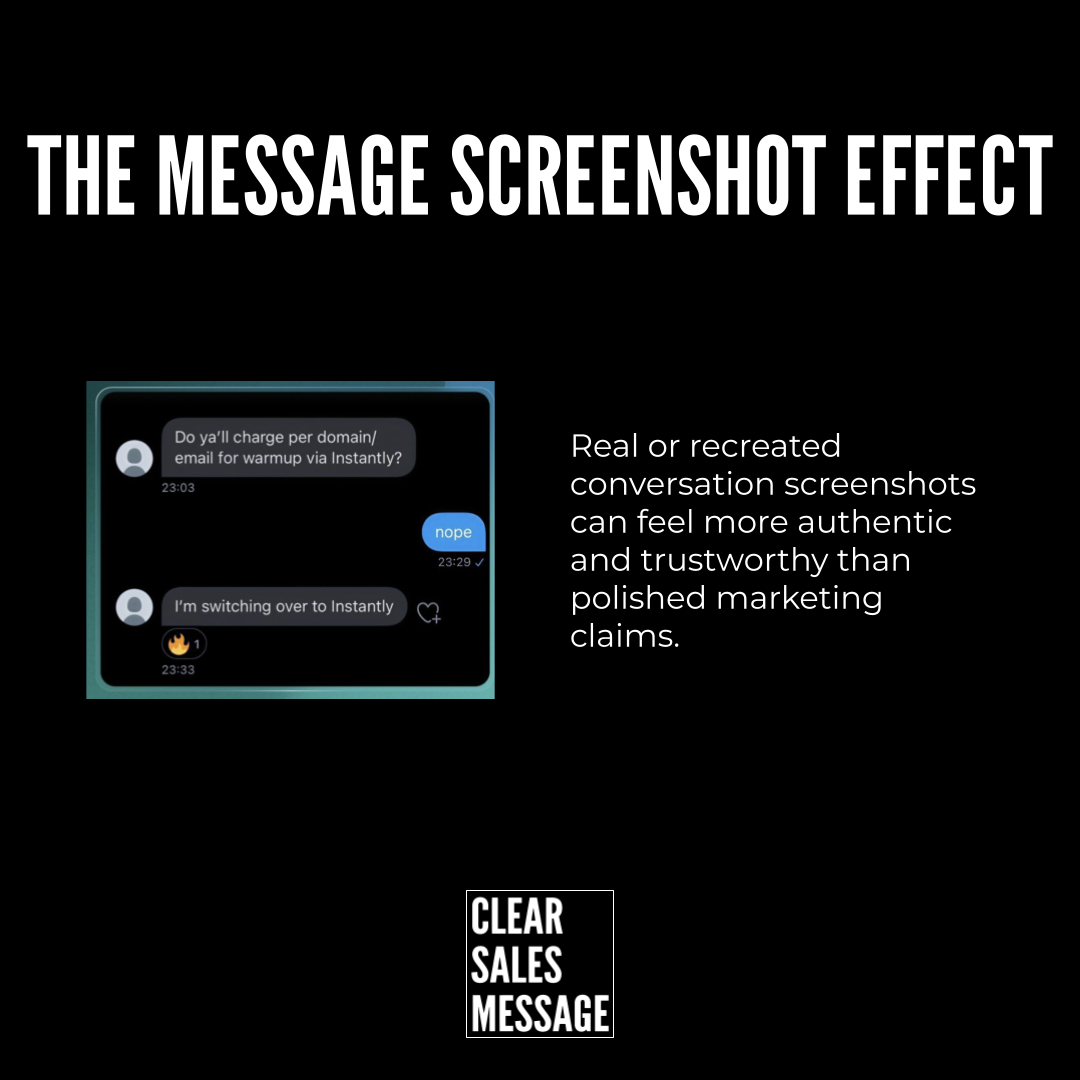
A screenshot of a real conversation is different. Typos are in there. Timestamps are visible. The messiness of real life shows through. And that messiness is exactly what makes it feel true. Because no one fakes the small details. No one invents a flame emoji reaction at 23:33. Those details say: this actually happened.
That is the Message Screenshot Effect. When buyers see a real-looking conversation – a DM, a WhatsApp message, a Slack reaction – the authenticity hits harder than any polished quote ever could. And in a world where buyers are increasingly sceptical of curated marketing, raw proof cuts through in a way that nothing else quite manages.
What Is The Message Screenshot Effect?
The Message Screenshot Effect is when real or recreated conversation screenshots create a stronger sense of trust and credibility than traditional marketing claims. The format itself does the trust-building – before the buyer has even read the content.
Screenshots can come from anywhere. A DM saying “just switched over and it’s brilliant.” Maybe a WhatsApp message asking a quick question and getting a simple honest reply. Or a Slack thread where someone recommends your product unprompted. An email reply saying “this is exactly what we needed.” In every case, the raw format signals authenticity.
However, the effect also works with recreated screenshots – conversations formatted to look like real messages but not direct grabs from an app. The visual language of a chat interface still carries the same feeling of informal honesty. So even a styled recreation of a real exchange can carry more trust than a polished pull quote.
Why Does The Message Screenshot Effect Work?
Polished things feel curated. And curated things feel controlled. When a buyer sees a beautifully formatted testimonial, part of their brain registers that someone chose it, edited it, and placed it there deliberately. That awareness creates a small but real layer of doubt.
Screenshots feel uncontrolled. They carry the visual noise of real communication – the interface, the timestamp, the read receipt, the emoji reaction. None of that looks designed. It looks captured. And things that look captured feel more honest than things that look designed.
There is also a psychology of imperfection at play. When a message has a typo, informal language, or a casual tone, it feels more human. As a result, the buyer reads it and thinks: a real person wrote this, in a real moment, about a real experience. And that feeling is worth more than any amount of professional copywriting.
How Can You Use The Message Screenshot Effect In Sales?
The goal is to surface the raw, unfiltered reactions your product or service already generates – and put them where buyers are making decisions.
Capture real reactions as they happen
The best screenshots are the ones you did not plan. A client DMs you saying they just recommended you to three people. A buyer replies to your email saying it was exactly what they needed. A team member shares a Slack message from a happy client. Screenshot those moments as soon as they happen. Because the raw, unedited version of a real reaction is one of the most powerful pieces of trust-building content you can own.
Place them where doubt tends to sit
Screenshots work best at the moments when a buyer is hesitating. Pricing pages, proposal documents, landing pages, and the space just before a call to action are all high-doubt moments. So put your most compelling screenshots there. Because a raw, honest reaction from a real person at the exact moment a buyer is wondering “but does it actually work?” can do more to close the gap than almost anything else.
Use them on social media
Screenshots travel well on social platforms. A post showing a real conversation – a buyer saying something honest and unscripted – tends to get more engagement than a polished graphic with a quote. Because the format feels native to the platform. It looks like something shared between friends rather than something published by a marketing team. And that difference matters a great deal to how people respond.
Recreate real exchanges where sharing is not possible
Sometimes you cannot share the real screenshot – perhaps the client prefers privacy, or the original message is in a context that cannot be easily shared. In those cases, a recreated version of the exchange can still carry much of the same effect. Use a chat-style format, keep the language natural and unpolished, and include small details – a timestamp, an informal sign-off, a specific reference – that make it feel real. Because the visual language of a message interface does a lot of the trust-building work even when the content is recreated.
Let the imperfections show
Resist the urge to clean screenshots up. Keep the typo in. Leave the emoji where it is. Avoid reformatting the message into something tidier. The rawness is the point. A perfectly presented screenshot starts to look like something that has been touched – and the moment it looks touched, it loses the authenticity that made it powerful in the first place.
When The Message Screenshot Effect Works Best
This effect works best in markets where buyers are highly sceptical of traditional marketing. If your audience has seen a lot of polished testimonials and curated social proof, the raw format of a screenshot stands out immediately. Because contrast is one of the fastest ways to get attention – and something that looks genuinely undesigned cuts through a sea of designed content.
It also works well for newer businesses or offers that do not yet have a long track record. A formal case study takes time to produce and requires a willing client. But a screenshot of a real reaction can happen on day one. So for businesses building credibility early, the Message Screenshot Effect is one of the most accessible and immediate trust-building tools available.
Similarly, it is powerful in social selling and direct outreach. When a salesperson shares a screenshot of a relevant conversation – a peer recommending their product, a client reaction, an honest exchange – it carries a peer-to-peer quality that formal marketing cannot replicate. Because it feels like one person telling another, not a brand broadcasting to a crowd.
When The Message Screenshot Effect Becomes Dangerous
The biggest risk is fake screenshots. This is not just an ethical problem – it is a practical one. Buyers are increasingly good at spotting fabricated conversations. The font is wrong, the timestamp does not make sense, the language feels too clean. When a fake screenshot gets spotted, the damage to trust is severe and hard to undo. So only ever use real exchanges or clearly recreated versions of real ones.
It can also backfire when the screenshot raises more questions than it answers. A vague reaction like “love it!” from an unnamed person with no context does not carry much weight. The power comes from the specificity of the moment – and a generic reaction is no more convincing than a generic quote.
Also, sharing screenshots without permission can damage relationships. Even if the message is positive, the person who sent it may not want it shared publicly. Therefore, always ask before publishing. Because a client who feels their private message was used without consent becomes a very different kind of story – and not one you want circulating.
Common Message Screenshot Effect Mistakes
Over-polishing the screenshot
Many businesses take a raw screenshot and then clean it up – cropping it neatly, removing the interface details, brightening it, and formatting it into a graphic. Each of those changes chips away at the thing that made it powerful. So keep it raw. The interface, the timestamp, the casual language, the imperfect framing – all of those things tell the buyer this is real. Remove them and it starts to look like every other testimonial they have learned to ignore.
Not collecting screenshots as they happen
The best screenshot moments are fleeting. A client sends a great message, you feel pleased, and then you move on. Three months later you wish you had saved it. So build a habit of capturing positive reactions the moment they arrive. A folder, a saved messages channel, a shared Slack thread – any simple system works. Because the screenshots you collect consistently are far more valuable than the ones you try to remember after the fact.
Using screenshots without context
A screenshot shown without surrounding context can feel confusing or incomplete. The buyer does not know who the person is, what they were responding to, or why their reaction matters. So add a brief line of context where it helps. Not a formal introduction – just enough to orient the reader. Because a screenshot the buyer can understand in two seconds is far more persuasive than one they have to work to interpret.
Only using screenshots from obvious fans
A screenshot from someone clearly already enthusiastic carries less weight than one from someone who was initially hesitant. If you have a screenshot of a buyer who had doubts saying “I wasn’t sure at first but this has been exactly what we needed,” that is far more powerful than a long-term fan saying “love it as always.” Because sceptics converted are more credible witnesses than fans confirmed.
The Message Screenshot Effect – An Example
A cold email tool is trying to stand out in a crowded market. Their website has case studies, star ratings, and a well-produced testimonials section. But conversion from the pricing page is low. Visitors are reading, but not committing.
The team notices their community forum is full of users posting unprompted about the product. One post shows a simple DM exchange: a user asks “do you charge per domain for warmup?” The reply is just “nope.” Then a follow-up message: “I’m switching over to Instantly.” There is a flame emoji reaction. The timestamp reads 23:33.
They put a cropped version of that screenshot on the pricing page. Raw, unedited, interface intact. The conversion rate improves noticeably within two weeks. The product has not changed. The price has not changed. But one messy, honest, 23-word conversation at half eleven at night did more trust-building work than every polished case study on the site. That is the Message Screenshot Effect in action.
See also: