Practical Sales Training™ > How To Get Attention > The Pattern Effect

The Pattern Effect
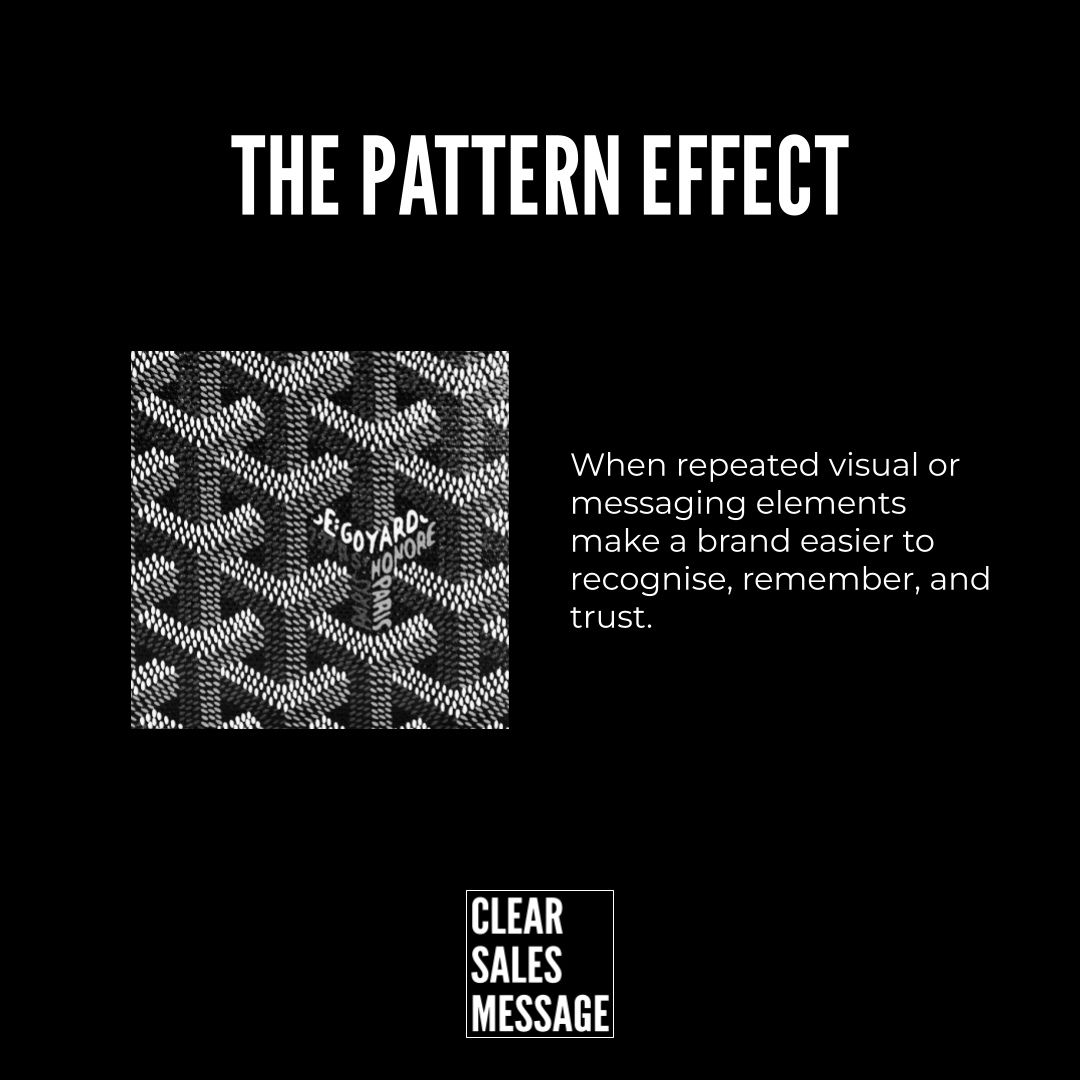
Think of the Goyard chevron print. You do not need to see a logo. You do not need to read a name. The pattern alone tells you exactly what you are looking at. That instant recognition is not an accident. It is the result of a deliberate and consistent visual choice repeated across everything the brand touches.
Most businesses change their look and feel far too often. New colours, new fonts, new layouts, new phrases – each update feels like progress. But in reality, every change resets the recognition clock. Because familiarity takes time to build, and you cannot build it if you keep starting over.
The Pattern Effect is what happens when you stop changing and start repeating. And the businesses that master it stop having to fight for attention – because buyers recognise them before they have even read a word.
What Is The Pattern Effect?
The Pattern Effect is when repeated visual or messaging elements make a brand easier to spot, recall, and trust over time. The pattern can be visual – a colour, a shape, a print, a layout. Or it can be a messaging pattern – a phrase, a tone, a structure, a way of opening every communication.
In either case, the mechanism is the same. The element gets repeated until the brain starts to expect it. And once expectation forms, recognition follows. As a result, the brand starts to feel familiar – even to people who have only seen it a handful of times.
However, this is not just about looks. A business that always opens its emails the same way, always frames its problem the same way, or always uses the same key phrase creates a messaging pattern that buyers come to recognise just as clearly as any visual. The medium is different. But the effect is identical.
Why Does The Pattern Effect Work?
The brain is a pattern-recognition machine. It is always looking for familiar signals – things it has seen before that it can process quickly and trust more easily. So when a brand repeats its visual or messaging elements consistently, the brain starts to file it away as known and safe.
There is also a trust effect tied to consistency. A brand that always looks and sounds the same feels reliable. Because inconsistency creates a low-level sense of unpredictability – and unpredictable things feel less safe to commit to. In contrast, a consistent pattern feels stable. And stability builds confidence.
Also, familiarity reduces the effort buyers need to make when they encounter your brand. They do not have to figure out who you are or what you stand for – they already know. As a result, they can spend that mental energy on deciding whether to buy rather than on working out whether to pay attention.
How Can You Use The Pattern Effect In Sales?
The goal is to identify your most distinctive elements and then repeat them everywhere, consistently, over time. Not once or twice – but as a permanent standard.
Pick one or two visual elements and own them
A distinctive colour, a recurring graphic element, a consistent layout – any of these can become a pattern that buyers associate with you. But only if you use them consistently. So choose the elements that best reflect your brand and then apply them across every touchpoint without variation. Because the pattern only forms through repetition. One or two strong elements used everywhere beat ten different elements used once each.
Create a messaging pattern, not just a visual one
The words you use, the way you frame problems, and the phrases you repeat all create a messaging pattern that buyers recognise over time. For example, a business that always opens with a sharp one-line observation, or always ends with the same call to action, creates a rhythm that starts to feel familiar. So think about your messaging the same way you think about your visuals – as something to be repeated, not reinvented.
Apply the pattern across every channel
A pattern only works if it appears everywhere. Your website, your emails, your social posts, your proposals, your packaging – all of them should carry the same recognisable elements. Because buyers do not encounter your brand in one place. They see it across many. And the more consistently your pattern appears, the faster recognition builds and the longer it sticks.
Resist the urge to change things
The biggest enemy of the Pattern Effect is the impulse to refresh. New season, new campaign, new look – it feels like progress. But in practice, every significant change is a step backward in recognition. So before you update anything, ask whether the change genuinely adds value or whether it is change for the sake of it. Because the most valuable thing about a strong pattern is that it compounds over time. And you can only get that compound if you leave it alone long enough to work.
When The Pattern Effect Works Best
The Pattern Effect is most powerful for businesses that compete for attention in crowded markets. When buyers see many similar options, the brand that feels most familiar tends to get chosen – not because it is objectively better, but because familiarity feels safer. So in a busy market, consistent patterns become a genuine competitive advantage.
It also works especially well for businesses that rely on repeat exposure before a buyer commits. In longer sales cycles, buyers may see your brand many times before they reach out. Each consistent touchpoint adds to the recognition. So by the time they are ready to buy, your brand already feels known – and known feels trustworthy.
Similarly, the Pattern Effect matters a great deal for businesses that grow through referrals. When a client describes you to someone else, they often lead with how you look or what you say – “you know, the one with the black-and-white chevron” or “the company that always says X.” A strong pattern gives buyers something specific and memorable to pass on. And that makes word of mouth work harder.
When The Pattern Effect Becomes Dangerous
The risk comes when the pattern becomes outdated but nobody changes it. A visual or messaging pattern that once felt fresh can start to feel stale after many years. So the goal is not to never evolve – it is to evolve slowly and deliberately rather than frequently and reactively. Small updates that preserve the core pattern are far less damaging than full rebrands that wipe it out entirely.
It can also be a problem if the pattern you establish is the wrong one. A colour that clashes with your market positioning, a phrase that sends the wrong signal, or a visual that appeals to one audience but puts another off – these things become harder to fix the longer they run. So before you commit to a pattern, test it with the people you are trying to reach. Because the Pattern Effect amplifies whatever you repeat – and that includes mistakes.
Also, a pattern that looks great on one channel may not work on all of them. Therefore, before you lock anything in, check how it performs across the formats your buyers actually use. Because a pattern that only works on a website but falls apart in an email or a social post is not yet strong enough to rely on.
Common Pattern Effect Mistakes
Changing too often
The most common mistake is treating brand elements as things to refresh regularly. New campaigns, new colours, new taglines – each feels exciting internally. But externally, it resets the recognition buyers were just starting to build. So discipline yourself to change less than feels comfortable. Because the patience to stay consistent is usually what separates well-known brands from forgotten ones.
Having too many patterns at once
Some businesses try to create a pattern by using many distinctive elements at once. But too many competing signals cancel each other out. The brain cannot latch onto a pattern if there is no clear repeating element to hold onto. So pick fewer elements and commit to them fully. Because one strong, consistent pattern beats five weak ones every time.
Applying the pattern inconsistently
A pattern that appears on the website but not in emails, or in marketing materials but not in proposals, only does part of its job. Because buyers encounter your brand across many channels – and inconsistency between them creates a fragmented impression rather than a clear one. So apply the pattern everywhere, even in the places that feel less visible. Because recognition compounds across every touchpoint.
Mistaking novelty for distinctiveness
There is a difference between something that feels new and something that feels distinctively yours. Novelty wears off quickly. But distinctiveness – a pattern that is genuinely associated with your brand and no one else’s – builds over time. So instead of chasing what feels fresh right now, ask what could be associated with you specifically in five years. Because that is the question that leads to a real Pattern Effect.
The Pattern Effect – An Example
Goyard is one of the clearest examples of the Pattern Effect in action. Their distinctive chevron print has remained essentially unchanged for over a century. You do not need to see the logo or read the name. The pattern alone is the brand signal – and that signal is instantly recognisable to anyone who has encountered it before.
As a result, Goyard does very little traditional advertising. The pattern does the work instead. Every bag, every box, every piece of tissue paper carries the same distinctive print. So every time a customer uses a Goyard product in public, they become a moving display of the pattern. And each display reinforces the recognition of everyone who sees it.
The lesson is not that you need a luxury brand or a century of history. It is that a strong, consistent, repeated visual element becomes a recognition engine over time. So pick your pattern, apply it everywhere, and leave it alone long enough to work. Because the compound value of a well-maintained pattern is one of the most powerful and lowest-cost brand assets a business can build.
See also: