Practical Sales Training™ > Wordplay > Tmesis
Tmesis
Most words get read and forgotten. They do their job and disappear. But when a word is split open and something unexpected is placed inside it, the brain stops.
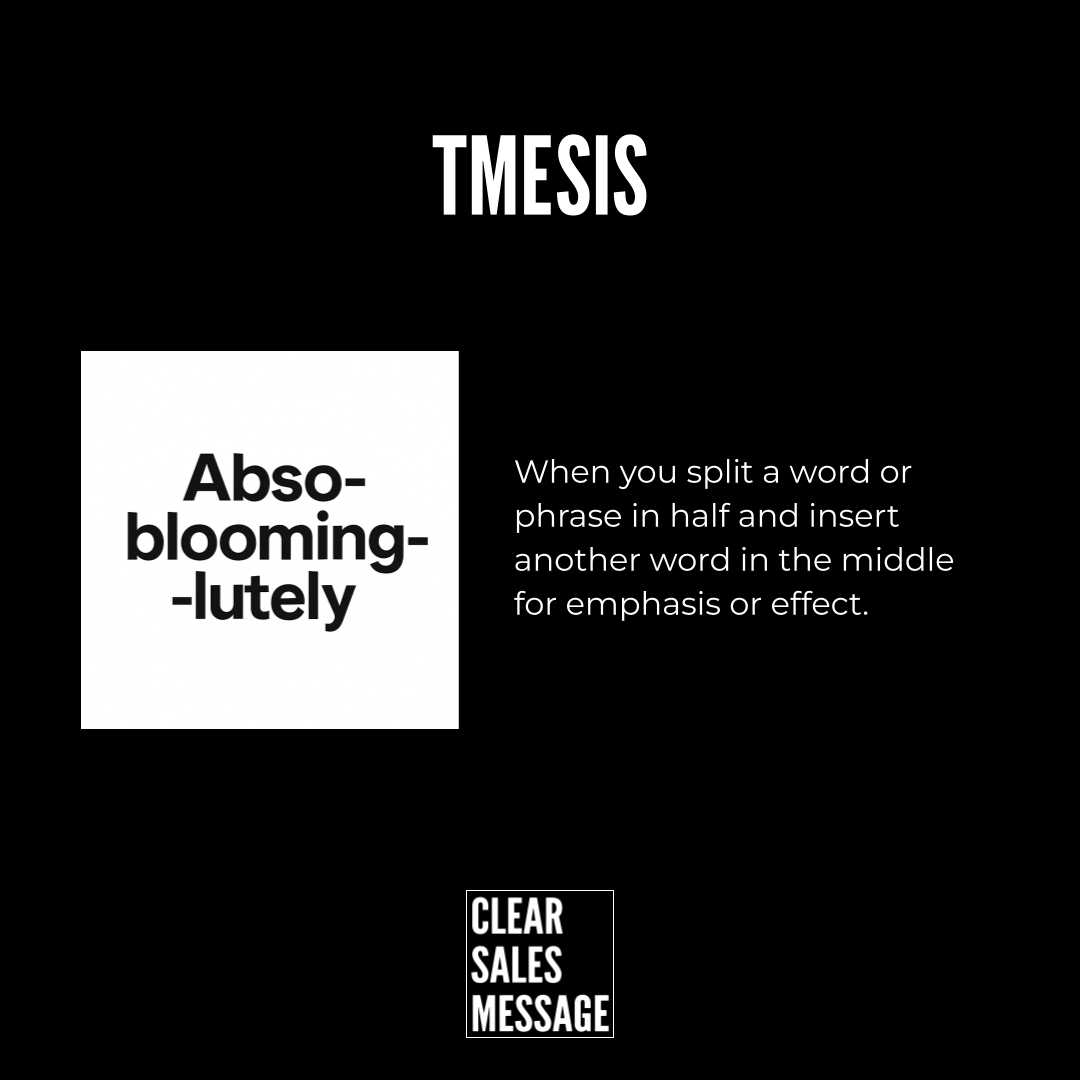
That stop is the whole point. Tmesis turns a normal word into a small attention-grabber by interrupting the pattern readers expect. Un-seriously-believable. To-profit-gether. Abso-blooming-lutely. Each one lands differently because it breaks the rule of how words are supposed to look.
It is one of the oldest tricks in language. But in sales copy, it still works – because surprise is one of the few things that reliably cuts through noise.
What Is Tmesis?
Tmesis is when you split a word and insert another word inside it to add emphasis or surprise. The inserted word changes the tone, adds meaning, or simply creates a jolt that makes the reader look twice.
You have heard it in everyday speech. “Abso-blooming-lutely” is a classic example. The word “absolutely” does the job on its own, but inserting “blooming” in the middle makes it feel more emphatic, more human, and more memorable.
In sales messaging, the same principle applies. A single tmesis word in a headline or subject line can do more work than a whole sentence of carefully worded copy, because it creates a reaction before the reader has finished reading it.
Why Does Tmesis Work?
Tmesis interrupts the reader’s pattern. We expect whole words, so when a word is split open, the brain pauses to process it. That tiny pause creates impact, because anything that slows a reader down also gets remembered more clearly.
There is also an emotional dimension. The word inserted inside the split carries its own meaning, so the reader gets two ideas at once – the original word and the interjection. When those two ideas reinforce each other, the combined effect is stronger than either word on its own.
Visually, tmesis also draws the eye. A hyphenated split in the middle of a word looks different from the text around it, so it acts as a natural focal point on the page. As a result, readers are more likely to notice it even when they are scanning rather than reading carefully.
How Can You Use Tmesis In Sales?
Headlines and taglines
A tmesis word in a headline creates instant standout without needing more words. “Make your pitch un-forgettably-clear” lands harder than “make your pitch unforgettably clear” because the split forces the reader to slow down at the exact point you want emphasis. That moment of pause is also a moment of engagement.
Email subject lines
Subject lines compete in a crowded inbox, so anything that looks different gets opened more. A tmesis subject line – “Your message is un-needlessly-confusing” – stands out from the plain text around it and creates enough curiosity to earn a click. Keep it short and readable, because a clever subject line that takes effort to parse will be skipped.
Social posts and carousels
A single tmesis word as the hook on a social post or carousel cover stops the scroll before the rest of the content has a chance to land. Because it looks unusual in a feed full of normal text, it earns a second look – and a second look is all you need to pull someone into the message.
Slides and presentations
In a deck, tmesis works especially well when the inserted word is styled differently – a different colour, weight, or size. This turns the split into a visual device as well as a linguistic one, so the emphasis lands even for people who are half-listening while they read the slide.
When Tmesis Works Best
It works best when used once per message. A single tmesis word feels like a deliberate creative choice. Two or three in the same piece starts to feel like a style tic, and the surprise that makes the first one land disappears entirely by the third.
It is also most effective when the inserted word is genuinely relevant. The best tmesis examples work because the interjection reinforces or amplifies the meaning of the split word. When the two ideas connect, the reader feels the emphasis. When they do not, the split just looks odd.
Short, punchy formats suit tmesis particularly well – because the technique rewards readers who are scanning quickly rather than reading deeply. So headlines, subject lines, and slide titles are the natural home for it.
When Tmesis Becomes Dangerous
The risk is unreadability. If the split is too long, or the inserted word is too complex, the reader has to work too hard to decode what they are looking at. That effort replaces the surprise with frustration, and the technique defeats itself.
Tone mismatch is another danger. Tmesis has an inherently playful quality, so it suits informal copy, social content, and brand-led messaging. However, it can feel out of place in a formal proposal or a serious B2B document, where the reader expects precision rather than wit.
Overuse across a brand also dilutes the effect. If every campaign uses tmesis, it stops being a surprise and starts being a signature – which is fine only if that is the intention. Otherwise, save it for moments where the impact will actually land.
Common Tmesis Mistakes
Making it too hard to read
The split word still needs to be readable at a glance. If the reader has to stop and work out what the original word was, the technique has gone too far. So keep the inserted word short and the split clean, because clarity always comes before cleverness.
Inserting a word that adds nothing
The inserted word needs to do a job – add emphasis, add wit, or add meaning. A random interjection that has no connection to the split word creates noise rather than impact. So always ask what the inserted word is doing and whether the message is stronger with it than without it.
Using it in the wrong context
Tmesis is a playful technique and it needs a context that can hold that playfulness. In a formal document, a legal proposal, or a serious follow-up email, the split word will feel jarring rather than clever. Match the technique to the tone of the piece and the expectations of the reader.
Tmesis – An Example
“Abso-blooming-lutely” is one of the most well-known examples of tmesis in everyday language. The word “absolutely” does the job on its own. But inserting “blooming” in the middle gives it extra force, warmth, and personality – which is exactly what makes it stick.
See Also
- 25+ wordplay techniques that work (and sell)
- 100+ ways to seize buyer attention
- The Pronunciation Effect