Practical Sales Training™ > How To Get Attention > Viral Loops

Viral Loops
Most growth relies on pushing outward. You run ads, make calls, send emails. But the best-growing products pull people in by design. Every time someone uses them, another person finds out about them. That’s a viral loop.
It’s not luck. It’s structure. When you build sharing into the product itself, growth compounds. One user becomes two. Two become four. The loop does the work instead of you.
You don’t need to be a tech giant to use this idea. The principle applies to any business that can build a natural reason for customers to tell others.
What Is a Viral Loop?
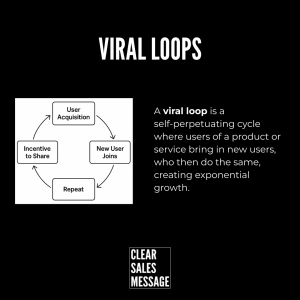
A viral loop is when your product or service has a built-in mechanism that encourages every new user to bring in more users. Each action creates the chance for another action, which creates another, and so on.
The classic example is Hotmail. In the 1990s, every email sent from a Hotmail account automatically added the line “Get your free email at Hotmail.” That tiny link turned every email into an advert. Millions of new users signed up at almost zero cost, simply because existing users were sending emails anyway.
Other well-known examples include Dropbox, which offered extra free storage when you invited a friend. Uber gave ride credits for referrals. Zoom links spread naturally because you need an account to host a call. In each case, the product itself did the marketing.
Why Do Viral Loops Work?
Viral loops work because they make growth self-perpetuating. Instead of relying only on ads or cold outreach, the product does the spreading. The effort goes in once, at the design stage, and then the loop runs on its own.
Three things drive the effect. First, built-in exposure. Every use of the product shows it to someone new. The user doesn’t have to think about promoting it. It happens as a by-product of normal use. Second, incentives. When users are rewarded for spreading the product, they do it more. The reward doesn’t have to be large. It just has to feel fair. Third, social proof. People trust what comes from someone they know. A recommendation from a friend carries far more weight than an advert from a brand they’ve never heard of.
Together, these create the loop effect: one user brings two, two bring four, four bring eight. The compounding is what makes it so powerful.
How Can You Use Viral Loops In Sales?
You can build viral loops into your business by creating natural sharing mechanisms at key points in the customer journey.
Email and Communication Tools
Add subtle branding or a link that travels with every message you or your customers send. This is the Hotmail approach. The message gets sent anyway. So the promotion is free. Even a small line in an email signature can reach people who would never have found you through search or social media.
Referral Programs
Reward customers who bring in friends, clients, or colleagues. The reward can be a discount, an upgrade, a gift, or cash. What matters is that the incentive is clear and the process is easy. Because if referring someone feels like hard work, most people won’t bother even if they want to.
Collaboration Features
Build your product so that inviting others unlocks more value. Zoom is a good example. You can join a call without an account, but you need one to host. So every call a user runs is also a subtle prompt for others to sign up. The collaboration itself is the loop.
Gifting and Trials
Let customers share a free sample or trial with someone else. This works well in B2B settings where a happy buyer wants to pass something useful to a colleague. The gift is free for them. But for you, it’s a warm introduction to a new prospect who already has a reason to trust you.
Shareable Outputs
If your product creates something the user wants to share, that output becomes your marketing. A report with your branding on it. A certificate with your logo. A result that looks good and gets posted. Each share puts your name in front of a new audience without any extra effort on your part.
When Viral Loops Work Best
They work best when sharing is a natural part of how the product is used. The loop shouldn’t feel forced or bolted on. It should happen as a side effect of normal behaviour. The closer the sharing mechanism is to the core use of the product, the more naturally it spreads.
Viral loops also work well when the product delivers clear value quickly. If a new user gets a benefit fast, they’re far more likely to tell others. So the speed of the first win matters. A slow or confusing onboarding experience breaks the loop before it starts.
Similarly, they work better in markets where trust between users is high. A recommendation from a trusted colleague in a B2B setting can be worth dozens of cold outreach attempts. The loop amplifies that trust because it travels through existing relationships.
When Viral Loops Become Dangerous
A viral loop can spread a bad experience just as fast as a good one. If the product doesn’t deliver on its promise, the loop accelerates the damage. Every new user who feels let down becomes a potential negative review or warning to others. So the loop only works in your favour when the product is genuinely worth sharing.
Loops built on incentives can also attract the wrong users. When the reward for referring is too large, people refer anyone just to collect it. As a result, you get volume without quality. Conversion drops and the cost of acquisition rises, which defeats the point.
And poorly designed loops can feel spammy. If users feel pressured into sharing or if the branding is too intrusive, it creates resentment rather than advocacy. The best loops feel effortless and natural. When they feel like a trap, they damage the brand they were meant to grow.
Common Viral Loop Mistakes
Building the Loop Before the Product Works
A viral loop scales whatever experience you’ve built. So if the product isn’t ready, the loop spreads disappointment at speed. Fix the core experience first. Then build the loop around it. Trying to grow before the foundations are solid just creates more noise around a weak offer.
Making Sharing Feel Like an Obligation
If users feel pushed into referring others, the loop creates friction instead of flow. The best viral loops make sharing feel like a natural, generous act. Instead of prompting users to refer before they’ve even had a chance to experience the product, wait until they’ve had a win. Then ask.
Ignoring the Viral Coefficient
The viral coefficient is the number of new users each existing user brings in. If it’s below one, the loop shrinks over time. If it’s above one, it grows. Most businesses never measure this. But without tracking it, you can’t tell whether your loop is working or quietly dying. Measure it and optimise around it.
Relying on the Loop Alone
A viral loop is a growth accelerator, not a complete growth strategy. It works best alongside other channels, not instead of them. Because even the strongest loop needs a base of users to start from. Without that initial group, there’s nothing to loop from.
Viral Loops – An Example
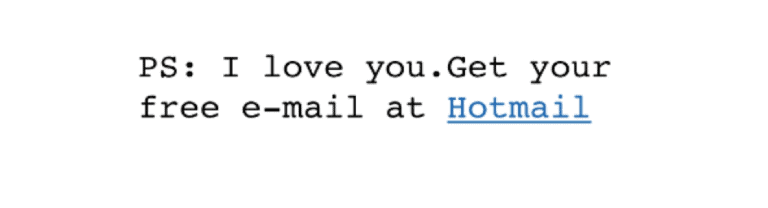
Hotmail’s viral loop is one of the most studied in business history. Every email sent from a Hotmail account ended with a simple line: “PS: I love you. Get your free email at Hotmail.” The user didn’t have to do anything. They just sent their email. But the recipient saw the link, clicked it, and signed up. That new user then sent emails with the same line. The loop ran itself.
Within 18 months, Hotmail grew from zero to 12 million users. The loop cost almost nothing to run. But it turned every single user into a passive salesperson with every email they sent. That’s the power of a well-built viral loop.
See also