Practical Sales Training™ > How To Convert > The Token Effect
The Token Effect
What Is It
When you exchange money for tokens, it distorts your understanding of value. That distortion can cut both ways, and it’s worth knowing how to use it well.
A token isn’t just a different unit. It changes how big or small a number feels, even when the real value underneath stays exactly the same.
Once money becomes a token, the usual instinct for what something “costs” quietly goes out the window.
Why Does It Work
It works because we’re used to equating money with purchasing power, the larger the number, the better. But a larger number doesn’t always mean a lot more value.
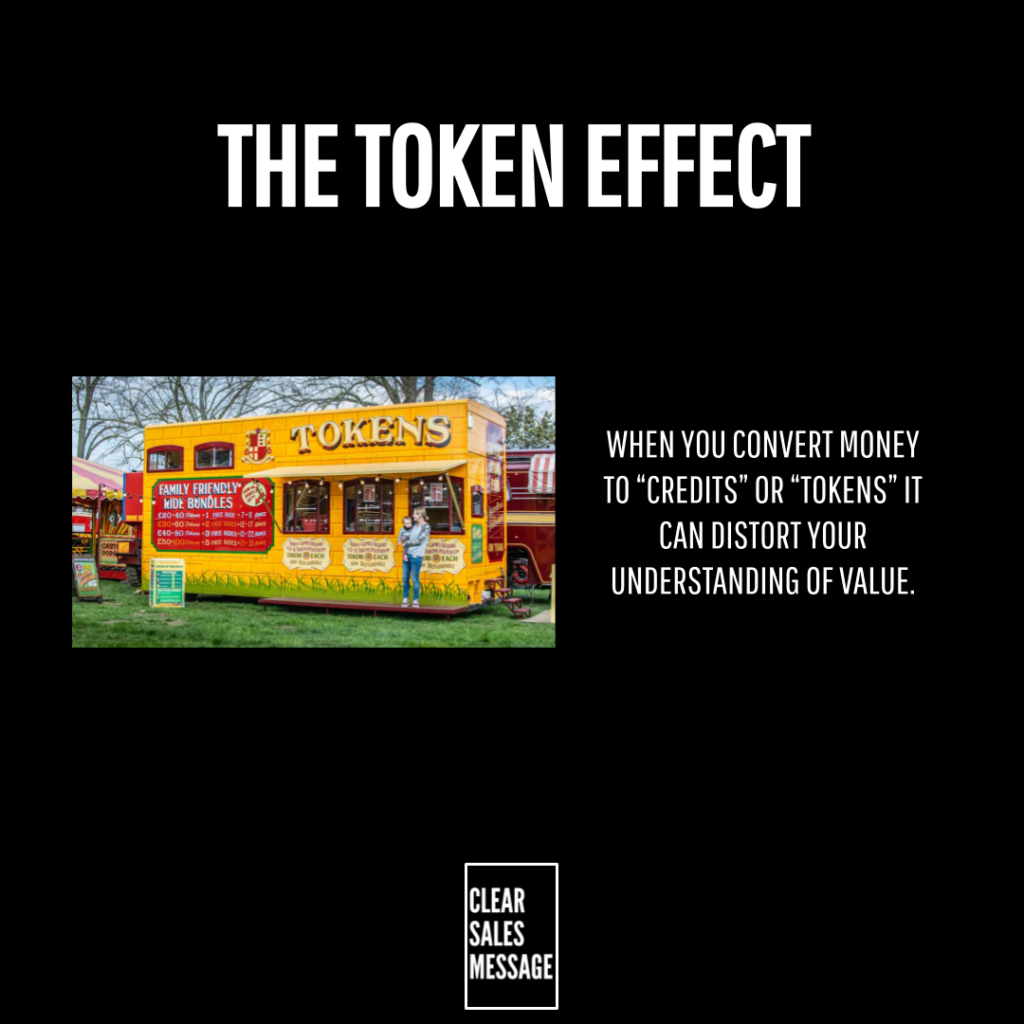
Let’s explain. It costs 1,000 tokens to buy a toy at the fairground. The toy costs £5, but you may well spend £15 to “win” enough tokens to get the toy for “free.”
This also happens when you travel. If you exchange £100 for 1,732,895 Indonesian Rupiah, it feels like you somehow have more money. The units of value change, and you equate more units with more worth. 1.7 million of anything is a lot, right?
How Can You Use It
Convert cash into a bigger sounding number
If you allow buyers to acquire tokens, points, or credit, using much larger numbers will make your buyer perceive they’re getting more.
Frame the exchange as a gain, not a swap
Exchanging £10 for 1,000 points can feel more enticing than exchanging £10 for 10 tokens, since in the first example you’re “getting more.”
Apply it consistently across the ecosystem
A token system works best when it’s used everywhere in your offering, upgrades, rewards, and purchases, so buyers stop converting back to pounds in their head.
When It Works Best
This works best in gamified or points based ecosystems, arcades, loyalty schemes, and platforms where the whole experience already runs on credits.
It also works best when the exchange rate genuinely feels generous. A small number of tokens for a small amount of money undercuts the whole effect.
When It Becomes Dangerous
It backfires if buyers eventually work out the real cost behind the tokens. Feeling misled about the true exchange rate damages trust more than the original spend ever justified.
It also becomes risky if it’s used to deliberately obscure genuinely poor value. There’s a real ethical line between clever framing and disguising a bad deal.
Overcomplicating the token system causes its own problem too, since a confusing exchange rate frustrates buyers rather than delighting them.
Common Mistakes
Making the exchange rate too obviously bad
If the real cost per token is easy to spot and clearly unfavourable, buyers feel tricked rather than delighted the moment they do the maths.
Using tokens to disguise genuinely poor value
The effect should make good value feel even better, not make poor value feel acceptable. Keep the underlying offer genuinely fair.
Applying it inconsistently
Switching between pounds and points at random breaks the illusion and reminds buyers exactly how much they’re really spending.
The Token Effect – An Example
An Arcade Gaming Card System
At a family entertainment centre, you don’t use cash at each machine. Instead, you buy a game card and load it with “credits.”
- £10 buys you 1,000 credits
- A claw machine costs 100 credits per play
- A basic prize costs 1,200 credits to redeem
Why it works: Instead of thinking “this claw machine costs £1,” you’re thinking in credits, and it feels like you’re spending less, even though you’ve paid more to get those credits and potentially overpaid for the prize value in return.
The high number of credits, 1,000 versus £10, also tricks the brain into thinking you’re getting more value than you actually are.
How to use this:
- Create a “token” or “point” system with larger numbers to increase perceived value
- Use these tokens for upgrades, rewards, or purchases inside your ecosystem
- This approach can also make discounts feel more generous, “Save 500 points” sounds better than “Save £5”
It’s a clever pricing psychology tool that can increase sales and engagement when done ethically.
See also