Practical Sales Training™ > How To Convert > Adaptive Pricing

Adaptive Pricing
Most businesses set one price and leave it there. But a fixed price means you leave money on the table when demand is high – and lose buyers when demand is low.
Adaptive pricing solves both problems. The price moves depending on conditions, so you capture more value at peak times and stay competitive during quieter ones.
It is not about discounting. It is about matching what you charge to the reality of the market at any given moment.
What Is Adaptive Pricing?
Adaptive pricing is when your price changes depending on set conditions – usually time or level of demand. The product or service stays the same. Only the price shifts.
You see it everywhere once you start looking. Airlines charge more for seats booked last minute. Hotels raise rates over bank holidays. Uber charges more during rain or rush hour. In each case, the price responds to what is happening in the market right now.
It is also sometimes called dynamic pricing. But the principle is simple: your price is not fixed – it reflects the value of what you sell at that specific moment.
Why Does Adaptive Pricing Work?
Fixed pricing ignores the fact that demand is never constant. Some days, buyers want what you sell badly. Other days, they are less urgent. A flat price treats both situations the same – which means you are either undercharging the motivated buyer or overcharging the hesitant one.
Adaptive pricing matches price to context. When demand is high, you earn more from buyers who would have paid it anyway. When demand is low, a lower price brings in buyers who might have passed at full rate.
It also removes the need to discount in the traditional sense. Instead of offering 20% off to everyone, you simply have a lower entry point at certain times. That protects your brand value while still making your offer accessible to a wider range of buyers.
How Can You Use Adaptive Pricing In Sales?
Option 1: Time-based pricing
The simplest approach is to set lower prices at fixed times – early bird windows, off-peak slots, or end-of-month deals. Because the timing is predictable, buyers can plan around it. This works well for services, events, training, and anything with a set delivery date.
For example, a workshop that costs £500 per seat might drop to £350 if booked six weeks out. The price is lower, but your pipeline fills earlier and your planning improves as a result.
Option 2: Demand-based pricing
This is more complex but more powerful. Your price rises when demand is high and falls when it is quiet. Uber’s surge pricing is the most well-known version – but the principle works in many B2B and service contexts too.
However, this option often needs technology to work well. You need a way to track demand signals and update prices in near real time. So it tends to suit businesses with digital booking or e-commerce infrastructure already in place.
Be transparent about how it works
Buyers accept adaptive pricing when they understand the logic. They resist it when it feels random or unfair. So communicate the rules clearly – whether that is “prices go up after X date” or “availability is limited at this rate.” Clarity builds trust, and trust makes the price feel reasonable.
When Adaptive Pricing Works Best
Adaptive pricing works best when your supply or capacity is limited. If you only have 20 places on a course, 10 tables in a restaurant, or a set number of consulting days per month, it makes sense to price those slots differently depending on when they are booked.
It also works well when your buyers are used to variable pricing. Consumers accept it readily in travel, hospitality, and events. B2B buyers may need more framing, but they respond well when the logic is sound and the value is clear.
Similarly, it suits businesses where demand peaks at predictable times – end of financial year, seasonal spikes, or product launch windows. In those cases, you can plan your pricing tiers in advance and communicate them clearly.
When Adaptive Pricing Becomes Dangerous
Buyers notice when pricing feels exploitative. If your price jumps sharply at exactly the moment someone needs you most – and they feel they have no choice – resentment follows. They may pay, but they will remember it.
Opaque pricing also creates problems. If buyers cannot see why the price has changed, or feel like they are being penalised for not knowing the rules, trust erodes fast. The model needs to be legible to work.
Finally, not every business model suits this approach. If you sell on long-term contracts, charge day rates, or compete on price stability, adaptive pricing may confuse buyers more than it helps. The fit has to be right.
Common Adaptive Pricing Mistakes
Not telling buyers the rules
If buyers find out the price changed after they paid, they feel cheated even if the price was fair. So always make the pricing logic visible before purchase. The more clearly you explain how and when prices move, the more comfortable buyers feel acting on it.
Using it as a cover for discounting
Adaptive pricing is not an excuse to run permanent sales. If your “low demand” price is always available, buyers will simply wait for it. The model only works if the higher price is the real price and the lower price is genuinely conditional.
Applying it to the wrong offer
Some offers should not move in price. Premium or bespoke services often sell on consistency and trust. Introducing variable pricing in those contexts can undermine the positioning and confuse buyers about what they are actually buying.
Making the price jump too sharply
A small step between price tiers feels logical. A large one feels like a trap. Keep the difference proportionate, and make sure the higher price is still one buyers can justify to themselves and to others.
Adaptive Pricing – An Example
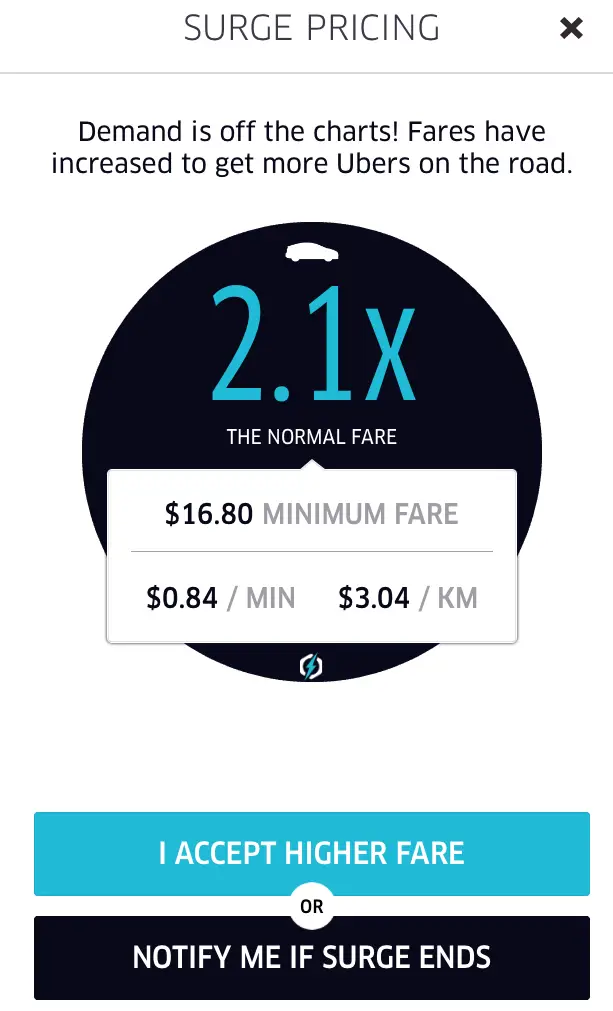
Uber uses a surge pricing model. The fare for the same journey goes up when lots of people need a car at the same time – Friday nights, bad weather, or events ending. At low-demand times, the price drops back down.
The buyer can see the surge multiplier before they confirm. So they know they are paying more and they choose to accept it – because the alternative is walking in the rain. Uber is transparent about the logic, and that transparency makes the model work.
In a B2B context, a training company might offer three price points: early bird (booked 8+ weeks out), standard (booked 2-8 weeks out), and last-minute (under 2 weeks). Each tier reflects the real cost and planning impact of that booking window. The buyer picks the one that fits their situation. As a result, the seller fills the programme earlier and earns more per seat overall.
See Also